
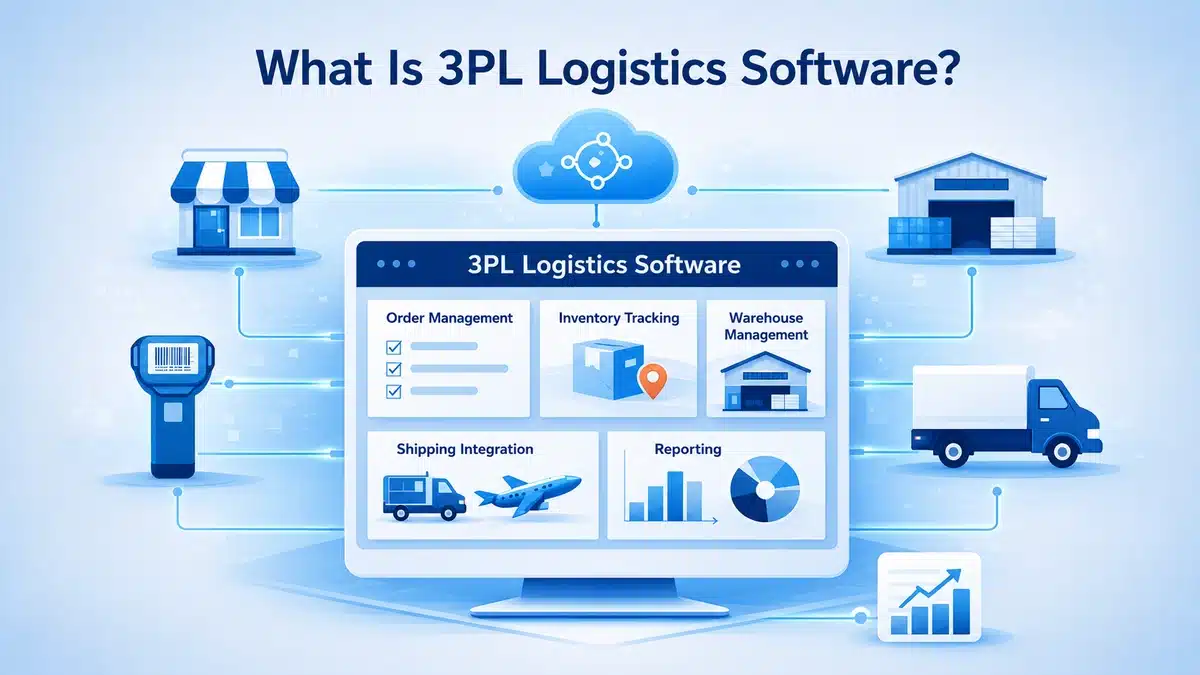
The worldwide supply chain is accelerating at an unprecedented pace. Consumers now demand same-day shipping, real-time tracking, precise documentation, and no delays. For third-party logistics providers, handling this increasing complexity manually is no longer sustainable, which is why many businesses are turning to 3PL Logistics Software to manage operations more efficiently.
The worldwide logistics sector was assessed at $9.6 trillion in 2023 and is anticipated to attain $14.3 trillion by 2030, exhibiting a compound annual growth rate (CAGR) of approximately 5.6%. This expansion is fuelled by the rise of e-commerce, the intricacies of global supply chains, and the demands for just-in-time delivery.
Rather than managing logistics through spreadsheets, disconnected tools, emails, and separate accounting systems, 3PL providers can use software to connect and manage important parts of their operations more efficiently.
What is 3PL Software?
3PL software helps third-party logistics providers manage client orders, transportation, tracking, billing, reporting, and other logistics operations. Its features depend on the type of logistics services offered. Warehouse and inventory management are not included in every 3PL platform. Fulfillment-focused systems may support receiving, inventory, picking, packing, and dispatch, while freight-focused platforms primarily handle transportation, carrier coordination, tracking, and billing.
Some platforms also integrate with separate WMS, TMS, ERP, or accounting systems.
Who Uses 3PL Software?
3PL businesses do not all operate in the same way. A company managing ecommerce fulfillment has different operational requirements from a freight broker coordinating transportation.
3PL software is used by different types of logistics providers, including:
- Asset-based 3PLs: Manage owned trucks, warehouses, and other logistics assets.
- Non-asset-based 3PLs: Coordinate shipments through external carriers and service providers.
- Freight-oriented 3PLs: Manage transportation, carriers, tracking, and freight billing.
- Fulfillment-oriented 3PLs: Handle receiving, inventory, picking, packing, and shipping.
- Warehouse and distribution providers: Manage storage, distribution, and related services.
- Multi-client logistics providers: Manage different customer contracts, rates, workflows, and reporting requirements.
For example, Client A may have one transportation rate structure while Client B has separate handling charges, return fees, or reporting requirements.
This is one of the areas where software designed specifically for 3PL operations becomes particularly useful.
Why 3PL Providers Need Specialized 3PL Software Systems
Unlike businesses managing a single supply chain, 3PL providers often serve multiple clients with different SLAs, billing rates, workflows, and reporting requirements. Specialized 3PL software helps manage these differences while connecting carrier operations, billing, tracking, and client reporting.
Businesses that utilize 3PL software are seeing logistics costs drop by as much as 15% and operational efficiency rise by 20%. The worldwide market for 3PL software is expected to expand at a compound annual growth rate (CAGR) of 9% between 2022 and 2030. This highlights its significance.
What Features Can 3PL Software Include?
The exact feature set depends on whether the 3PL mainly manages transportation, warehousing, fulfillment, distribution, or a combination of services.
|
Feature |
What to retain |
| Order Management | Processes orders received through client systems, portals, APIs, EDI, or imports. |
| Transportation Management | Supports carrier selection, shipment planning, dispatch, and delivery coordination. |
| Shipment Visibility | Consolidates tracking updates, delivery statuses, and exceptions. |
| Financial Workflows | Connects accounts payable, receivable, carrier costs, and invoicing. |
| Client-Specific Billing | Applies client rate cards to recorded logistics activities. |
| Integrations | Connects with ERP, WMS, TMS, carrier, accounting, and ecommerce systems. |
| Client Management | Keeps client-specific rules, rates, documents, and reports separate. |
| Reverse Logistics | Supports return requests, inspections, reconsignment, and close-out. |
| Warehouse Workflows | Where supported, handles receiving, picking, packing, scanning, and dispatch. |
| Inventory Visibility | Provides stock information by client, SKU, location, or warehouse where supported. |
| Reporting | Provides operational, financial, shipment, and client-specific reports. |
Different 3PL providers need different capabilities depending on their operations. For a more detailed breakdown, explore the essential features of third-party logistics software to understand which functionalities matter most for your business.
How 3PL Logistics Software Works
It becomes clear why 3PL software systems are so effective when one understands how they operate.
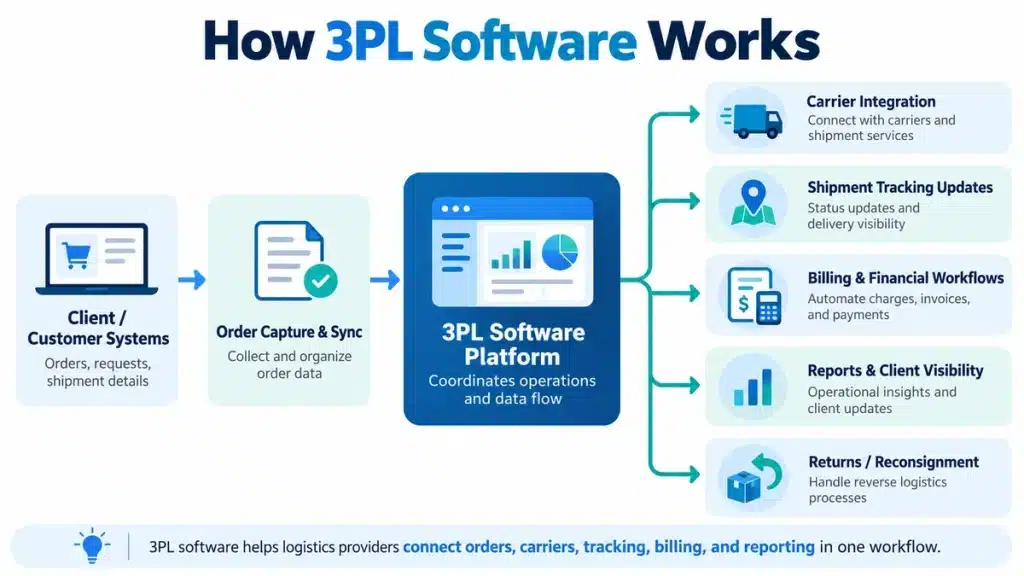
1. Processing of Orders
Orders enter through client portals, APIs, EDI, or ERP integrations. The system validates and processes them according to client requirements.
2. Warehouse Inbound Operations
Warehouse-capable platforms record receiving, pallet information, barcode verification, quality checks, and inventory updates.
3. Warehouse Outbound Operations
Outbound workflows may cover order picking, packing, dispatch, carrier requirements, and shipping documents.
4. Tracking and Delivery Visibility
Shipment updates, delivery confirmations, and exceptions are consolidated where supported by carrier integrations.
5. Documentation and Compliance
Digital records such as Bills of Lading, manifests, and delivery confirmations are stored for easier retrieval.
6. Client-Specific Billing and Revenue Automation
Different clients may have separate charges for storage, handling, transportation, packaging, or returns. Billing-capable systems connect recorded activities with client rate cards, reducing the risk of missed charges.
Accurate billing still depends on correctly recorded activities and maintained rate cards.
7. Reverse Logistics and Returns
Returns may involve approvals, inspections, reconsignment, tracking, and close-out workflows.
Example of How 3PL Software Works
Consider a 3PL managing fulfillment and transportation for an ecommerce client.
An order is placed on the client’s ecommerce platform.
Step 1: Order Received
The ecommerce or ERP system sends the order to the 3PL through an API, EDI connection, CSV import, or another supported method.
Step 2: Order Processing
The 3PL system identifies:
- The client
- Order details
- Required service
- Delivery requirements
- Applicable operating rules
Step 3: Warehouse Execution
If the 3PL manages fulfillment, warehouse staff receive the picking requirement.
The items are picked, scanned, packed, checked, and prepared for dispatch.
This functionality may exist directly inside the 3PL platform or in a connected WMS.
Step 4: Carrier or Transportation Execution
Shipment details are passed to the selected carrier or transportation system.
The shipment is booked and dispatched.
Step 5: Tracking
Tracking information received from the carrier can flow back into the 3PL system.
Operations teams and, where supported, clients can then see the latest available shipment status.
Step 6: Billing
The activities performed for the order can create billable events.
For example:
- Picking fee
- Packaging charge
- Transportation charge
- Special handling charge
The appropriate charges are then applied according to the client’s rate structure.
The basic flow looks like this:
Client ERP/Ecommerce System → 3PL Software → Warehouse and/or Transportation Execution → Carrier → Tracking Updates →
Billing and Client Reporting
Not every 3PL platform performs every step internally. In many operations, the 3PL system connects several specialized systems together.
How 3PL Software Connects With Client and Carrier Systems
A 3PL rarely works with only one system.
Clients may already use ERP, ecommerce, order-management, or marketplace platforms. At the other end of the process, the 3PL may work with several carriers, accounting systems, warehouse tools, or transportation platforms.
3PL software can act as the connection point between these systems.
Client ERP and Ecommerce Systems
Orders and other operational information can enter the 3PL environment from client systems.
Depending on the integration, this may include:
- Orders
- Shipment requests
- Product information
- Delivery details
- Inventory-related information
3PL Software
The 3PL system processes the information according to the provider’s workflow.
It may then:
- Create operational tasks
- Send information to warehouse systems
- Send shipments to transportation systems
- Record documents
- Update statuses
- Generate billable events
- Prepare reports
Carrier Systems
Carrier integrations can support activities such as:
- Shipment booking
- Carrier selection
- Tracking
- Delivery status
- Shipment documentation
Tracking Updates
Tracking information can flow from carrier systems back into the 3PL platform and then be made available through reports, dashboards, portals, or notifications.
Billing and Reporting
Operational activities can feed client billing and reporting.
Billing information may then be transferred to an ERP or accounting application.
How These Systems Exchange Data
Common methods include APIs for direct data exchange, EDI for structured business documents, and CSV/file imports for transferring information. Carrier and accounting integrations can exchange shipment updates and financial data.
The right integration approach depends on the systems already used by the client, 3PL, and carrier. Understanding how 3PL integration improves logistics operations can also help businesses identify where connected systems can reduce manual data entry, improve coordination, and provide better operational visibility.
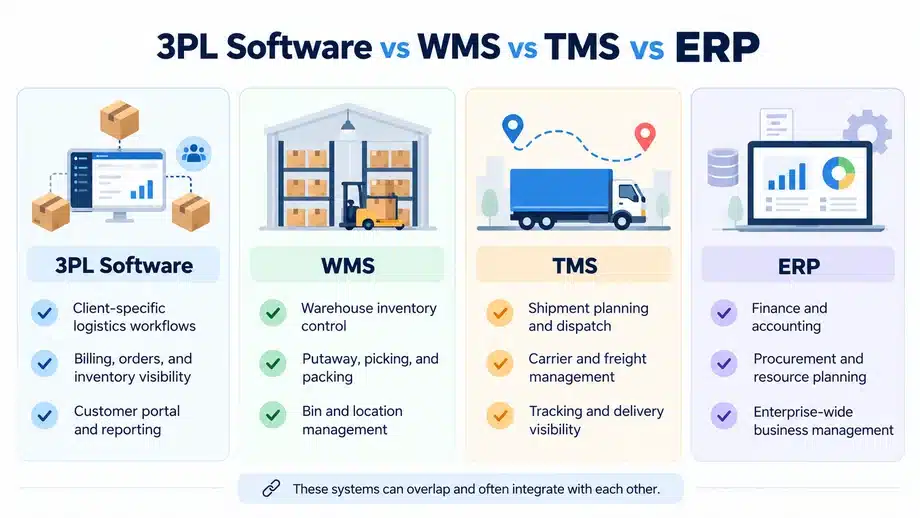
Is 3PL Software the Same as WMS, TMS, or ERP?
These systems can overlap and integrate with each other, but they are designed around different primary requirements.
|
System |
Main Focus |
Typical Role |
| 3PL Software | Managing logistics services for external clients | Orders, transportation, client workflows, billing, tracking, returns, integrations, reporting, and in some platforms warehouse operations |
| WMS | Warehouse execution | Receiving, putaway, inventory, picking, packing, storage, and shipping |
| TMS | Transportation management | Freight planning, carriers, routes, transportation execution, tracking, and freight processes |
| ERP | Enterprise-wide business management | Finance, procurement, sales, manufacturing, HR, accounting, and other core functions |
3PL software may include WMS or TMS capabilities or integrate with these systems, depending on the logistics provider’s operating requirements.
Key 3PL Trends Driving Software Adoption
Growing ecommerce volumes, demand for real-time shipment visibility, complex client billing, and the need for connected systems are driving 3PL software adoption.
While automation and AI are gaining attention, the priority should be solving actual operational problems rather than adopting technology simply because it’s trending.
How 3PL Logistics Software adds value to the business
3PL logistics software can help businesses:
- Process more orders without proportional increases in manual work.
- Reduce repetitive data entry through system integrations.
- Improve shipment visibility and client reporting.
- Shorten billing cycles and reduce missed charges.
- Improve coordination between operations and finance.
For example, connecting order processing, carrier tracking, and billing reduces the need to manually transfer information between systems.
Actual benefits depend on implementation, integration quality, transaction volume, and system adoption.
How to Choose the Right 3PL Software
Choosing 3PL software requires evaluating how well the system fits existing operations and future requirements.
Key factors include:
- Operational Fit: Check whether the software supports freight, warehousing, fulfillment, or transportation workflows.
- Multi-Client Support: Evaluate separate client rates, operating rules, access, and reporting.
- Billing Flexibility: Test the system using actual client contracts and charges.
- Integrations: Verify compatibility with ERP, WMS, TMS, carrier, and accounting systems.
- Tracking and Visibility: Check shipment updates, exceptions, and missing-data handling.
- Scalability: Consider future clients, order volumes, users, and warehouse requirements.
- Customization: Understand which workflows can be configured and which require development.
- Reporting: Check operational, financial, and client-specific reporting.
- Implementation: Assess migration, integration, testing, training, and go-live support.
- Vendor Support: Review ongoing maintenance, support, and change management.
A practical software evaluation should use real business scenarios rather than relying only on demonstrations. Once the operational requirements are clear, the next step is evaluating the provider. Our guide on how to choose the best 3PL software vendor explains what businesses should consider before making that decision.
Where iLogistech Fits In –
iLogistech is Mechsoft’s 3PL logistics platform designed to connect multiple logistics workflows within a single system.
Depending on implementation requirements, iLogistech supports multi-source order processing, inbound and outbound operations, barcode workflows, trucking coordination, shipment tracking, documentation, contract-based billing, financial workflows, returns, reconsignment, and external integrations.
The Measurable Outcomes Include:
Mechsoft’s published American logistics transformation case study reported:
- 200%+ increase in order-handling capacity without proportional headcount growth.
- 30% improvement in profit margins and cash flow through better integration of operational and financial workflows.
- Reduced manual work and improved visibility across logistics operations.
These outcomes relate to one project and are not guaranteed for every implementation.
Frequently Asked Questions About 3PL Software
Q.1. What is 3PL software?
A. 3PL software helps logistics providers manage client orders, transportation, tracking, billing, returns, and related operations.
Q.2. Who uses 3PL software?
A. It can be used by asset-based 3PLs, non-asset-based 3PLs, freight providers, fulfillment companies, warehouse and distribution operators, and multi-client logistics businesses.
Q. 3. Does all 3PL software include warehouse and inventory management?
A. No. Warehouse and inventory functions are typically found in fulfillment-focused platforms, while freight-oriented systems may focus on transportation and carrier management.
Q. 4. Is 3PL software the same as a WMS?
A. No.A WMS mainly manages warehouse activities such as receiving, putaway, inventory, picking, packing, and shipping. Some 3PL platforms include WMS functionality, while others integrate with a separate WMS.
Q. 5. Is 3PL software the same as a TMS?
A. No. A TMS primarily focuses on transportation planning and execution, including carriers, freight movement, routes, shipment tracking, and related transportation processes. A transportation-oriented 3PL platform may include or overlap with some TMS capabilities.
Q.6. How does 3PL software connect with client and carrier systems?
A. Depending on the platforms involved, information can be exchanged through APIs, EDI connections, CSV or file imports, carrier integrations, and accounting integrations.
Q.7. Can 3PL software automate client billing?
A. Yes, billing-capable platforms can calculate charges using recorded logistics activities and client rate cards. Accuracy still depends on correct activity records and billing configurations.
Q.8. What should companies look for when choosing 3PL software?
A. Important factors include:
- Operational fit
- Multi-client support
- Billing flexibility
- Integrations
- Tracking
- Scalability
- Customization
- Reporting
- Implementation requirements
- Vendor support
The best evaluation is based on actual business workflows rather than a generic feature checklist.
Conclusion
3PL logistics software helps providers manage orders, transportation, tracking, billing, returns, and client-specific operations more efficiently.
However, the right platform depends on the business. Freight-oriented and fulfillment-focused 3PLs have different requirements.
When evaluating solutions such as iLogistech, businesses should prioritize operational fit, integrations, billing requirements, and scalability rather than simply comparing feature lists.


