
For a logistics company, choosing software is rarely just an IT purchase. The decision affects how orders enter the business, how exceptions are handled, how clients receive updates, how operational events reach billing, and how existing systems exchange data.
That is why the SaaS vs custom software question becomes more difficult as a logistics business grows. SaaS can be the sensible choice when processes are fairly standard and the business wants to get operational quickly. Custom development becomes more relevant when a company has client-specific workflows, unusual billing rules, or established systems that cannot simply be replaced. It can also make sense when operational processes form part of the company’s competitive advantage.
Custom software is not automatically the better option. It makes sense when a business has a clear reason to take more control over how its workflows are handled.
Quick Answer: SaaS vs Custom Software for Logistics Companies
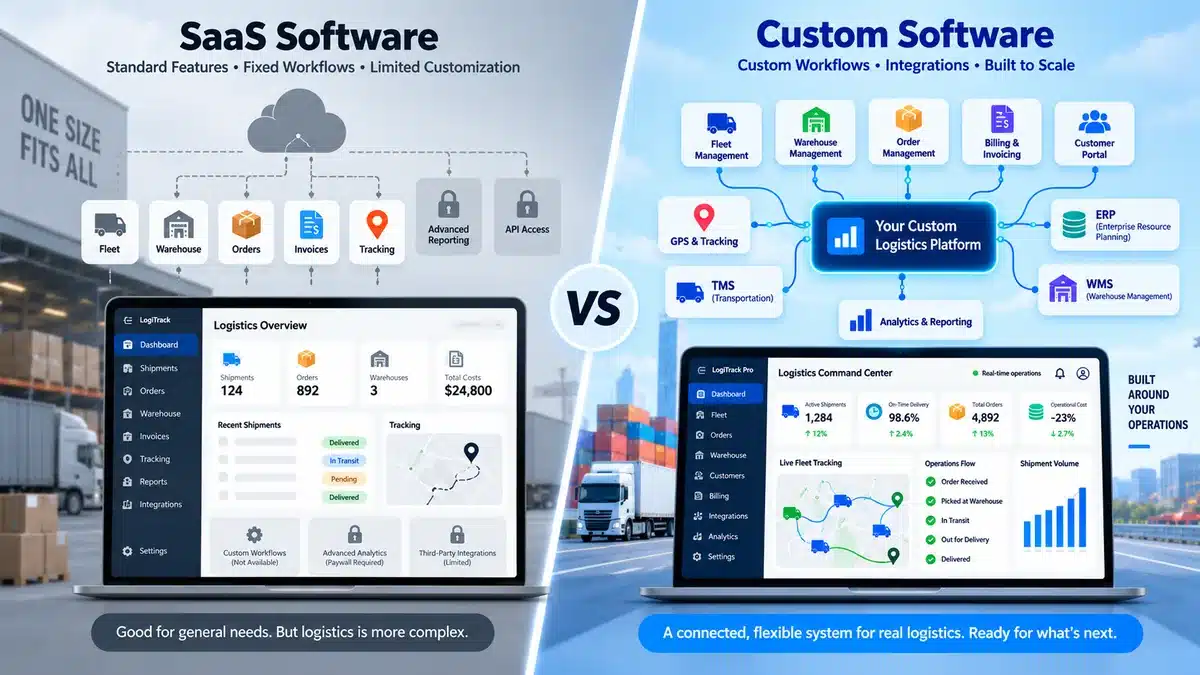
Logistics companies generally choose custom development when a standard SaaS platform would require too many workarounds, manual handoffs, duplicate data entries, or changes to established operational processes.
The strongest reasons tend to be:
- highly specific workflows or exception rules
- different operating requirements for different clients
- complex billing or documentation processes
- integrations with existing ERP, accounting, client, carrier, or operational systems
- the need to change software logic without waiting for a vendor roadmap
- reporting or data structures that are specific to the business
If most processes are standard, integrations are straightforward and rapid implementation matters more than customization, SaaS may still be the better business decision.
SaaS vs Custom Software: Why Build vs Buy Is Not a Binary Decision
The old technology question was simple: buy an existing product or build your own.
The choice is no longer always that simple. Gartner’s build, buy and blend model looks beyond a strict build-or-buy decision and considers a mix of purchased applications, internally built capabilities and integrated technologies.
For logistics companies, that mix can be more practical than choosing one approach for everything.
A company might continue using an established accounting platform, an existing client ERP and specialized external systems. It can then develop a custom operational layer to connect the parts of the process where its requirements differ.
Custom development does not always mean replacing every existing system or building everything from scratch.
In many cases, the practical approach is:
Keep what already works → integrate the systems that need to stay → customize the workflows that matter → replace systems only when there is a clear business reason.
SaaS vs Custom Software: When SaaS Still Makes Sense for Logistics
There are good reasons SaaS products are widely used.
A SaaS platform can provide a faster starting point because the core product already exists. The provider generally handles infrastructure, upgrades and standard functionality. That can be valuable for a logistics company with limited internal IT resources or a relatively conventional operating model.
SaaS deserves serious consideration when:
- the required processes closely match the product’s existing workflows
- only standard integrations are required
- implementation speed is a major priority
- the business is comfortable with the available configuration options
- the required capability is not a source of competitive differentiation
- ongoing product maintenance should remain largely with the vendor
Problems start when a business selects SaaS based mainly on the feature list and discovers during implementation that its real workflows do not fit those features cleanly.
SaaS vs Custom Software: Why Logistics Operations Can Outgrow SaaS
Logistics rarely operates as one clean sequence.
An order can arrive from one client through an API, another through EDI and another through a file upload. Service priorities may differ by customer. Documentation requirements can change by shipment. Returns may follow different processes from normal deliveries. Billing may depend on events recorded by operations.
The more client-specific rules a logistics company carries, the harder it becomes to evaluate software only by asking, “Does this system have order management, tracking and billing?”
A better question is:
Can the software represent the way these processes actually interact?
This is particularly important for 3PL providers because they are operating on behalf of multiple clients rather than running one uniform internal supply chain. Mechsoft’s guide to how 3PL logistics software works across operational stages provides additional context on how order processing, inbound and outbound activities, tracking, documentation, billing and returns can connect within a 3PL workflow.
SaaS vs Custom Software: When Logistics Software Integration Becomes a Challenge
Logistics software integration matters because a logistics platform usually needs to exchange data with several other systems.
Depending on the business, information may need to move between customer systems, accounting applications, ERP platforms, barcode processes, external delivery partners, carrier services and older internal applications.
A SaaS platform can handle this well when the right connectors and APIs already exist. Problems usually appear when data needs to move according to business-specific rules that the standard integration does not support.
This challenge shows up in real logistics technology projects. The DHL Logistics Trend Radar Echo, based on responses from more than 2,500 supply-chain professionals, highlights the difficulty of connecting new technologies with existing systems and day-to-day processes across several technology areas.
For a logistics operation, that can mean the difference between genuine integration and another process where employees download data from one system, clean it in Excel and upload it somewhere else.
SaaS vs Custom Software: When Legacy System Integration Matters Most
Replacing an old system is not always commercially sensible.
It may contain years of operational history, support a process that still works or connect to another important part of the company. The real requirement may therefore be to modernize around it rather than remove it immediately.
IBM’s legacy application modernization guidance specifically identifies APIs as a way to connect existing applications with modern systems and the wider technology ecosystem.
This is where legacy system integration can influence the decision. If a SaaS vendor can reliably support the connections you need, building them separately may not be necessary. But when the business depends on unusual data mappings, proprietary interfaces or phased modernization, custom development gives you more control over how those connections are handled.
SaaS vs Custom Software: A Practical Logistics Comparison
| Decision factor | SaaS | Custom software |
| Initial deployment | Usually faster | Requires discovery, development and testing |
| Workflow fit | Strong when processes match the product | Can be designed around specific operating rules |
| Integrations | Best when supported connectors/APIs already exist | Greater scope for business-specific integrations |
| Changes | Dependent partly on product configuration and vendor roadmap | Priorities can be controlled by the business or development partner |
| Maintenance | Mostly vendor-managed | Requires ongoing technical ownership |
| Upfront investment | Usually lower | Usually higher |
| Best fit | Standardized processes and rapid deployment | Complex, differentiated or integration-heavy operations |
The table should not be treated as a scorecard. A fast SaaS implementation that fits 95% of a company’s real requirements can be a better investment than an unnecessary custom project.
Likewise, a cheap subscription can become operationally expensive if teams spend years maintaining manual workarounds around it.
Five Questions That Usually Reveal the Right Direction
Before choosing either option, map the operation rather than starting with vendor demonstrations.
Do our core workflows follow common industry processes?
Then investigate five practical questions:
- Which workflows are genuinely unique?
- Which existing systems must remain?
- Where are employees currently moving or correcting data manually?
- What changes are expected as new clients, locations or services are added?
- Who will own the software after implementation?
If the organization cannot answer these clearly, it is probably too early to make a confident custom-development decision.
Custom Software Has Its Own Risks
Custom development should not be treated as an escape route from poor processes.
If operating rules are unclear, developers will simply automate unclear rules. A new interface will not fix unreliable master data either. Poor user involvement can also hurt adoption, regardless of how well the system was engineered.
Custom systems also require maintenance, security work, testing, documentation, technical knowledge and continued investment as connected platforms change.
The result depends on more than the software itself. Workflow maturity, data quality, implementation effort, user adoption, integration quality and business complexity all affect how well it works.
That is also why replacing every existing application is not always necessary. A hybrid approach may be more practical.
SaaS vs Custom Software: Where a Customizable 3PL Platform Fits
For 3PL companies, the choice does not have to be a fixed product or a completely new system built from scratch. Another option is to start with an existing logistics platform and customize the workflows that are different.
Mechsoft’s comparison of custom and ready-made 3PL software discusses this approach in more detail.
Its iLogistech 3PL platform supports specific 3PL workflows, including order intake and synchronization, inbound and outbound operational steps, tracking, documentation, receivables/payables, returns and reconsignment. It also supports API connections to internal and external systems. The product information also states that workflows such as returns and reconsignments can be customized for business-specific processes.
This model will not suit every logistics company. But configurable or customizable platforms are worth considering during the build vs buy software discussion rather than treating SaaS and full custom development as the only two choices.
FAQ: SaaS vs Custom Software for Logistics
Q. Is custom logistics software always better than SaaS?
A. No. Custom software is justified when workflow differences, integrations, business rules or competitive requirements are important enough to outweigh the additional development and maintenance responsibility. SaaS can be a better choice for standardized requirements.
Q. When should a growing logistics company move away from SaaS?
A. Not simply because it is growing. Warning signs include increasing manual workarounds, unsupported integrations, client requirements that cannot be configured properly and important workflows being changed primarily to accommodate software restrictions.
Q. SaaS vs Custom Software: How Does Legacy System Integration Affect the Choice?
A. Start by identifying which systems should remain, which data they own and what information must move between them. Then assess whether existing APIs, middleware or SaaS connectors can meet the requirement before deciding that custom development is necessary.
Q. Can a company use SaaS and custom software together?
A. Yes. In many cases that is the more sensible architecture. Standard capabilities can remain on established platforms while custom applications or integrations handle the workflows that are specific to the business.
Conclusion
The SaaS vs custom software decision should start with how the logistics operation actually works, not with a preference for one software model.
If the company’s workflows are standard and a SaaS product can support the required integrations without creating unnecessary workarounds, buying is often the practical choice.
If client rules, exceptions, integrations and operational processes are a key part of how the logistics company operates and competes, custom development or a customizable platform connected to existing systems may be a better fit.
Before choosing either option, document the workflows, systems, integrations and business rules the software needs to support. This will usually give you a clearer answer than comparing feature lists alone.
SaaS vs custom software comparison for logistics companies showing features, integrations, and scalability.


