

A 3PL does not usually lose control because one pallet is missing. The real problem begins when the system says one thing and the warehouse floor shows something else.
Stock appears available even though it is still in receiving. An order looks ready, but picking hasn’t been completed. Clients ask for updates, and employees start checking spreadsheets, emails, and warehouse records to find out what’s actually happening.
This gap between inventory records and warehouse activity is why real-time inventory visibility matters.
According to the Association for Supply Chain Management (ASCM), supply chain visibility helps businesses make timely decisions, identify bottlenecks earlier, improve inventory optimization, and allocate resources more effectively.
For 3PL providers, inventory information affects much more than stock management. When updates are delayed or incorrect, the consequences can reach order fulfillment, dispatch schedules, client reporting, and billing.
What Is Real-Time Inventory Visibility?
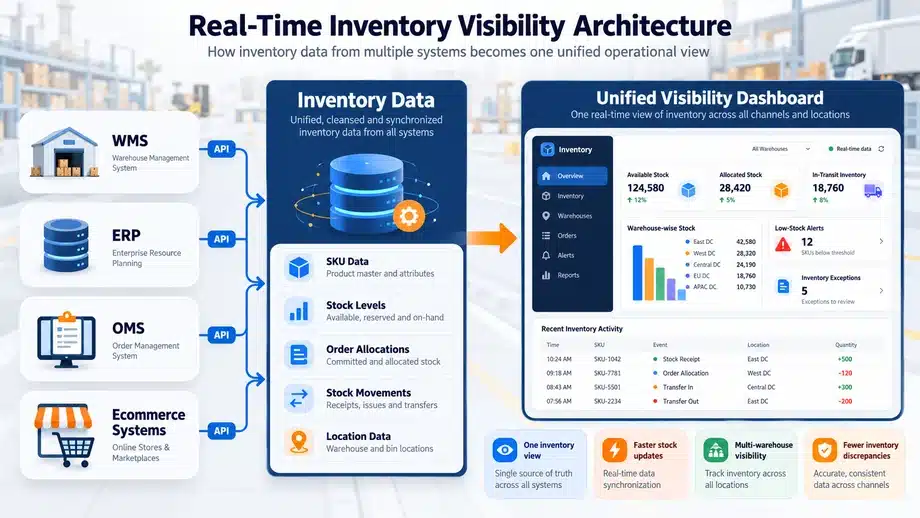
Real-time inventory visibility is the ability to access up-to-date information about stock quantities, locations, movements, allocations, and availability as inventory activities are recorded across connected systems.
It tells teams not only how much inventory is present but also where it is, whether it can be used, and how much has already been committed to existing orders.
There are four related terms that are often used interchangeably, although they mean different things.
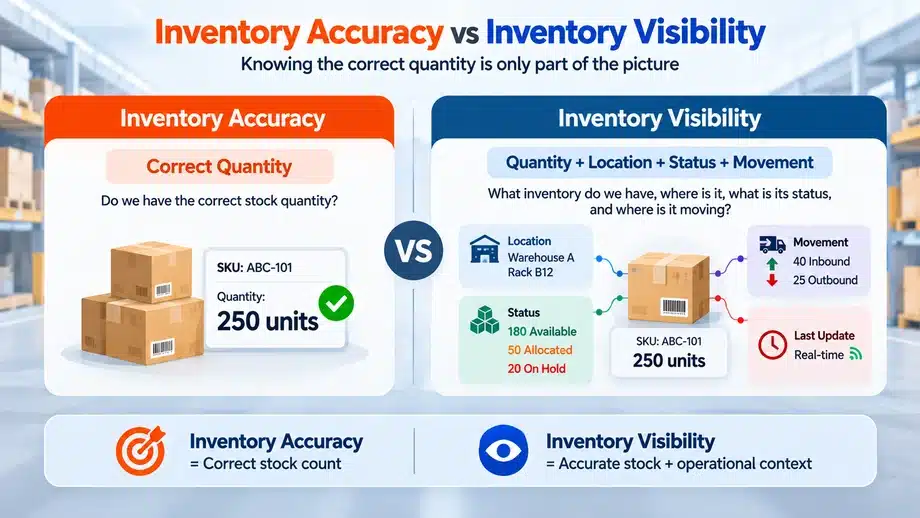
- Inventory accuracy: Whether the stock quantities and details recorded in the system match the actual inventory.
- Inventory visibility: Whether employees can access information about inventory quantities, locations, and stock status.
- Real-time inventory tracking: How quickly inventory records are updated when receiving, picking, stock movement, or dispatch activities take place.
- Available-to-promise (ATP) inventory: The quantity that can be committed to new orders after considering existing allocations, restrictions, and eligible incoming stock.
A warehouse may have accurate inventory counts at the end of the day. But if stock movements are not updated during working hours, order processing and dispatch teams may still be using outdated information.
So, having accurate inventory records does not necessarily mean the business has timely inventory visibility.
Inventory Accuracy vs Inventory Visibility
Both are important, but they solve different problems.
|
Factor |
Inventory accuracy |
Inventory visibility |
| Meaning | How closely system records match actual stock | How easily teams can access current inventory information |
| Main purpose | Maintain reliable stock records | Support timely operational decisions |
| What it measures or shows | Quantity and record correctness | Quantities, locations, movements, status, and availability |
| Typical problem | Physical stock differs from recorded stock | Information is correct but not updated or accessible when needed |
| 3PL example | A cycle count identifies a stock mismatch | Dispatch cannot confirm whether stock has been picked or staged |
A 3PL warehouse needs both. Accurate inventory records help prevent incorrect stock decisions, while timely visibility allows employees to use those records when orders are being processed.
Reliable inventory information also helps reduce order processing errors, particularly when order allocations and stock availability need to be confirmed before fulfillment.
On-Hand Inventory vs Available-to-Promise Inventory
One common mistake in inventory management is assuming that all physical stock is available for new orders.
That is not always the case.
A warehouse may have inventory that is already allocated, under inspection, awaiting confirmation, or restricted from fulfillment.
On-hand inventory: Stock physically recorded as present at a warehouse or location.
Allocated inventory: Stock reserved for existing orders or other commitments.
Available inventory: Stock that can be used to fulfill new orders after considering allocations and restrictions.
Inbound inventory: Stock expected to arrive or currently being received. It should not automatically be considered available.
Quarantined or blocked inventory: Stock restricted from fulfillment because of inspection, damage, quality concerns, or other operational reasons.
Consider a simple example.
A warehouse has 100 units on hand. Of these, 30 are already allocated to existing orders, and another 10 are on quality hold.
That leaves only 60 units immediately available for new orders.
The actual ATP quantity may differ if the business includes eligible incoming stock, future supply dates, or other commitments in its calculation.
This is why a dashboard showing “100 units in stock” may not provide enough information for the order management team to confirm a delivery commitment.
Why Inventory Data Becomes Inconsistent Across Systems
In a typical 3PL operation, receiving, warehouse operations, dispatch, customer service, and finance may all depend on inventory information.
But they may not always be looking at the same data.
Inventory discrepancies often occur because of:
- Delayed receiving, putaway, picking, or dispatch confirmations
- Manual spreadsheet entries and end-of-shift updates
- Disconnected WMS, ERP, and Order Management System (OMS) platforms
- Duplicate SKUs or inconsistent product identifiers
- Incorrect stock allocation
- Returns that have not been recorded or verified
- Failed or delayed integrations
- Different systems using different stock status definitions
For example, goods may have physically arrived at the warehouse, but the receiving transaction has not yet been confirmed in the Warehouse Management System (WMS).
The warehouse team can see the goods, while the order management team still considers them unavailable.
The opposite can happen too. Inventory may already be reserved or dispatched, but an older record continues showing it as available.
These differences create confusion between warehouse employees, order management teams, and clients. Employees then spend time checking records instead of working with information they can trust.
What Does ‘Real-Time’ Actually Mean in Inventory Management?
Real-time inventory visibility does not always mean every connected system updates at exactly the same moment.
The way inventory information is updated depends on how the systems exchange data.
Event-based updates happen when an activity such as receiving, picking, or dispatch is recorded and triggers an update.
Near-real-time synchronization transfers information shortly after an event, depending on the systems and integrations involved.
Scheduled synchronization updates records at defined intervals rather than after every transaction.
The delay between an inventory activity and the information appearing in another system is known as data latency.
This matters because stock may move faster than the records are updated.
A warehouse processing frequent order allocations may need information to update much sooner than a location handling relatively few daily transactions.
Before choosing inventory visibility software, 3PL businesses should check how frequently information updates, what happens when an integration fails, and whether the delay is acceptable for their operations.
How Poor Inventory Visibility Affects 3PL Operations
Inventory problems rarely remain limited to stock records. They affect the teams that depend on those records to complete their work.
Receiving and Putaway
Receiving is where many visibility problems begin.
Goods may arrive at the warehouse, but until receiving, inspection, or putaway is confirmed, the system may continue showing them as unavailable.
If stock is waiting for quality checks or location assignment, employees need to know that status.
Without timely updates, the warehouse and order management teams may have different information about the same inventory.
Barcode scanning, transaction confirmations, and clear stock status management can help when the warehouse’s systems and processes support them.
Picking, Staging, and Dispatch
Another problem appears during order fulfillment.
If picking is confirmed late, inventory may continue appearing available even after it has been committed to an order.
Similarly, when staging information is missing, dispatch teams may have to contact warehouse employees to confirm whether an order is ready, partially completed, or still being processed.
A supervisor should not need several phone calls and a walk across the warehouse just to know whether an order can leave that day.
Delayed confirmations can lead to missed carrier cutoffs, short shipments, and avoidable dispatch delays.
Once an order leaves the warehouse, real-time shipment tracking becomes important for monitoring shipment progress, carrier updates, and delivery exceptions.
Billing, Documentation, and Client Reporting
Inventory-related activities also affect billing, although this connection is often overlooked.
A 3PL provider may perform additional services such as relabeling, repacking, returns handling, temporary storage, quality checks, or special handling.
If these activities are not recorded properly, the billing team may miss charges that apply under the client’s agreement.
Inventory visibility alone does not guarantee accurate billing. The completed activity must be captured and connected to the correct billing rules.
The Institute for Supply Management (ISM) also discusses the importance of accurate inventory records for accounting and operational processes.
Client reporting is another common issue.
When clients regularly request inventory reports, stock confirmations, or status updates through email, employees spend additional time collecting information that should ideally be available through an agreed reporting process.
Business Impact of Poor Inventory Visibility
When inventory records are incorrect or delayed, the business consequences can extend beyond the warehouse.
|
Inventory visibility problem |
Possible business consequence |
| Stock appears available when it is not | Incorrect order promises and cancellations |
| Receiving or picking updates arrive late | Delayed processing and dispatch |
| Employees cannot confirm stock status | Repeated manual checks and additional staff time |
| Inventory records differ between systems | Customer escalations and inaccurate reporting |
| Businesses cannot rely on stock availability | Excess safety stock or emergency replenishment |
| Inventory allocations are incorrect | Fulfillment exceptions and disrupted delivery commitments |
These problems can increase operating costs and make planning more difficult.
For example, when employees do not trust inventory availability, the business may decide to maintain additional safety stock or arrange emergency replenishment.
But increasing stock does not necessarily solve the problem.
If allocation records remain incorrect or stock updates continue to arrive late, the same issues can occur even with more inventory on hand.\
How Inventory Visibility Affects Customer Experience
Clients expect their 3PL providers to give reliable information about stock availability, order status, and delivery commitments.
Suppose a client asks whether inventory is available for a same-day order.
The system shows sufficient stock on hand. However, part of that inventory is under inspection, some units are already allocated, and a few pallets have moved without confirmed updates.
The employee responding to the client may be using the information available in the system, but that information does not represent what can actually be shipped.
The result may be an incorrect order confirmation, a shipment delay, or even an order cancellation.
When this happens repeatedly, clients may begin questioning the reliability of the provider’s updates.
Reliable warehouse inventory visibility helps teams confirm availability before making commitments and communicate potential problems earlier.
Why Real-Time Inventory Visibility Is Difficult to Achieve
Maintaining reliable inventory information becomes more difficult as warehouse operations grow.
A 3PL business may manage several warehouse locations, thousands of transactions, different client requirements, and multiple connected applications.
The challenge becomes more complex with multi-warehouse inventory management, where stock quantities, allocations, and transfers must remain consistent across different locations.
Every physical inventory activity needs to be recorded correctly before the software can reflect it.
Even warehouses using barcode or RFID systems can face problems caused by missed scans, delayed confirmations, damaged stock, returns, or incorrect allocations.
Different applications may also update information at different intervals or use different definitions for inventory status.
The difficulty is not simply displaying all this information on a dashboard.
The business needs to make sure that physical activities are recorded properly, connected systems exchange data correctly, and inventory rules remain consistent.
What Technology Is Needed for Real-Time Inventory Visibility?
Different systems can contribute to inventory visibility, depending on how the 3PL operation is managed.
|
Technology |
Role in inventory visibility |
| Warehouse Management System (WMS) | Records warehouse inventory movements and operational activities |
| Enterprise Resource Planning (ERP) | Maintains enterprise-wide inventory and related business information |
| Order Management System (OMS) | Supports order allocation and fulfillment information |
| Ecommerce/store systems | Use stock availability information for customer-facing orders |
| Barcode, RFID, and event capture | Record physical stock movements and transaction events |
| API integrations | Exchange information between connected systems |
| Inventory visibility layer | Consolidates and reconciles inventory data from relevant sources |
| Dashboards and reporting | Display quantities, stock status, and operational exceptions |
A 3PL business does not necessarily need every technology listed here.
The required setup depends on its existing applications, warehouse complexity, transaction volumes, and the information employees and clients need.
A good starting point is understanding warehouse management software and how it records receiving, putaway, inventory movements, and dispatch activities.
Why a Single Inventory Source of Truth Matters
Connecting several systems to one dashboard may improve access to information, but it doesn’t automatically make that information reliable.
If the WMS, ERP, and OMS show different stock quantities, employees still need to determine which record is correct.
A reliable inventory source of truth requires:
- Consistent inventory records
- Clear ownership of inventory data
- Common SKU and location identifiers
- Defined stock status and allocation rules
- Agreed synchronization procedures
- Regular validation and reconciliation
For example, the WMS may be responsible for recording physical warehouse movements, while the OMS manages order allocations.
Both systems need clear rules for exchanging information.
Otherwise, they may show different quantities of available stock even when each is following its own configured rules.
The goal is to give employees a consistent basis for inventory decisions, not simply another place to view conflicting records.
How to Improve Real-Time Inventory Visibility
Before investing in a new system, identify where inventory information becomes delayed or inconsistent.
1. Map Existing Inventory Data Flows
Document where inventory activities occur, which systems record them, and which teams use that information.
2. Identify the Systems Responsible for Inventory Records
Decide which application is responsible for physical stock, allocations, and other important inventory details.
3. Standardize Inventory Definitions
Use consistent SKU codes, location identifiers, and stock status definitions across connected systems.
4. Improve Inventory Event Capture
Review whether barcode scanning, RFID, or transaction confirmations can help employees record receiving, movement, and dispatch activities more reliably.
5. Connect Relevant Business Systems
Check how the WMS, ERP, OMS, and client applications exchange information. Identify where manual updates or disconnected processes create delays.
6. Define Inventory Update Requirements
Decide how quickly inventory information needs to appear in each system and what level of data latency is acceptable.
7. Establish Allocation and ATP Rules
Make it clear which stock is available, allocated, blocked, or eligible for future orders.
8. Monitor Inventory Exceptions and Integration Failures
Track inventory mismatches, missed transactions, failed integrations, and delayed updates.
9. Review Inventory Visibility Performance Regularly
Check whether employees still need frequent manual stock confirmations and whether inventory-related fulfillment problems are reducing.
Software alone will not correct inconsistent scanning practices, unclear responsibilities, or poor inventory discipline.
ASCM also emphasizes standardized processes and employee training as important parts of improving supply chain visibility.
Metrics to Measure Inventory Visibility
A dashboard may show current inventory information, but that alone does not tell you whether the visibility process is working properly.
The following measures can help identify gaps.
|
Metric |
What it helps measure |
| Inventory record accuracy | How closely recorded stock matches physical stock |
| Inventory update latency | Time between an inventory activity and its appearance in the required system |
| Stock discrepancy rate | How frequently physical and recorded quantities differ |
| Inventory synchronization failure rate | How often data exchanges between systems fail |
| Stock-related order cancellations | Orders cancelled because inventory is unavailable |
| Manual reconciliation effort | Time employees spend checking and correcting inventory records |
| Stock availability accuracy | How often reported stock availability matches actual fulfillment eligibility |
| Inventory-related fulfillment exceptions | Orders affected by stock status, allocation, or availability problems |
The appropriate targets depend on the company’s order volumes, service commitments, and warehouse operations.
Where Logistics Software Fits In
Not every warehouse needs a new system immediately.
Sometimes the first step is to improve scanning practices, define who is responsible for updating inventory status, or correct inconsistent reporting processes.
In other cases, the warehouse may already have the necessary systems but needs better connectivity between them.
Supply Chain Management Review’s 2025 Warehouse/DC Operations Survey highlighted continuing inventory challenges and receiving congestion, along with investment in warehouse technology.
When evaluating 3PL logistics software, companies should check whether order information, dispatch updates, documents, reporting, and billing records can be exchanged reliably with their existing inventory systems.
Mechsoft Digital Technologies offers iLogistech for 3PL logistics operations. Businesses evaluating the platform should compare its documented operational capabilities and available integration options with the systems they already use.
Complete WMS functionality, barcode-based inventory validation, warehouse inventory control, and inventory status management should not be assumed without product confirmation.
Real-time inventory visibility is not simply about having another dashboard. It is about having inventory information that employees can rely on when making operational decisions.
When the records reflect what is actually happening in the warehouse, teams can spend less time checking information and more time managing orders, dispatches, and client requirements.
FAQs About Real-Time Inventory Visibility
Q. 1. What is real-time inventory visibility in a 3PL warehouse?
A. Real-time inventory visibility is the ability to access updated information about inventory quantities, locations, movements, allocations, and stock status as relevant warehouse activities are recorded and shared across systems.
Q. 2. How is real-time inventory tracking different from cycle counting?
A. Cycle counting verifies inventory accuracy at regular intervals. Real-time inventory tracking in 3PL warehouses focuses on updating inventory records as receiving, stock movement, picking, and dispatch activities occur.
Q. 3. Can inventory visibility software improve billing accuracy?
A. Yes, when relevant operational activities are recorded correctly and connected to client-specific billing rules. Inventory visibility alone does not guarantee accurate invoices.
Q. 4. What should inventory visibility software show?
A. It should provide the information required by the operation, including stock quantities, locations, allocations, blocked inventory, receiving status, dispatch readiness, and inventory exceptions.
Q. 5. Does real-time inventory visibility mean instant updates?
A. Not always. Some systems use event-based updates, while others synchronize information near real time or at scheduled intervals. Businesses should evaluate data latency based on their operational requirements.
Q. 6. Why can on-hand inventory differ from available inventory?
A. Some stock may already be allocated to orders, blocked for inspection, damaged, or otherwise restricted. As a result, the physical stock quantity may be higher than what can be committed to new orders.
Q. 7. When does warehouse inventory visibility become urgent?
A. It becomes important when employees regularly depend on manual stock checks, delayed records, repeated client confirmations, or unresolved inventory discrepancies to make operational decisions.


