
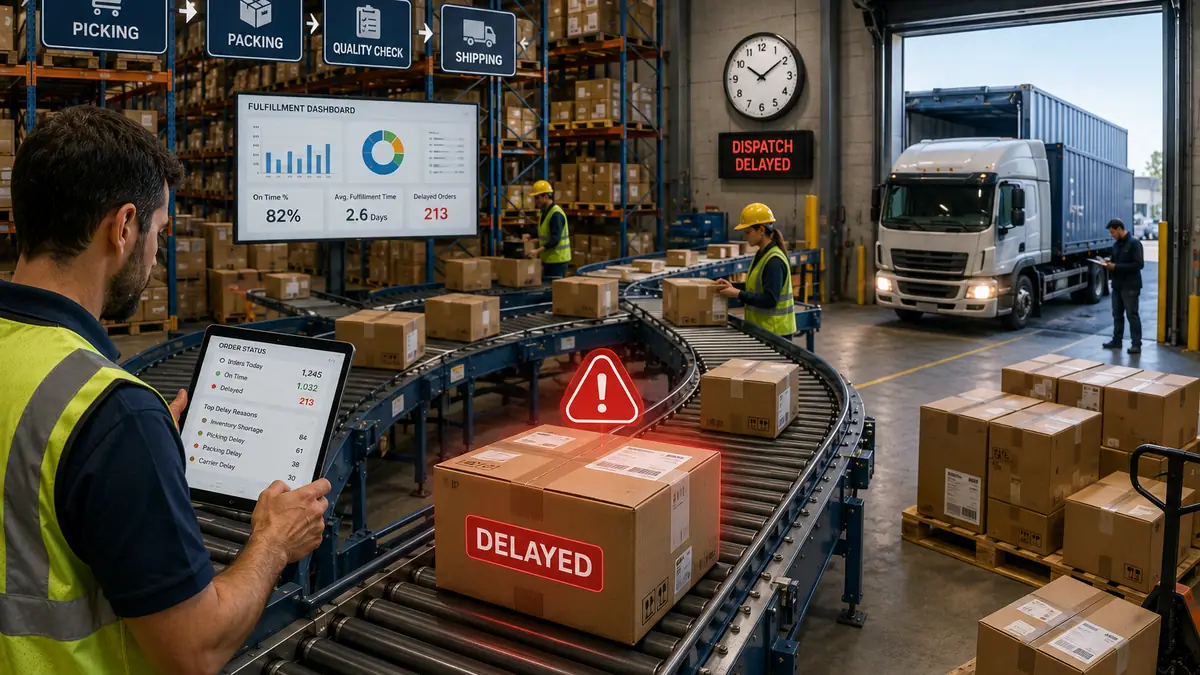
3PL fulfillment services play a critical role in helping businesses process, pack, and deliver customer orders efficiently. When customers place an order, they expect accurate delivery, timely updates, and a smooth buying experience. They rarely think about the number of operational steps that happen between clicking “Buy Now” and receiving a package. For logistics providers, every order passes through multiple checkpoints. Even a small disruption at one stage can delay the entire process.
For companies offering 3PL fulfillment services, delays are rarely caused by a single mistake. More often, they result from a combination of planning gaps, inaccurate inventory, communication issues, warehouse bottlenecks, labor shortages, or unexpected transportation disruptions. If these issues are not identified early, they can lead to dissatisfied customers, higher operating costs, chargebacks, and lost business.
This article explores the most common reasons behind order fulfillment problems, explains how they affect day-to-day operations, and discusses practical ways to reduce delays without making unrealistic promises or relying on oversimplified solutions.
Quick Answer: Why 3PL Fulfillment Services Face Delays
Delays in 3PL fulfillment services usually occur because of poor demand forecasting, inventory inaccuracies, warehouse inefficiencies, labor shortages, system integration issues, communication gaps, and external shipping disruptions. Improving visibility across the fulfillment workflow, standardizing processes, and using reliable operational data can significantly reduce delays.
Why Delays Matter in 3PL Fulfillment Services
A delayed shipment affects far more than delivery timelines. For a retailer, it may mean customer complaints, refund requests, or poor online reviews. For a manufacturer, delayed replenishment can interrupt production schedules. For a marketplace seller, repeated delays may reduce seller ratings and increase penalties.
From a logistics provider’s perspective, delays also consume internal resources. Customer service teams spend more time responding to status inquiries, warehouse teams deal with expedited requests, and operations managers spend valuable hours identifying where the process slowed down.
As customer expectations continue to rise, businesses increasingly evaluate logistics partners not only on cost but also on operational consistency.
Understanding the 3PL Fulfillment Services Workflow
Before identifying where delays happen, it helps to understand the typical workflow followed by many logistics providers.
- A customer order is received.
- Inventory availability is verified.
- Picking instructions are generated.
- Items are picked from warehouse locations.
- Products are packed and labeled.
- Shipment is handed over to the carrier.
- Delivery status is updated until completion.
Each stage depends on the successful completion of the previous one. A delay during inventory verification or picking can easily affect dispatch schedules later in the day.
Instead of looking only at delayed deliveries, experienced operations teams usually examine every stage of this workflow to identify recurring bottlenecks.
Efficient 3PL fulfillment services depend on every stage of this workflow operating without unnecessary interruptions.
The Most Common Causes of Delays in 3PL Fulfillment Services
1. Poor Demand Forecasting in 3PL Fulfillment Services
Many fulfillment delays begin long before an order enters the warehouse. Forecasting errors often result in unexpected stock shortages, excessive inventory, or uneven warehouse workloads.
Imagine an online retailer preparing for a seasonal promotion. If expected order volumes are underestimated, warehouse staff may suddenly need to process thousands of additional orders without enough inventory or labor capacity.
The result is predictable:
- Backorders increase.
- Picking queues become longer.
- Packing stations become overloaded.
- Delivery commitments start slipping.
Forecasting does not eliminate uncertainty, but it helps operations teams prepare for expected demand instead of reacting after problems appear.
According to the Council of Supply Chain Management Professionals (CSCMP), better planning and supply chain visibility remain essential for improving fulfillment performance and reducing operational inefficiencies.
2. Inventory Inaccuracies in Warehouse Fulfillment
Inventory accuracy directly affects warehouse fulfillment performance. If warehouse records show 50 units available while only 35 actually exist, the picker eventually reaches an empty shelf.
At that point, someone must:
- verify stock,
- search nearby locations,
- contact supervisors,
- update inventory,
- and often notify customer service.
What initially appears to be a simple stock discrepancy quickly becomes a fulfillment delay.
Inventory inaccuracies typically occur because of:
- delayed inventory updates,
- incorrect receiving procedures,
- misplaced products,
- manual data entry errors,
- cycle counting gaps.
Warehouses that regularly monitor inventory accuracy usually identify these issues before they affect customer orders.
3. Warehouse Fulfillment Layout and Process Bottlenecks
A warehouse does not need to be full to become inefficient. Sometimes the biggest delays occur because products are stored in locations that increase travel time.
Consider a picker responsible for collecting ten items located across opposite ends of the warehouse.
Instead of spending most of the shift picking products, the employee spends much of the day simply walking.
Other common workflow bottlenecks include:
- congested packing stations,
- poorly organized storage locations,
- unclear picking routes,
- excessive manual paperwork,
- repeated quality inspection queues.
Small process improvements often reduce fulfillment time more effectively than adding more warehouse staff. Efficient warehouse fulfillment depends on organized storage locations, standardized picking routes, and minimizing unnecessary movement across the warehouse.
4. Labor Shortages and Inadequate Training
Warehouse operations remain highly dependent on people.
Even facilities with modern automation still require experienced teams for receiving, picking, packing, quality checks, returns, and exception handling.
During peak seasons, businesses frequently hire temporary workers.
Without proper onboarding, new employees may:
- pick incorrect items,
- scan products incorrectly,
- require frequent supervision,
- slow overall productivity,
- increase shipping errors.
The challenge is not simply hiring more workers.
It is ensuring that every team member understands warehouse procedures before order volumes increase.
Cross-training employees across multiple warehouse activities also helps maintain productivity when absenteeism or unexpected demand occurs.
5. Technology and System Integration Issues in 3PL Fulfillment Services
In addition, modern order fulfillment rarely depends on a single software platform.
A typical fulfillment workflow may involve:
- ERP systems
- eCommerce platforms
- warehouse applications
- shipping software
- customer portals
- barcode scanners
- accounting systems
If information does not move correctly between these systems, delays can follow quickly.
For example, an online marketplace may confirm an order immediately. However, if inventory synchronization happens only every few hours, warehouse staff may begin processing outdated stock information.
Similarly, shipping labels generated from incomplete customer data may require manual correction before dispatch. These issues increase handling time and create unnecessary interruptions in the fulfillment workflow.
NIST research on supply-chain traceability highlights the importance of linking and querying data across different systems to improve visibility and help organizations respond to disruptions.
For readers new to logistics operations, our guide on What Is 3PL Logistics Software and How It Works explains the fundamentals of modern 3PL workflows.
6. Communication Breakdowns Between Teams in Order Fulfillment
Another common reason for order fulfillment problems is poor communication.
Fulfillment operations involve multiple participants, including:
- warehouse teams
- transportation partners
- procurement
- customer service
- sales
- clients
- carriers
If each team works with different or outdated information, delays become much harder to prevent.
For example, a customer may change the delivery address after an order has entered the picking process. If warehouse staff receive the update too late, the shipment may still leave with the original address.
Correcting the mistake afterward can increase transportation costs, create additional rework, and frustrate the customer.
Good communication is not simply about sending more emails. It requires all teams to work with consistent, up-to-date operational information.
Many communication gaps also arise from broader Order Management Challenges, especially when order details move across multiple systems.
7. Transportation and Carrier Disruptions
Not every fulfillment delay begins inside the warehouse.
Even well-organized 3PL fulfillment services remain dependent on transportation networks.
Carrier delays may occur because of:
- severe weather,
- road closures,
- customs inspections,
- port congestion,
- limited carrier capacity,
- unexpected equipment failures.
These external factors cannot always be prevented.
However, logistics providers can reduce their impact by maintaining realistic delivery commitments, working with multiple transportation partners where appropriate, and communicating shipment updates promptly to customers.
This distinction is important because businesses often assume every delayed delivery reflects poor warehouse performance, when the actual cause may lie outside warehouse operations altogether.
How One Delay Creates Multiple Operational Problems
A fulfillment delay rarely stays isolated.
It usually creates a chain reaction across different business functions.
| Initial Issue |
Operational Impact |
| Inventory mismatch | Picking delays and backorders |
| Slow picking | Late packing and dispatch |
| Packing bottleneck | Missed carrier cutoff times |
| Carrier delay | Customer service inquiries increase |
| Delayed delivery | Refund requests, complaints, and reduced customer trust |
Understanding this cause-and-effect relationship helps operations teams focus on solving root problems rather than repeatedly addressing symptoms.
How to Reduce Delays in 3PL Fulfillment Services
No warehouse can eliminate every delay. Seasonal spikes, transportation disruptions, and unexpected customer requests are part of logistics. The goal is to identify recurring bottlenecks early and build processes that reduce their frequency and impact.
The following practices are commonly used by high-performing fulfillment operations.
Improve Demand Planning
Forecasting should not rely only on historical sales. Businesses also need to consider promotions, seasonal trends, customer purchasing behavior, supplier lead times, and market changes.
Regular forecasting reviews help warehouse teams prepare for upcoming demand instead of reacting after order volumes increase.
Maintain Accurate Inventory Records
Inventory accuracy is one of the strongest indicators of warehouse performance.
Good practices include:
- Regular cycle counting
- Barcode or scanning during receiving and dispatch
- Immediate recording of inventory movements
- Periodic reconciliation between physical and system inventory
- Investigating repeated inventory discrepancies instead of correcting numbers without identifying the cause
Small inventory errors accumulate quickly in large warehouses. Maintaining accurate inventory data reduces unnecessary searching, manual verification, and delayed shipments.
Standardize Warehouse Processes
Many warehouses develop different working methods across shifts or supervisors. While these approaches may work temporarily, inconsistent processes often create avoidable delays.
Standard operating procedures help ensure that receiving, picking, packing, quality checks, and dispatch follow the same sequence regardless of who performs the task.
Process consistency also makes employee training easier and simplifies performance measurement.
Monitor 3PL Fulfillment Performance Continuously
Many businesses discover fulfillment problems only after customers start complaining.
Instead, warehouse managers should monitor operational metrics throughout the day.
Examples include:
- Order processing time
- Picking accuracy
- Packing accuracy
- Orders awaiting dispatch
- Backorder volume
- Inventory accuracy
- On-time shipment rate
Tracking these metrics regularly allows teams to identify trends before they become larger operational issues.
Strengthen Communication Across Departments
Warehouse teams cannot work effectively if they receive incomplete or delayed information.
Sales teams should communicate large customer orders in advance.
Procurement teams should update expected replenishment dates promptly.
Customer service teams should immediately share order modifications or delivery changes.
Similarly, transportation partners should communicate delays as early as possible so customers receive accurate updates.
Clear communication reduces unnecessary rework and helps different departments make informed decisions.
A Practical Workflow for Reducing Order Fulfillment Problems
Instead of treating delays individually, many operations teams review the entire fulfillment process.
A simple workflow looks like this:
Step 1: Receive the order
Confirm customer information, product availability, and delivery requirements before processing begins.
↓
Step 2: Verify inventory
Ensure physical inventory matches system records.
↓
Step 3: Pick and pack efficiently
Follow standardized picking routes and quality checks.
↓
Step 4: Dispatch on schedule
Coordinate with carriers while monitoring shipment cut-off times.
↓
Step 5: Track exceptions
Investigate delayed orders immediately instead of waiting for customer complaints.
↓
Step 6: Review recurring patterns
If similar delays occur repeatedly, identify the underlying operational issue instead of addressing each incident individually.
This continuous improvement cycle helps reduce recurring bottlenecks over time.
A Quick Checklist for 3PL Fulfillment Services
Ask these questions regularly.
- Is inventory accuracy consistently high?
- Are customer orders processed within expected timelines?
- Does every warehouse shift follow the same procedures?
- Are carrier delays monitored separately from warehouse delays?
- Can managers identify bottlenecks using operational reports?
- Are communication gaps causing avoidable rework?
- Are employees trained before peak demand periods?
If several answers are “No,” the issue is probably not one isolated delay but a process that needs improvement.
Why Technology Supports 3PL Fulfillment Services but Cannot Fix Every Problem
Many organizations assume that implementing new software automatically eliminates fulfillment delays.
In reality, software supports operational processes; it does not replace them.
Even well-designed systems depend on:
- Accurate operational data
- Consistent workflows
- Proper employee training
- Clear business rules
- Reliable integrations
- Ongoing process reviews
Technology can improve visibility and reduce manual work, but poor warehouse practices, inaccurate inventory records, or inconsistent communication will continue to create delays regardless of the software being used.
Businesses should first understand their operational challenges. They can then evaluate technology that addresses those specific issues.
Looking Beyond Individual Delays
When organizations investigate delayed shipments one by one, they often solve only the immediate issue.
A more effective approach is to examine recurring patterns.
For example:
- Are delays concentrated during certain shifts?
- Do specific products experience repeated fulfillment issues?
- Are particular warehouse zones creating congestion?
- Are certain carriers consistently missing delivery commitments?
- Do inventory discrepancies occur within the same product categories?
Looking at operational trends rather than isolated incidents makes continuous improvement more achievable.
McKinsey’s discussion of building a risk-resilient supply chain also emphasizes the importance of identifying vulnerabilities early instead of responding only after disruptions occur.
Delays often affect more than delivery timelines. They can also reduce profitability, as discussed in Why 3PL Companies Lose Revenue.
Conclusion
Ultimately, delays in 3PL fulfillment services rarely result from a single operational failure. Most occur because several small issues combine over time, including forecasting errors, inventory inaccuracies, warehouse inefficiencies, communication gaps, labor constraints, and transportation disruptions.
Businesses that consistently improve fulfillment performance usually focus on strengthening the entire workflow instead of reacting only after deliveries are delayed.
Regular process reviews, accurate inventory management, standardized warehouse procedures, better communication, and performance monitoring all contribute to faster and more reliable order fulfillment.
As customer expectations continue to increase, operational consistency is becoming just as important as delivery speed. Organizations that understand where delays originate are better positioned to improve customer satisfaction, reduce operational costs, and build stronger long-term relationships with their clients.
Frequently Asked Questions
Q. What are the most common causes of delays in 3PL fulfillment services?
A. The most common causes include poor demand forecasting, inventory inaccuracies, warehouse bottlenecks, labor shortages, communication gaps, technology integration issues, and transportation disruptions.
Q. How do inventory inaccuracies create order fulfillment problems?
A. When inventory records do not match actual stock levels, warehouse staff spend additional time locating products, verifying inventory, or managing backorders. This slows the entire fulfillment process.
Q. Can technology eliminate warehouse fulfillment delays?
A. Technology can improve visibility and automate many operational tasks, but it cannot compensate for poor workflows, inaccurate data, or inconsistent warehouse practices. Successful implementations depend on process maturity, data quality, user adoption, and effective system integration.
Q. How can warehouse managers identify recurring fulfillment bottlenecks?
A. By monitoring operational metrics such as order processing time, picking accuracy, inventory accuracy, dispatch performance, and backorder rates, managers can identify recurring issues before they affect customers.
Q. Are transportation delays always the responsibility of a 3PL provider?
A. No. Some delays occur because of weather conditions, customs inspections, road closures, port congestion, or carrier capacity limitations. However, effective communication and contingency planning can help reduce their impact on customers.


