
Managing freight looks simple from the outside. A shipment is booked, transported, delivered, and billed. But freight management software becomes important when the work behind each shipment starts getting difficult to track manually.
Inside a logistics business, every shipment creates dozens of operational activities. Orders arrive from different customers. Carrier availability changes. Shipment documents need verification. Delivery updates must reach customers on time. Billing depends on accurate shipment data, while operations teams need visibility into delays before they become customer complaints.
As shipment volumes grow, these activities become harder to manage through spreadsheets, disconnected applications, or manual communication.
This is usually the point where businesses start looking for a better way to manage freight operations.
The software helps teams keep shipment information, documents, and day-to-day freight activities organized in one place without changing how logistics decisions are made.
Quick Answer
Freight management software is a digital system that helps logistics providers, freight forwarders, distributors, and transportation teams manage freight-related operations from shipment creation through delivery tracking and operational reporting.
Depending on the platform, it may support activities such as:
- Shipment planning
- Order processing
- Documentation
- Operational visibility
- Status tracking
- Billing support
- Customer communication
- Analytics and reporting
Every product is different, so it’s worth checking whether the software supports the workflows your business actually needs.
Why Freight Management Software Has Become More Important
Global supply chains are moving larger shipment volumes through increasingly interconnected transportation networks.
Many logistics organizations today often work with:
- Multiple customers
- Multiple warehouses
- Different transportation partners
- International documentation
- Customer-specific workflows
- Higher service expectations
At the same time, customers expect shipment updates almost immediately.
An operations team may still rely on emails, spreadsheets, phone calls, and messaging applications to coordinate freight movements. While this may work for a smaller operation, it becomes difficult to maintain consistency as shipment volumes increase.
According to the CSCMP State of Logistics Report, rising transportation complexity continues to increase the need for better operational visibility and coordination across logistics networks.
What Does a Freight Management System Actually Do?
A freight management system provides a structured workflow for handling freight-related activities.
Instead of keeping shipment information across different spreadsheets and systems, it keeps everything connected in one operational record that different teams can access.
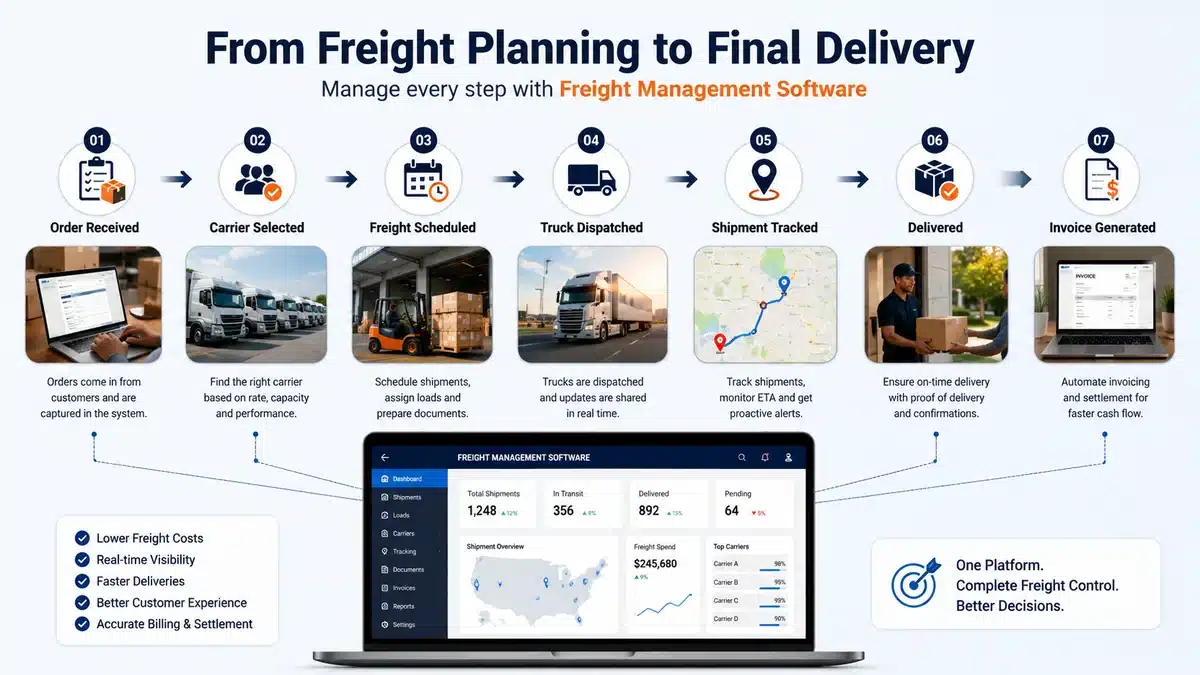
A typical workflow may look like this:
Customer Order
↓
Shipment Creation
↓
Document Verification
↓
Freight Planning
↓
Operational Tracking
↓
Delivery Confirmation
↓
Billing & Reporting
Different businesses may add additional approval stages, integrations, or compliance checks depending on their industry.
Common Problems Without Freight Logistics Software
Many logistics businesses continue operating successfully without dedicated software for years.
The problems usually start showing up as shipment volumes and customer requirements grow.
Some common examples include:
Shipment information exists in multiple places
One department updates spreadsheets.
Another uses emails.
Warehouse teams maintain separate records.
Customer service checks another application.
As a result, nobody has a complete operational picture.
Manual status updates consume valuable time
Operations teams often spend a significant portion of the day answering questions like:
- Has this shipment left?
- Which carrier is handling it?
- Has delivery been delayed?
- Where is the POD?
- Has billing been completed?
These questions are usually answerable – but finding the information requires searching across multiple systems.
Documentation becomes difficult to manage
Freight operations generate documents throughout the shipment lifecycle.
Examples include:
- Bills of Lading
- Proof of Delivery
- Commercial invoices
- Shipping instructions
- Customer documentation
When documents are stored across emails and local folders, retrieving them later becomes difficult.
Decision-making becomes reactive
Without centralized visibility, managers often discover issues only after customers report them.
Instead of identifying trends early, teams spend most of their time solving immediate operational problems.
What Features Should You Look for in Freight Operations Software?
Not every logistics business requires the same functionality.
A company moving domestic pallet shipments has different needs than a global freight forwarder.
However, most businesses should evaluate whether a solution supports the following operational capabilities.
|
Capability |
Why It Matters |
| Shipment visibility | Helps monitor freight progress across operations |
| Order management | Keeps shipment information organized |
| Document management | Reduces manual searching for shipment documents |
| Operational dashboards | Provides managers with better visibility |
| Customer status updates | Improves communication consistency |
| Reporting and analytics | Supports operational improvement |
| Integration capabilities | Connects with existing business systems |
How Businesses Benefit from Freight Management Software
A software platform alone does not solve operational problems. The results depend on well-defined workflows, accurate data, system integrations, and team adoption. However, when implemented thoughtfully, freight management software can help businesses improve consistency across daily freight operations.
Better Operational Visibility
Having shipment information in one place makes daily work much easier than switching between spreadsheets, emails, and messaging apps.
For example, if a customer asks about a shipment delay, the operations team can quickly review its current status, related documents, and previous updates instead of contacting multiple departments.
This reduces internal coordination time and helps customer-facing teams respond with greater confidence.
Fewer Manual Coordination Tasks
Many logistics teams spend a large part of the day following up internally.
Questions such as:
- Has dispatch been completed?
Has the carrier acknowledged pickup?
Is the proof of delivery available?
Has billing been triggered?
may require several phone calls or email exchanges.
With a centralized freight management platform, teams spend less time chasing routine updates and more time resolving shipments that actually need attention.
More Consistent Documentation
Freight operations involve documents at almost every stage of the shipment lifecycle.
Examples include:
- Bills of Lading (BOL)
- Proof of Delivery (POD)
- Shipping instructions
- Commercial invoices
- Customer-specific documents
- Delivery acknowledgements
Keeping these documents linked to their respective shipments makes retrieval easier during customer inquiries, audits, or billing reviews.
Better Decision-Making Through Reporting
In addition, daily operations generate valuable data.
Without reporting, that data often remains unused.
A reporting dashboard can help managers identify patterns such as:
- Frequently delayed routes
- Customers with recurring shipment exceptions
- Seasonal shipment fluctuations
- Average delivery timelines
- Operational bottlenecks
- Documentation delays
Instead of reacting to individual issues, teams can identify recurring problems and improve processes over time.
When Does a Business Usually Need a Freight Management System?
However, there is no fixed shipment volume at which software becomes necessary.
Instead, businesses usually begin evaluating a freight management system when operational complexity starts affecting service quality.
Common indicators include:
- Shipment information exists in multiple spreadsheets.
- Teams regularly ask for shipment updates through calls or messaging apps.
- Customers request tracking information that takes time to retrieve.
- Documents are difficult to locate after delivery.
- Billing is delayed because shipment records are incomplete.
- Managers lack real-time operational visibility.
- Growth is increasing faster than existing processes can handle.
If several of these situations sound familiar, reviewing existing freight processes may be worthwhile before operational inefficiencies become more expensive.
Choosing the Right Freight Operations Software
Not every logistics software product serves the same purpose.
Many platforms focus primarily on transportation planning.
Others emphasize shipment execution, documentation, customer visibility, or operational reporting.
Before selecting a solution, consider questions such as:
- Which operational problems are we trying to solve?
- Which processes are still heavily manual?
- Which systems need integration?
- How much operational visibility do managers currently have?
- Can the software adapt as our business grows?
- How easy will it be for teams to adopt?
The answers often matter more than comparing long feature lists.
This approach also aligns with recommendations from Gartner Supply Chain Research, which emphasizes evaluating supply chain technology based on business requirements, integration capabilities, scalability, and long-term operational fit rather than feature comparisons alone.
Freight Management Software Implementation Considerations
In practice, successful software implementation is rarely just a technology project.
It usually involves improvements in processes, data quality, user training, and operational governance.
To prepare effectively, businesses should plan for:
- Process mapping before implementation
- Data cleanup and standardization
- Integration with existing ERP or accounting systems where required
- Team training
- User adoption monitoring
- Ongoing workflow improvements
Businesses usually get better results when they improve their processes alongside the software instead of treating implementation as just another IT project.
Even the best logistics software won’t fix inconsistent data or unclear responsibilities. The system works best when teams follow consistent processes.
How iLogistech Supports Freight Management Software Workflows
Businesses looking to digitize broader 3PL operations may also evaluate platforms such as iLogistech. It supports operational workflows including order management, shipment visibility, documentation, receivables, payables, returns, and customer communication within 3PL environments.
It isn’t meant to replace every logistics application. Instead, it helps 3PL providers manage the operational activities that support freight movement more efficiently.
If your organization is currently relying on disconnected spreadsheets or manual shipment tracking, you may also find these resources useful:
- What Is 3PL Logistics Software and How It Works?
- Signs Your 3PL Management Process Has Outgrown Excel Sheets
- Top 3PL Challenges in 2026
Frequently Asked Questions
Q. What is freight management software?
A. Freight management software helps businesses organize freight-related operations such as shipment creation, operational tracking, documentation, reporting, and shipment visibility through a centralized digital platform.
Q. What is the difference between a freight management system and a TMS?
A. A Transportation Management System (TMS) typically focuses on transportation planning, carrier selection, route optimization, and freight execution. A freight management system may have a broader or different scope depending on the software provider, so businesses should evaluate the actual capabilities rather than relying solely on product names.
Q. Can small logistics companies benefit from freight logistics software?
A. Yes. Smaller logistics providers often use software to improve shipment visibility, organize documents, reduce manual coordination, and prepare for business growth. The right solution depends on shipment volume, workflow complexity, and operational goals.
Q. Does freight operations software replace manual work completely?
A. No. It reduces repetitive administrative tasks and improves visibility, but logistics teams still make operational decisions, manage exceptions, coordinate with customers, and resolve unexpected issues.
Q. How do I choose the right freight management platform?
A. Start by identifying your operational challenges rather than comparing feature lists. Consider workflow support, integration capabilities, scalability, reporting, ease of adoption, and how well the platform fits your existing business processes.
Conclusion
As freight operations expand, complexity often grows faster than expected. More customers, shipments, carriers, documents, and service expectations can make manual coordination increasingly difficult.
Freight management software helps teams keep shipment information organized, improve visibility, and manage daily freight operations more consistently. While software is not a substitute for well-managed processes, it can provide teams with the information they need to make faster, more informed decisions.
Choose software that fits your day-to-day operations and works well with your existing systems instead of selecting a product just because it has the longest feature list.


