
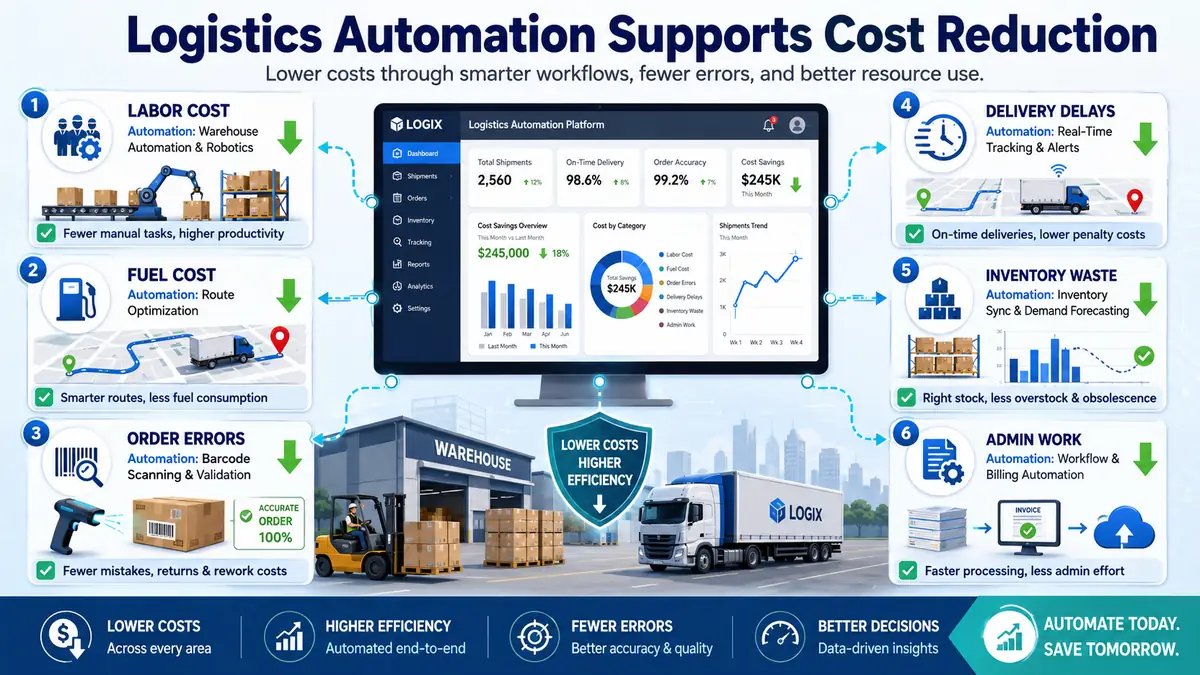
For logistics companies, reducing cost does not necessarily mean reducing headcount, choosing cheaper carriers, or cutting service levels. Sustainable Logistics Cost Reduction often comes from cutting out repetitive work: re-entering orders, checking the same information across systems, correcting documents, manually updating shipment status, reconciling invoices, and fixing avoidable errors.
Manual processes can look inexpensive when order volumes are low. The problem becomes clearer as the business grows. More clients mean more orders, billing rules, documents, exceptions, delivery partners, and status updates. If every increase in order volume also adds more administrative work, operating costs keep rising with it.
However, automation changes that relationship when teams apply it to the right processes.
Quick Answer: How Does Automation Reduce Logistics Costs?
Automation can lower logistics operating costs by reducing repetitive admin work, preventing avoidable errors, and linking operational activity with billing and documentation. It can also help teams handle more transactions without adding the same amount of manual work.
The strongest opportunities usually come from processes that are:
- high-volume;
- repetitive;
- rule-based;
- prone to manual errors;
- dependent on information moving between systems or teams; and
- measurable in terms of time, rework, delays, or missed revenue.
For that reason, logistics cost optimization should start by fixing the workflow before deciding what to automate.
Why Automation Is Becoming a Priority for Logistics Cost Reduction
Automation is now being used more widely across supply chain operations, rather than only in isolated warehouse projects. The 2026 MHI supply chain technology findings report robotics and automation as the second-most disruptive technology identified by supply chain leaders, with 73% expecting adoption within five years.
For a 3PL, the more useful question is: which recurring activities are pushing up the cost per order, and which of them are worth automating?
Consider a growing operation that receives orders from several customers. One sends spreadsheets, another connects through an API, and another provides files in its own format. Employees then validate the order, enter information into an operating system, create documents, coordinate warehouse activity, update shipment status, and eventually prepare billing information.
None of these tasks looks particularly costly on its own. The cost adds up when the same work has to be repeated hundreds or thousands of times.
If your current operation is already heavily dependent on spreadsheets and repeated reconciliation, the warning signs are covered in Signs Your 3PL Management Process Has Outgrown Spreadsheets.
Where Automation Creates Practical Logistics Cost Reduction
1. How Automated Order Processing Supports Logistics Cost Reduction
Order entry is one of the first places to look when deciding how to reduce logistics cost.
A manual process may require employees to receive an order, interpret its format, re-enter the information, verify customer details, identify priority or SLA requirements, and then pass instructions to another team.
In contrast, a better workflow looks more like this:
Order received → Data captured → Validation rules applied → Operational workflow created → Status recorded → Exceptions sent for review
The goal is not to remove people from the process. It is to avoid using employee time on routine transactions that already follow clear rules.
For high-volume 3PLs, automated order processing becomes useful because staff do not have to handle every routine order manually. They can spend more time dealing with exceptions and issues that actually need attention.
Mechsoft’s discussion of order management challenges in high-volume 3PL operations also shows why barcode validation and QA controls become increasingly important as transaction volume rises.
2. Automation Reduces Rework Caused by Handoffs
Ogistics contains many operational handoffs. These include client to 3PL, inbound team to warehouse operations, warehouse to trucking provider, trucking provider to delivery agent, and finally delivery confirmation back to operations and finance.
At each handoff, information can be missed, delayed, or entered incorrectly.
Employees may spend time asking:
- Has the order arrived?
- Was QA completed?
- Which pallet contains it?
- Has the truck left?
- Was delivery completed?
- Where is the POD?
- Can the customer be billed yet?
When the system records events consistently and automatically shares them with the next process, employees spend less time chasing routine updates.
This cost is easy to overlook because it is spread across several departments instead of showing up as one clear expense.
3. How Barcode and QA Controls Support Logistics Cost Reduction
An operational error rarely costs only the time required to correct one record.
A receiving discrepancy can later create a picking problem. A wrong pallet assignment can affect dispatch. Incorrect delivery information can create client queries. Missing confirmation can delay invoicing.
Barcode scanning and structured QA checks can move validation closer to the point where the activity takes place.
For Logistics Cost Reduction, the bigger benefit is preventing errors and rework later in the process, not simply making scanning faster.
4. Billing Automation Protects Revenue as Well as Reducing Work
Reducing expenses is only one side of the picture. Preventing missed or unbilled charges can also protect operating margin.
3PL billing can involve customer-specific rules for storage, handling, transportation, accessorial services, returns, and other activities. If employees must later reconstruct operational activity manually for invoicing, they spend additional time reconciling records and may miss legitimate charges.
The 2025 Third-Party Logistics Warehouse Benchmark Report found increases in respondents identifying both uncaptured charges and lack of automation among their billing challenges, illustrating how closely operational records and financial performance are connected.
A better billing process connects each billable activity with the correct customer contract and charging rules.
For a closer look at this issue, see how manual 3PL billing can contribute to revenue leakage.
5. How Automated Reporting Supports Logistics Cost Reduction
Operations managers should not need several employees to collect information from different spreadsheets every time a client asks for a status report.
When teams record operational events in structured systems, the system can generate routine reports from the same data used to run the operation.
This reduces reporting work and also helps managers spot delayed orders, repeated exceptions, unusual activity, and costly accounts sooner.
Automation can also make inefficient processes easier to spot because managers have clearer operational data to work with.
Which Processes Should You Automate First for Logistics Cost Reduction?
Automating everything at once is rarely the best place to start.
Use the operational problem to set the priority.
|
Operational symptom |
Good automation candidate |
Metric to monitor |
| Employees repeatedly entering orders | Order capture and validation | Processing time per order |
| Frequent shipment or receiving errors | Barcode and QA controls | Error/rework rate |
| Staff constantly chasing updates | Event-based status tracking | Manual follow-ups per order |
| Billing takes days to prepare | Operational-event-to-billing workflow | Invoice preparation time |
| Managers build reports manually | Automated operational reporting | Reporting hours per month |
Start with one or two workflows where the financial impact is already visible. Measure the baseline before implementation and compare it after the process stabilizes.
This gives you a clearer business case for Logistics Cost Reduction instead of assuming that every automation project will save money.
What Can Undermine Logistics Cost Reduction Through Automation?
Putting software around a poorly designed process does not automatically make it efficient.
According to McKinsey’s digital logistics research, more than 40% of surveyed companies said previous digital implementations took longer than expected to achieve their business goals. Data quality, integration complexity, skills, and change management were among the recurring obstacles.
Before automating a workflow, check:
- Is the current process clearly defined?
- Are exceptions understood?
- Is the underlying data reliable?
- Can existing systems exchange information?
- Do employees understand how their roles will change?
- Can the financial impact be measured?
The results will depend on factors such as business size, transaction volume, workflow maturity, data quality, integrations, implementation quality, and how well the team adopts the system.
If these factors are ignored, the business may end up paying for another system that employees still have to work around manually.
Where iLogistech Fits Into Logistics Cost Reduction
For 3PL companies specifically, iLogistech is relevant where cost problems originate from repetitive order handling, operational coordination, documentation, tracking, billing, or returns.
The iLogistech 3PL logistics software platform supports order receipt and synchronization from multiple sources, inbound and outbound operational workflows, QA and barcode scanning, and order tracking. It also supports BOL and manifest documentation, customer billing, AR/AP processes, returns and reconsignments, and API integrations with external systems.
The same setup will not suit every logistics business. If the main problem is route optimization, fleet planning, or a specialized WMS requirement, the company may need a different system or additional software.
The real question is whether the platform fixes the manual processes that are currently adding to your operating cost.
Frequently Asked Questions
Q. How can automation help with Logistics Cost Reduction?
A. Automation can reduce repetitive labor, manual data entry, rework, documentation effort, status follow-ups, billing administration, and other transaction-processing costs. The actual savings depend on the workflow being automated and how frequently that process occurs.
Q. How Can You Achieve Logistics Cost Reduction Without Reducing Service Quality?
A. Start by removing waste rather than reducing service. Identify repeated data entry, preventable errors, unnecessary approvals, manual reporting, missed billing events, and duplicated communication. These areas can often be improved without compromising delivery standards.
Q. What Role Does Automated Order Processing Play in Logistics Cost Reduction?
A. Automated order processing can capture incoming order information, apply predefined validation or workflow rules, record status changes, and send exceptions for human review. This reduces the need for employees to manually handle every routine order.
Q. What Should You Measure for Effective Logistics Cost Reduction?
A. Track both financial and operational measures, including cost per order, employee time per transaction, order-processing time, error and rework rates, billing cycle time, manual touches per order, and exception rates. Cost savings that damage accuracy or service levels are not genuine optimization.
Conclusion
Automation helps with Logistics Cost Reduction when it removes specific manual work, errors, and delays instead of simply adding another system to an already complicated process.
For many 3PLs, the best starting points are order intake, repetitive data movement, QA, shipment-status communication, documentation, billing, and reporting. These processes occur frequently enough that small inefficiencies become expensive as the business grows.
A practical starting point is to identify where employees spend repeated effort, measure the current cost or time involved, automate the predictable work, keep people involved for exceptions, and then track whether the change actually improves the process.
If higher-order volumes are also creating more manual work, review those workflows first. It will help you see where automation can genuinely reduce cost and where investing in more technology may not be worthwhile.


