

Third-party logistics is no longer just about moving goods from one place to another. It involves speed, accuracy, shipment visibility, cost control, and client expectations that continue to grow.
According to Armstrong & Associates, global third-party logistics revenue reached an estimated $1.3 trillion in 2025. As the industry grows, managing operations through spreadsheets, disconnected systems, manual communication, and delayed information becomes increasingly difficult.
Billing errors, shipment delays, repeated data entry, and poor coordination can affect both daily operations and long-term profitability. The 2023 Third-Party Logistics Warehouse Benchmark Report by Extensiv also highlighted rising labor costs, lengthy invoicing cycles, and cash flow challenges among 3PL warehouse operators.
Let’s examine eight common 3PL challenges in 2026, their business impact, and practical ways logistics companies can address them.
Why 3PL Challenges Are Becoming More Complex in 2026
Running a 3PL operation involves coordinating clients, carriers, warehouse teams, financial processes, and technology systems. In 2026, several factors are making that coordination more demanding.
Growing order volumes, rising operating costs, and client expectations are making 3PL operations harder to manage.
Clients expect timely tracking updates, accurate billing, and connectivity with their existing systems. At the same time, 3PL companies must manage different carriers, data formats, and service requirements.
Automation can help, but it requires reliable data, connected systems, and clearly defined processes.
What Are the Most Common 3PL Challenges?
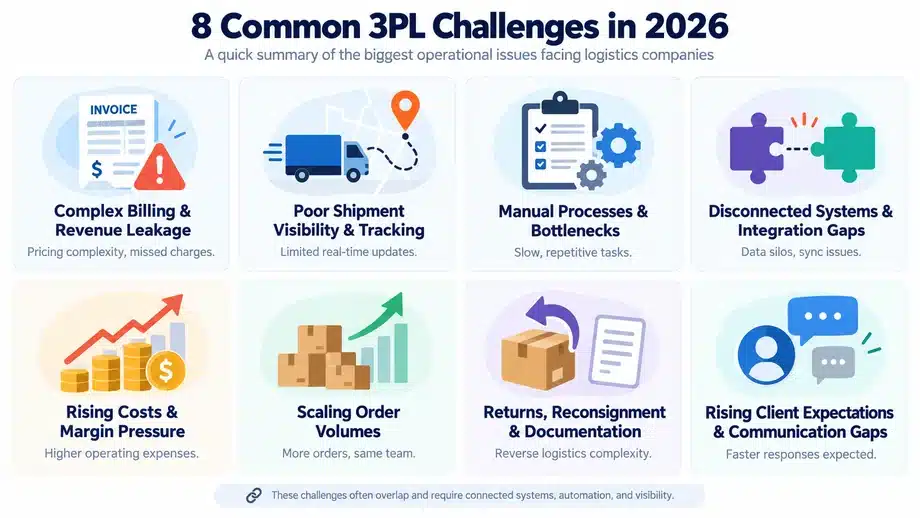
The eight common challenges 3PL companies face in 2026 are:
1. Complex Billing and Revenue Leakage
3PL companies often manage different client rate cards, billing cycles, and charges for storage, handling, transportation, packaging, and returns.
When billable activities are recorded across spreadsheets or disconnected systems, finance teams may miss charges, apply incorrect rates, or delay invoices.
How 3PL Companies Can Improve Billing Accuracy
Billing processes should connect completed logistics activities with the applicable client rates.
Client contract → Completed service → Applicable rate → Recorded charge → Client invoice
Capturing billable events as they occur, rather than reconstructing them at month-end, can reduce errors and missed charges.
Business impact: Billing errors reduce revenue, delay payments, and increase administrative work. Accurate charge capture helps protect profitability.
2. Poor Shipment Visibility and Tracking
Shipment information often sits across carrier portals, warehouse systems, emails, and manual reports. Without connected updates, 3PL teams struggle to track delays, delivery exceptions, and shipments at risk of missing SLAs.
For example, a carrier may report a delay, but the account manager may only discover it when the client asks for an update.
How 3PL Companies Can Improve Shipment Visibility
Centralizing available tracking information, establishing consistent shipment milestones, and recording exceptions can help teams identify delays earlier.
Carrier integrations and shared tracking updates can also reduce manual follow-ups. However, tracking accuracy still depends on timely and reliable information.
Business impact: Poor visibility increases support work and delays exception handling. Reliable tracking improves response times and client communication.
3. Manual Processes and Operational Bottlenecks
As order volumes grow, spreadsheet-based operations and repeated data entry become difficult to manage.
An order received through email may be manually entered into an order sheet, copied into a carrier portal, updated in a tracking file, and later added to a billing record. Each step increases the possibility of errors and delays.
How 3PL Companies Can Reduce Manual Work
Identify repetitive tasks such as order imports, status updates, document preparation, and billing-event capture.
Standardizing and automating suitable workflows reduces unnecessary manual effort, while employees continue handling exceptions requiring judgment.
Business impact: Manual processes increase processing time and administrative costs. Automation can improve productivity and reduce repetitive work.
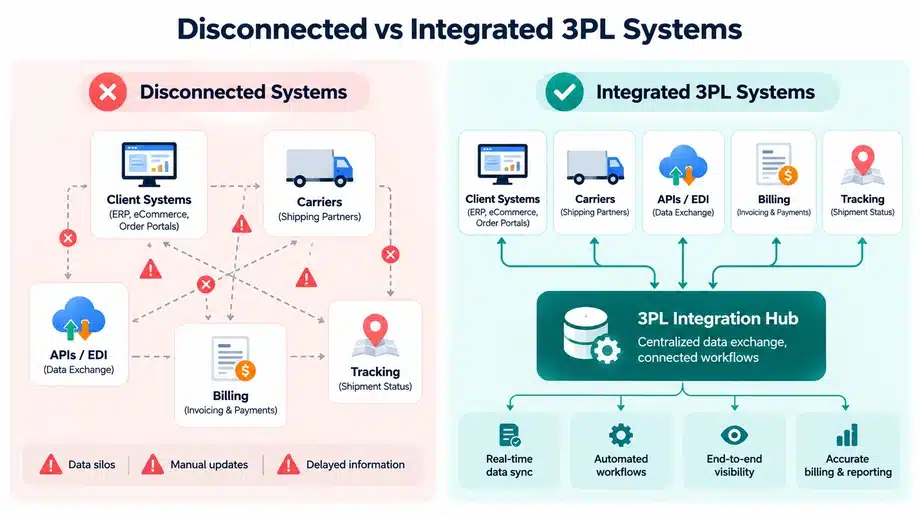
4. Disconnected Systems and Integration Gaps
3PL companies often rely on ERP, WMS, TMS, carrier, and accounting systems that do not exchange information reliably.
For example, an order may enter through a client’s ERP, move to a WMS for processing, and then require manual updates in tracking and billing systems.
This can lead to duplicate records, delayed information, and missed billing activities.
How 3PL Companies Can Improve System Integration
Depending on existing systems, 3PL providers can use APIs, EDI, or controlled file imports to exchange operational information.
Carrier and accounting integrations can also improve tracking and financial coordination. Data validation and exception monitoring remain necessary.
Business impact: Disconnected systems increase manual work, delay reporting, and make errors harder to identify. Reliable integrations improve information consistency across teams.
5. Rising Costs and Margin Pressure
Carrier rates, fuel, labor, handling, and returns costs can vary across clients and shipments.
A 3PL may continue charging an older client rate despite increased carrier costs. Similarly, two clients generating equal revenue may require different levels of operational effort, affecting profitability.
How 3PL Companies Can Improve Cost Control
Maintain updated carrier and client rate cards, record service-specific expenses, and review profitability by client.
Comparing expected and actual costs helps identify pricing gaps and unprofitable services.
Business impact: Poor cost allocation and outdated pricing reduce margins. Better cost visibility supports informed pricing and operational decisions.
6. Scaling Order Volumes Without Adding Equivalent Headcount
As 3PL companies gain clients and handle more orders, manual order entry, documentation, tracking, and billing can increase administrative workloads.
Each new client may also introduce different SLAs, billing rules, and reporting requirements.
How 3PL Companies Can Scale More Efficiently
Standardize order intake, configure client-specific workflows, and automate repetitive activities such as document preparation, status updates, and billing-event capture.
Employees can then focus on exceptions and activities requiring operational judgment.
Business impact: Scalable processes help companies handle greater order volumes without proportionally increasing administrative work and costs.
7. Returns, Reconsignment and Documentation Complexity
Failed deliveries, address changes, and consignee refusals can lead to returns or reconsignment requests.
These activities require coordination between clients, carriers, and operations teams, along with accurate BOLs, manifests, labels, and return records.
For example, outdated delivery instructions may cause a redirected shipment to reach the wrong location.
How 3PL Companies Can Improve Returns and Documentation
Link return and reconsignment requests to their original shipment records. Maintain consistent document templates, approvals, version control, and billing records.
Business impact: Poor documentation increases rework, transport costs, and billing disputes. Structured records improve exception handling and financial close-out.
8. Rising Client Expectations and Communication Gaps
3PL clients expect timely shipment updates, accurate billing, accessible documentation, and clear communication about delays.
However, different clients may require different reporting formats, update frequencies, or integration methods.
When information is scattered across systems, account managers spend more time gathering updates than responding to clients.
How 3PL Companies Can Improve Client Communication
Establish consistent shipment milestones, reporting requirements, and communication responsibilities.
Client portals, notifications, and shared reports can reduce repeated inquiries, provided the underlying operational data is accurate.
Business impact: Communication gaps increase support workloads and service disputes. Timely updates and reliable information help maintain client trust.
Managing Shipment Exceptions and Supply Chain Disruptions
Not every shipment delay is caused by an internal process problem.
3PL companies also deal with carrier capacity constraints, weather events, traffic disruptions, missed pickups, delivery failures, incorrect addresses, and unexpected changes in shipment requirements.
Logistics software cannot prevent these disruptions from happening.
What it can do is help teams identify and manage their effects more effectively.
For example, when a carrier reports a failed delivery attempt, the operations team should be able to identify the affected shipment, review the latest status, document the issue, and determine the next action.
A more controlled exception-management process includes:
- Identify the exception: Capture a delayed, failed, or changed shipment status as soon as reliable information is available.
- Assign responsibility: Make it clear which team or person should investigate.
- Coordinate the response: Contact the carrier, warehouse, consignee, or client as required.
- Document the issue: Record the reason, actions taken, and relevant documents.
- Communicate updates: Share accurate information with affected stakeholders.
- Close and review: Confirm the outcome and identify recurring causes.
Centralized shipment data and carrier connectivity can make this process easier, although they depend on timely updates from the systems and partners involved.
The goal is not to eliminate every disruption. It is to reduce confusion, improve response times, and communicate more clearly when problems occur.
Data Security and Integration Risk in Modern 3PL Operations
3PL companies exchange client, shipment, and financial information across multiple systems. Poorly controlled access, unsecured file transfers, and unnoticed integration failures can expose sensitive information or disrupt operations.
Role-based permissions, secure data transfers, activity logs, and integration monitoring can help reduce these risks. Security controls should reflect the information exchanged and applicable business requirements.
How 3PL Companies Can Prioritize Operational Improvements
Trying to solve every logistics problem at once can create additional complexity.
A more practical approach is to prioritize improvements based on their effect on daily operations and financial performance.
Start by reviewing recurring issues:
- Which activities require the most manual follow-ups?
- Where are charges being missed or corrected?
- Which shipment updates are consistently delayed?
- Where does the same information need to be entered more than once?
- Which client requirements create repeated exceptions?
- Can the company measure profitability at the client or service level?
Next, identify whether the root cause is an unclear process, unreliable data, missing integration, insufficient visibility, or a software limitation.
Some problems can be addressed through clearer procedures and training. Others may require better system configuration, integration, or automation.
A successful improvement plan should address the underlying process rather than simply adding another tool.
Where iLogistech Fits Into 3PL Operations
For companies dealing with disconnected workflows, manual billing, and limited shipment visibility, iLogistech, Mechsoft’s 3PL logistics software, supports order processing, tracking, client-specific billing, documentation, returns, and operational coordination.
The platform helps connect logistics activities that might otherwise depend on separate systems and manual follow-ups.
However, 3PL companies should evaluate their existing workflows, integrations, billing requirements, and implementation needs before choosing a software solution.
Final Thoughts on Solving 3PL Challenges
The biggest 3PL challenges in 2026 involve billing accuracy, shipment visibility, rising costs, manual processes, and growing client expectations.
Addressing these problems requires better workflows, reliable information, and connected systems. Logistics software can support these improvements, but successful results depend on how well it fits existing operations.
For growing 3PL companies, the priority should be handling increasing order volumes without losing control over costs, service quality, or profitability.
Frequently Asked Questions About 3PL Challenges
Q. 1. What are the biggest challenges 3PL companies face in 2026?
A. Common 3PL challenges include billing errors, poor shipment visibility, manual workflows, integration gaps, rising costs, scaling difficulties, returns management, and increasing client expectations.
Q. 2. Why do 3PL operations face shipping delays?
A. Shipping delays may result from warehouse bottlenecks, carrier issues, missed pickups, weather, incomplete documentation, or poor coordination. Consistent shipment tracking and exception management can help teams respond sooner.
Q. 3. How do billing problems affect 3PL profitability?
A. Billing problems can cause 3PL companies to miss storage fees, handling charges, transportation costs, return fees, and other billable services. Incorrect invoices also create disputes and additional administrative work. Connecting operational activities with client-specific billing rules helps improve charge accuracy.
Q. 4. Why is real-time visibility important in 3PL operations?
A. Real-time or timely shipment visibility helps 3PL teams monitor progress, identify delays, respond to exceptions, and provide clients with more accurate information. Its effectiveness depends on reliable data from internal operations and connected carriers.
Q. 5. How can 3PL companies reduce manual work?
A. 3PL companies can reduce manual work by standardizing workflows, connecting systems, automating suitable data transfers, capturing billing events during operations, and using consistent documentation processes. Automation should focus on repetitive tasks while allowing employees to manage exceptions and decisions.
Q. 6. Can logistics software prevent supply chain disruptions?
A. No. Software cannot prevent external disruptions, but it can help identify shipment exceptions, coordinate responses, and keep affected teams informed.
Q. 7. What is the role of integration in the 3PL process?
A. Integration allows relevant systems, such as ERP, WMS, TMS, carrier platforms, billing tools, and client portals, to exchange information. Depending on the systems involved, this may use APIs, EDI, or controlled file imports. Effective integration reduces duplicate entry and supports more consistent operational data.
Q. 8. How can 3PL companies scale without adding too much headcount?
A. By standardizing workflows, connecting systems, and automating repetitive tasks, 3PL companies can handle growing order volumes without proportionally increasing administrative work.


