
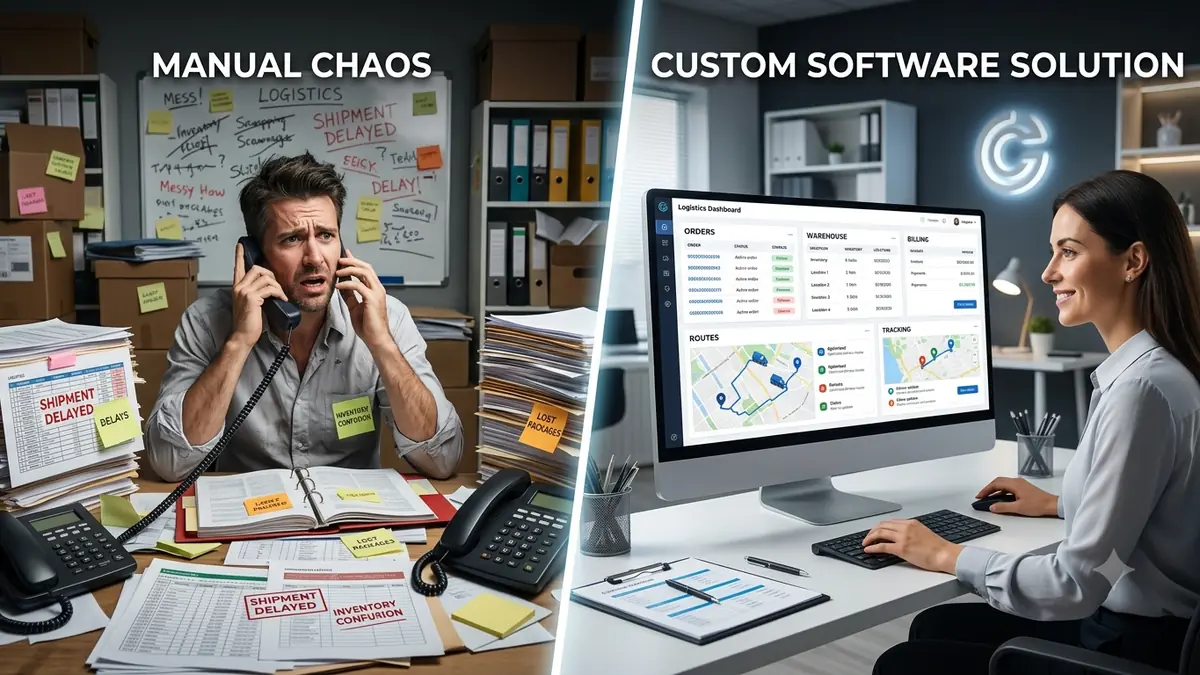
Logistics businesses rarely fail because one big system breaks overnight. They usually struggle because small operational gaps keep stacking up. That may include one Excel sheet for dispatch, another file for billing, a separate tool for warehouse updates, WhatsApp messages for customer follow-ups, and manual reports that nobody fully trusts. At the beginning, this setup feels manageable. A small team can remember exceptions, fix mistakes manually, and chase missing updates. But as orders increase, customers demand faster updates, and warehouses become busier, the same manual process starts costing real money. This is where custom software for logistics becomes a serious business discussion, not just a technology upgrade. The point is not to build software because custom sounds impressive. Instead, the goal is to remove operational friction that standard tools, spreadsheets, or disconnected systems can no longer handle.
For 3PL companies, freight operators, warehouse-led logistics businesses, and distribution teams, the real question is simple. Has your operation become too specific, too fragmented, or too manual for standard software to support properly?
When Do You Need Custom Software for Logistics?
Our logistics business may need custom software for logistics when daily operations depend heavily on spreadsheets, manual updates, disconnected systems, delayed reporting, poor shipment visibility, repeated warehouse errors, and workflows that ready-made tools cannot support.
A custom system makes sense when your business needs better control over order workflows, dispatch updates, billing, customer portals, integrations, and reporting. But it is not always the first answer. Software results depend on workflow maturity, data quality, implementation effort, team adoption, integrations, and business size.
Why Logistics Businesses Outgrow Standard Software and Need Custom Software for Logistics
Most logistics companies start with practical tools: Excel, accounting software, shared drives, email, messaging apps, and maybe basic logistics software development support through a basic logistics or operational systems. That is normal. Early-stage operations need speed, not complexity.
The problem starts when the business grows but the process does not mature.
A warehouse team may update stock manually. Dispatch may rely on phone calls. Finance may wait for POD documents before invoicing.
Customer service may ask operations for shipment updates because there is no live customer portal. Management may only see performance numbers after someone spends hours preparing reports.
This creates a hidden operating cost. It may not appear as one line item, but it shows up through delayed billing, wrong dispatch decisions, missed customer updates, duplicated data entry, and employee burnout.
The World Bank Logistics Performance Index measures logistics performance using factors such as tracking and tracing, timeliness, infrastructure, and logistics service quality. That matters because these are the same areas where weak internal systems usually hurt logistics businesses first.
9 Signs Your Logistics Business Needs Custom Software for Logistics
1. Spreadsheet Dependency Is a Sign You Need Custom Software for Logistics
Excel is useful. It is not the enemy. The problem is using Excel as the main operating system for dispatch, inventory, order status, billing, driver updates, and customer reporting.
When one person owns the “latest file,” the business becomes fragile. If the file is not updated, every downstream team works with stale data. If someone changes a formula, reports become unreliable. If multiple teams maintain separate files, nobody knows which version is correct.
This is one of the clearest signs that your logistics process has matured beyond basic tools. If this sounds familiar, your team may already be facing the same issues covered in MechSoft’s article on outgrown Excel sheets.
A custom system can replace scattered sheets with one shared workflow for order intake, operational updates, dispatch status, delivery updates, billing, and reporting.
2. Disconnected Teams May Need Custom Software for Logistics
Logistics depends on coordination. If operations, dispatch, billing, and customer support are working from different information, mistakes are guaranteed.
Here is a common example. The operations team updates an order status, but dispatch does not see the update immediately. The driver leaves late. Customer support tells the client the shipment is still being processed. Finance waits for proof of delivery. Management sees the issue only after the customer complains.
This is not a people problem. It is a system design problem.
A logistics business needs one operational source of truth. That does not always mean replacing every tool. Sometimes it means building a custom control layer that connects your existing systems and gives each department the data it needs.
3. Your Workflow Needs Custom Software for Logistics
Ready-made software is built for common processes. Your business may not work that way.
A 3PL company may have client-specific billing rules. A logistics team may handle different service rules for different customers. A distribution business may need dispatch coordination based on delivery windows, customer priority, and local constraints. A freight operator may need special document handling for certain shipment types.
When your team keeps saying, “The system does not allow that,” they usually create workarounds. Workarounds become side sheets, manual notes, duplicate entries, and exception tracking outside the system.
That is when custom software for logistics becomes practical. It can be designed around real logistics rules instead of forcing teams to bend operations around generic software.
4. Poor Shipment Visibility Signals a Need for Logistics Software Solutions
Customers do not want to keep calling for shipment updates. Internal teams do not want to chase internal teams or dispatch teams for every status change.
Poor visibility causes two types of damage. First, it increases support workload. Second, it reduces customer trust. Even when the shipment is moving correctly, lack of visibility makes the operation look unreliable.
A better system can provide real-time or near-real-time updates across order status, dispatch updates, shipment movement, proof of delivery, and billing readiness.
For businesses that need traceability across supply chain events, the GS1 EPCIS standard is a useful reference point because it focuses on capturing and sharing supply chain event data. Your business may not need full enterprise traceability from day one, but the principle is important: logistics teams need structured event data, not scattered manual updates.
5. Operational Errors Show Why Custom Software for Logistics Matters
Operational mistakes are not just warehouse problems. They affect dispatch, billing, customer service, returns, and client relationships.
Common issues include missed status updates, incorrect order details, delayed dispatch updates, poor exception visibility, and manual corrections. These problems become worse when teams depend on paper, spreadsheets, or disconnected tools.
This is where warehouse management features matter. Useful features may include status tracking, document capture, exception handling, approval workflows, customer-wise rules, billing triggers, and reporting dashboards.
The goal is not to add features for the sake of it. The goal is to reduce operational ambiguity. A team member should know what needs action, who owns it, how to confirm it, and what happens next.
6. Reporting Takes Too Long
If management reporting depends on someone manually combining data from Excel, accounting software, operational logs, dispatch records, and customer emails, your business is already losing decision speed.
Delayed reporting creates delayed decisions. You cannot fix margin leakage, operational delays, missed SLAs, or billing gaps quickly if the data arrives too late.
A custom logistics system can show role-specific dashboards: open orders, pending dispatches, delayed shipments, pending operational items, billing pending, client-wise workload, driver performance, and exception trends.
This is also where good logistics software solutions become more than operational tools. They help leaders understand where the business is leaking time, money, and capacity.
7. Changing Customer Requirements Need Flexible Logistics Software
Many logistics companies grow by serving different types of clients. That is good for revenue, but difficult for systems.
One client may want daily reports. One client may need API updates. Another may require custom invoice formats, account-level visibility, or strict SLA rules.
If every client requirement turns into manual work, your team will struggle as the customer base grows.
Custom software can support configurable workflows, client-wise rules, custom reports, role-based portals, and integrations. This is especially useful for 3PL businesses where customer requirements can vary widely across industries.
8. Integrations Are Breaking or Missing
A logistics business rarely uses only one system. There may be accounting software, ERP, customer portals, carrier platforms, billing systems, tracking tools, payment systems, and reporting tools.
If these systems do not talk to each other, your team becomes the integration layer. They copy data, upload files, reconcile records, and manually fix mismatches.
This is slow and risky.
Custom software can connect important systems through APIs, scheduled data syncs, validation rules, and exception alerts. It can also prevent bad data from moving forward. For example, an order should not move to billing if delivery confirmation or required documents are missing.
Security also matters here. Logistics software often handles customer data, commercial records, shipment details, employee access, and financial information. The NIST Cybersecurity Framework is a useful reference for thinking about access control, risk management, and system security discipline.
9. Manual Work at Scale Is a Sign You Need Custom Software for Logistics
Growth should improve operating leverage. If every new customer, location, or shipment volume increase requires more admin staff, your process is not scaling.
This is one of the strongest signs that your business needs custom software development.
The issue is not headcount alone. More people inside a broken process often create more handoffs, more communication gaps, and more chances for errors. Software should help the same team handle higher volume with better control.
For 3PL operators, this is where third party logistics software becomes important. A proper system can support customer-wise workflows, dispatch updates, billing rules, document handling, and performance reporting in one connected operating model.
Custom Logistics Software vs Ready-Made Logistics Tools
Not every logistics business needs custom software. Some companies are better served by improving their current process or adopting a ready-made platform.
| Situation | Ready-made software may work | Custom software may be better |
| Basic order and status tracking | Yes | Not necessary at first |
| Standard operational process | Yes | Only if client rules are complex |
| Heavy Excel dependency across departments | Limited | Strong fit |
| Client-specific billing and reports | Often weak | Strong fit |
| Multiple disconnected systems | Sometimes | Strong fit |
| Unique dispatch or service rules | Often limited | Strong fit |
| Need for custom customer portal | Limited | Strong fit |
| Strict integration requirements | Depends on vendor | Strong fit |
The mistake is assuming custom software is always better. It is not. Custom development costs more, takes more planning, and requires team adoption. But when operations are complex and standard tools keep creating workarounds, custom software can become the more practical long-term choice.
What Custom Software for Logistics Usually Connects
A useful custom logistics system does not need to start as a massive platform. In many cases, the best approach is to build around the highest-friction workflow first.
A typical workflow may look like this:
Order request enters the system. The operations team validates customer service, documentation, and billing requirements. Teams update order status and dispatch progress. Delivery or shipment status updates move through the system. The system captures proof of delivery. Billing receives the right documents and charges. Management sees performance reports without waiting for manual consolidation.
This process can include key features of 3pl services software such as order management, customer-wise rules, dispatch updates, document handling, billing triggers, customer portals, and reporting dashboards.
The best systems reduce handoffs. They do not just digitize bad processes.
Risks Before Investing in Custom Software for Logistics
Custom software is not magic. If your workflow is unclear, software will expose the confusion. If your data is messy, reports will still be unreliable. If your team avoids adoption, the system will become another unused tool.
Before investing, be honest about these questions:
- Do we understand our current workflow clearly?
- Which process causes the most delay or cost?
- Which teams will use the system daily?
- Which data must be accurate from day one?
- Which integrations are essential?
- Who will own implementation internally?
- How will we train users and measure adoption?
The most successful logistics software projects usually start with one painful workflow, not every possible feature. Trying to build everything at once increases cost, complexity, and delay.
How to Start Custom Software for Logistics the Right Way
Start with operational pain, not feature wish lists.
If Excel is the biggest risk, build order and workflow visibility first. If operational errors are costing money, prioritize status tracking, exception handling, and document control. If billing delays hurt cash flow, build document capture and billing triggers. If customers keep asking for updates, build a customer portal or automated status visibility.
For many logistics companies, the first version should focus on control: orders, status, documents, exceptions, and reporting. Advanced automation can come later once the core process is stable.
How MechSoft Supports Custom Software for Logistics
For a logistics business, the right software partner should not only ask what features you want. They should ask how orders move, where errors happen, how teams communicate, what customers expect, where billing gets delayed, and which reports management actually uses.
That is the practical value of custom software for logistics. It gives the business a system that reflects real operations instead of forcing operations into a generic structure.
MechSoft’s role is best positioned around workflow-first software for logistics and 3PL operations: order management, customer visibility, billing support, reporting, and system integration.
The right starting point is not “build a big platform.” The right starting point is identifying the operational bottleneck that creates the most repeatable damage.
Conclusion
Your logistics business needs custom software for logistics when manual work, disconnected tools, delayed visibility, operational mistakes, reporting gaps, and client-specific requirements start limiting growth.
The signs are usually visible before the business admits the problem. Teams spend more time updating files than managing operations. Customers ask for information your team should already have. Billing waits for documents. Managers wait for reports. New customers create more admin pressure instead of better margins.
Custom software is not the answer for every logistics company. But when your operation has outgrown standard tools, a well-planned custom system can give your business better control, cleaner workflows, and more reliable decision-making.
The smart move is to start small, solve the highest-impact workflow first, and build from real operational needs.
FAQ / People Also Ask Section
Q. What is custom software for logistics?
A. Custom software for logistics means building software around a logistics company’s specific workflows, such as order management, dispatch updates, shipment status, billing, customer portals, document handling, and reporting.
Q. When does a logistics business need custom software?
A. A logistics business may need custom software when spreadsheets, manual updates, disconnected tools, poor visibility, operational errors, and client-specific requirements start slowing operations or increasing costs.
Q. Is custom software better than ready-made logistics software?
A. Not always. Ready-made software works well for standard workflows. Custom software is better when your logistics process has unique rules, complex integrations, customer-specific requirements, or repeated manual workarounds.
Q. What are the most important features in 3PL logistics software?
A. Important key features of 3pl services software include order management, order visibility, dispatch updates, customer portals, document handling, billing rules, reporting, and integrations.
Q. Can custom software replace Excel in logistics operations?
A. Yes, but only if the workflow is mapped correctly. Custom software can replace Excel-based order tracking, status updates, dispatch updates, billing status, and reporting with a shared system.
Struggling with spreadsheets, disconnected systems, or growing 3PL complexity? Review your current workflow first. Then explore whether MechSoft’s 3PL logistics software can help you bring order workflows, customer visibility, billing processes, and reporting into one practical system.
A logistics software implementation specialist reviewed this article for accuracy across 3PL workflows, order management, billing processes, client reporting, and operational visibility systems.


