
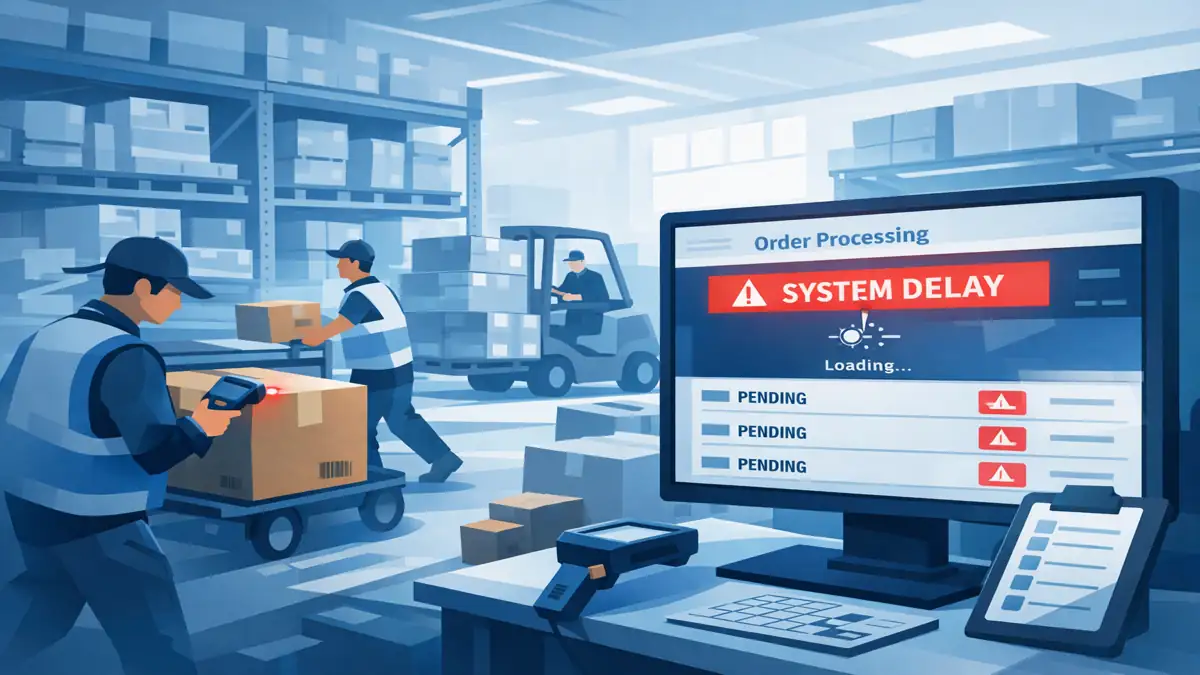
Supply chains today are moving faster than ever. As orders come in every second and the expectation from customers is for near-instant fulfilment, to handle multiple orders logistics companies need to coordinate thousands of SKUs between multiple customers and warehouses. This has made managing orders one of the largest operational challenges for logistics companies, significantly intensifying overall order management challenges across 3PL operations.
For third-party logistics (or 3PLs), however, it’s not just managing orders; the challenge is accurately separating, batching, and routing these thousands of orders through complex warehouse operations, without delays and with as few errors as possible.
When order volumes increase, even small inefficiencies in segregation or picking can create large ripples throughout the entire supply chain.
In this blog post, we will look at the order segregation challenges third-party logistics providers face when handling high-volume orders and the associated risks, as well as how a modern order management solution can help third-party logistics service providers streamline their order processing and picking operations.
The Growing Complexity of Order Management in 3PL
The explosive growth of e-commerce has fundamentally altered how warehouses function. Increasingly, orders are smaller, more frequent, and frequently customized.
In a modern-day third-party logistics (3PL) facility, orders for a multitude of clients are often processed simultaneously, each with their own product types, service agreements, shipping priorities, and inventory location.
As a result of this new level of order complexity, significant challenges exist for 3PLs to effectively manage the flow of their incoming and outgoing inventory/cases through the warehouse before items are picked and packed.
This statistic is important because poor order segregation will directly impact the efficiency of the picking process. If orders are not segregated appropriately before they are picked, then picking will be slower, less accurate, and significantly more costly.
Why Order Segregation Matters in 3PL Warehouse Operations
Order segregation is the process of organizing incoming orders based on criteria such as:
- Client
- SKU type
- Order priority
- Delivery location
- Warehouse zone
- Batch size
In high-volume 3PL warehouse operations, thousands of orders may arrive simultaneously from different clients and channels. Without intelligent segregation, warehouses face multiple operational bottlenecks:
- Pickers travel longer distances
- Orders get mixed between clients
- Packing errors increase
- Shipping delays multiply
In other words, poor order segregation amplifies order management challenges across the entire logistics workflow.
Major Order Management Challenges in High-Volume 3PL Operations
Let’s examine the biggest issues logistics providers face.
1. Complexity of Multi-Client Orders
Third-party logistics companies (3PLs) store and fulfill orders for multiple vendors unlike their single-brand counterparts. Each vendor has its own specific needs:
- Packaging,
- Service level agreement (SLA) for shipping,
- Labelling,
- Shipping carrier.
Sorting through thousands of orders arriving at the same time presents a significant challenge for 3PLs to manage customer orders correctly. Manual systems often fall short because they do not have the ability to re-classify based on changing variables and cannot dynamically maintain real-time classifications within spreadsheets. This is where many of the challenges in order management begin.
SKU Growth and Product Variability
E-commerce has significantly increased the quantity of products available to consumers. Warehouses have expanded their product offering from several hundred SKUs to tens of thousands of SKUs across many different categories. Each SKU has unique characteristics:
- Storage location,
- Picking method,
- Packaging requirements,
- Hazard handling instructions.
All of these elements create an extremely complex order fulfilment process that requires automated systems to achieve success. When filling an order that contains multiple SKUs located in diverse zones of a warehouse, the ability to properly segregate them prior to picking becomes critically important.
3. Inefficient Warehouse Picking Process
If order segregation fails, the warehouse picking process suffers immediately.
Pickers may:
- Walk longer routes
- Visit the same aisle multiple times
- Pick incorrect SKUs
- Delay batch processing
Studies show that order picking can represent up to half of total order processing time in warehouses, highlighting how critical this stage is for efficiency.
Even small improvements in segregation and picking strategy can significantly reduce operational costs.
4. Real-Time Order Volumes
Modern warehouses no longer deal with predictable order flows.
Orders arrive continuously from multiple channels:
- E-commerce platforms
- Marketplaces
- Retail stores
- B2B clients
- ERP systems
This dynamic environment creates real-time order management challenges, where warehouses must constantly reprioritize orders.
Traditional systems designed around static order batches struggle in this environment.
5. Warehouse Capacity Limitations
Warehousing infrastructure will undergo significant stress globally. According to industry estimates, many warehouses are operating near their maximum operational capacity. Some warehousing operations have reported totals exceeding 50-90% utilization. Increased levels of utilization make order segregation increasingly critical because slow processes create bottlenecks at the picking zones and packing stations. When order separation fails due to high load conditions, all of the materials in the warehouse operate at a slower rate.
How Technology Addresses Order Management Problems Manual Processes Are Unsustainable –
The size and complexity of the logistics industry have made it impossible to maintain a manual process. A reliable order management solution will enable logistics providers to automatically manage high-volume segregated orders. Rather than manually grouping orders together. Today’s systems analyze the incoming data from each order and optimize workflow in real time.
Intelligent Order Classification
Modern 3PL order management systems enable the automatic classification of orders based on:
- SKU location
- Priority status of the order
- Service level agreements of customers
- Warehousing zones
- Shipping carriers.
All of these characteristics allow warehouses to produce appropriately sized picking batches automatically. Automated Composite Batch Creation, Automated Order Management Solutions will allow you to compose picking batches on-the-fly. For example, when orders contain items located within the same warehouse zone, these would be grouped into the same picking batch. This would lower the amount of time that the pickers must travel when they are performing each picking operation and thus allows for increased efficiency in the picking operation. Several optimization algorithms have shown significant improvement in overall picking times when using intelligent composite batch strategies.
Real-Time Warehouse Visibility
Modern 3PL order management platforms provide real-time visibility across warehouse operations.
Managers can instantly monitor:
- Order status
- Picking queues
- Inventory levels
- Dispatch schedules
This visibility allows operations teams to resolve order management challenges before they impact fulfillment.
Integration with Warehouse Management Systems
An effective order management solution integrates seamlessly with:
- Warehouse Management Systems (WMS)
- Transportation Management Systems (TMS)
- ERP platforms
- E-commerce marketplaces
This integration ensures that 3PL order processing flows smoothly from order creation to dispatch.
The Role of Barcode Scanning and QA in 3PL Operations
For tackling order management challenges in high-volume operations, execution-level controls such as barcode scanning and QA processes are the key, and that’s where iLogistech comes in.
Barcode-Driven Accuracy and Speed
iLogistech facilitates barcode scanning in the entire order management cycle, including the stages of receiving, outbound, and final delivery of the products. From the QA process and barcode scanning of the received products to the validation carried out through barcode scanning by local delivery agents, the entire order management process in 3PL operations can be streamlined.
It also facilitates the outbound palletization, trucking, and eliminates the complexity of dealing with long-haul carriers and local delivery agents.
Built-in QA to Prevent Operational Leakages
iLogistech facilitates QA processes in the entire order management cycle, including the stages of receiving, outbound, and delivery, ensuring that operational leakages are addressed.
It helps in:
- Dealing with discrepancies with clients in an efficient way
- Ensuring fewer errors in the outbound process
- Improving control over operational leakages
By integrating barcode scanning with the QA process, iLogistech helps in strengthening the order management process in 3PL operations, ensuring faster, accurate, and scalable order management in the warehouse operations.
Benefits of Using a 3PL for Order Fulfillment
For businesses outsourcing logistics, working with a technology-enabled 3PL offers several advantages.
These benefits of using a 3PL for order fulfilment go beyond basic warehousing.
1. Faster Order Processing
Automated systems optimize order segregation and batch picking, reducing fulfillment times.
2. Higher Order Accuracy
Automation reduces human errors in SKU selection, labeling, and packing.
3. Scalable Operations
A digital order management solution allows warehouses to handle peak demand without operational chaos.
4. Lower Operational Costs
Efficient segregation reduces labor requirements and travel time in the warehouse.
5. Better Customer Experience
Accurate and timely deliveries improve customer satisfaction and retention.
The Future of Order Management in 3PL Logistics
The logistics industry is rapidly moving toward data-driven warehouse operations.
Emerging technologies such as:
- AI-driven picking optimization
- Autonomous warehouse robots
- Predictive demand forecasting
- Intelligent routing algorithms
are transforming how 3PL warehouse operations handle order segregation and fulfillment.
Research into AI-based warehouse routing shows that dynamic optimization models can significantly improve order completion rates and throughput times in high-volume environments.
As order volumes continue to grow, the importance of solving order management challenges will only increase.
Final Thoughts
In high-volume logistics, the reality is clear: order segregation is essential for the proper functioning of warehouses. When orders are unorganized, all aspects suffer; the pick of an order slows down, more errors are made in picking, shipments are delayed, and operational costs will rise.
As order volumes increase and the supply chain becomes more complicated, manual processes can no longer keep up with the order volume. 3PL Suppliers will need to utilize more technology that can automate the processing of orders, optimize warehouse picking, and provide real-time visibility into operations.
3PL Platforms, such as Mechsoft’s iLogistech, illustrate how integrated systems streamline the entire workflow of the 3PL industry, from intake of orders, successful completion of picking, successful tracking of orders, all the way to financial management. 3PL’s utilizing these systems will reduce the amount of manual effort within their operation and improve the overall communication of the different operations being performed, which will help to grow their operation in a sustainable manner and help to grow efficiently.
Today, with the increasing competition in the supply chain, more efficient methods of managing orders are no longer a choice, but a necessity to have an effective operation and continue to experience sustainable growth.


