
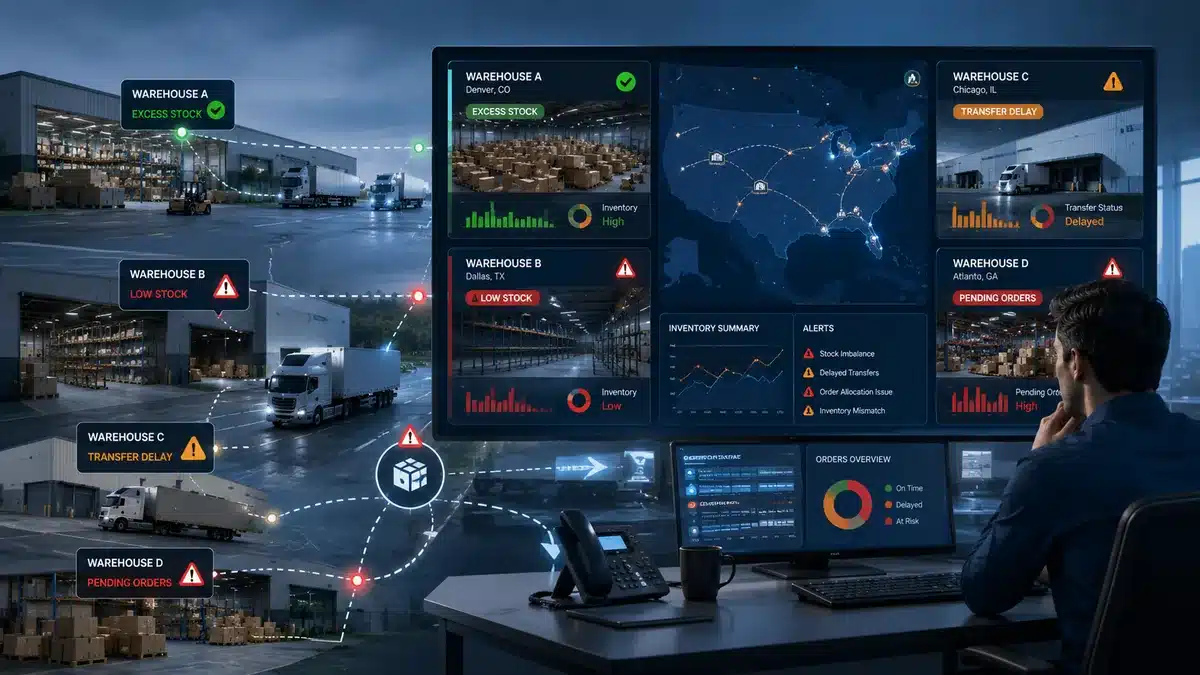
Multi warehouse inventory management helps businesses coordinate stock across multiple warehouses, serve regional demand, and keep inventory closer to customers. However, operating several warehouse locations also creates more stock movements, location-specific decisions, and opportunities for information to fall out of sync.
The main challenge is not the number of goods being managed. It is knowing exactly what each warehouse has available, what has already been committed to orders, what is being transferred, and what can actually be promised to customers.
Without consistent data and processes, one warehouse may end up with excess stock while another runs short. Orders may be shipped from the wrong location, transfers can remain unresolved, and customer-service teams may rely on outdated inventory information.
Quick Answer: Why Is Multi Warehouse Inventory Management Difficult?
Multi warehouse management becomes difficult because every inventory decision must account for location, demand, capacity, order priority, transfer time and stock status.
The most common challenges include:
- Incomplete inventory visibility
- Different processes across warehouses
- Inaccurate stock records
- Poor order-routing decisions
- Delayed inter-warehouse transfers
- Location-specific demand fluctuations
- Inconsistent product data
- Disconnected operational systems
- Difficult returns processing
- Weak performance and cost comparisons
Adding another dashboard alone will not solve these problems. Businesses need consistent warehouse processes, reliable transaction data and clear rules for allocating, transferring and adjusting inventory.
What Is Multi Warehouse Inventory Management?
Multi warehouse inventory management is the coordination of inventory across two or more warehouses, distribution centres, fulfilment sites or storage locations.
It covers more than knowing how many units exist. It includes determining where stock is located, whether it is available for fulfilment, which location should process an order, when replenishment is required, and how transfers between facilities are recorded.
It is also important to distinguish inventory management from warehouse inventory control. ASCM’s <a href=”https://www.ascm.org/topics/inventory-management”>explanation of inventory management and inventory control notes that inventory control focuses on product movement within a particular warehouse, while inventory management tracks inventory across the wider organization and its multiple facilities.
A warehouse may operate efficiently on its own, but the overall warehouse network can still struggle.
Major Multi Warehouse Inventory Management Challenges Across Multiple Locations
1. Inventory Visibility Is Often Incomplete
A central inventory report may show total stock across all warehouses, but that does not mean every unit is available for sale or fulfilment.
Inventory may be:
- Reserved for an existing order
- Awaiting receiving confirmation
- Under quality inspection
- Damaged or blocked
- Inventory teams have assigned it to an inter-warehouse transfer.
- In transit between facilities
- Returned products have not yet been inspected.
If these statuses are combined into one quantity, teams may promise stock that cannot actually be shipped. Reliable multi-location inventory management therefore requires visibility by both location and inventory status.
2. Stock Accuracy Varies Between Warehouses
One warehouse may scan every receipt and movement, while another records adjustments at the end of the shift. One facility may conduct regular cycle counts, while another waits for an annual physical count.
These differences create inventory records that appear consistent centrally but have different levels of reliability.
For example, a system may show 500 units in Warehouse B. Physically, 40 may be damaged, 25 may be in an unidentified staging area, and another 30 may already have been picked without a completed transaction. The system quantity is technically visible, but operationally misleading.
3. Processes Differ Between Warehouse Locations
As warehouse networks grow, local teams often develop their own methods for receiving, putaway, picking, counting and inventory adjustments.
Some local flexibility is necessary. Dock schedules, staffing patterns and storage layouts naturally differ. However, core transaction rules should not change from one site to another.
ASCM’s guide to warehouse management connects accurate tracking and coordinated communication with better inventory accuracy and wider supply-chain performance.
Businesses should standardize:
- Inventory status definitions
- Receiving and dispatch confirmation
- Adjustment reasons
- Transfer documentation
- Cycle-counting procedures
- Damage and return handling
- Escalation responsibilities
Otherwise, consolidated reports compare locations that are recording work differently.
4. Product and Location Data Become Inconsistent
A warehouse network depends on common master data. Yet SKU descriptions, units of measure, packaging configurations, bin codes and customer identifiers frequently differ between systems or facilities.
A carton may be treated as 12 units at one warehouse and as a single unit at another. A product may also appear under multiple SKU codes after data is imported from customers, suppliers or legacy systems.
The GS1 Global Traceability Standard emphasizes unique identification of products, logistics units, locations and parties, supported by consistent data capture and sharing.
Standard identifiers will not fix operational issues on their own, but they make scanning, traceability, and system integration much more reliable.
5. Orders Are Routed From the Wrong Warehouse
The nearest warehouse is not always the best warehouse for an order.
Instead, routing decisions may need to consider:
- Actual available stock
- Delivery commitment
- Transport cost
- Warehouse workload
- Order consolidation
- Customer-specific rules
- Product handling requirements
- Cut-off times
Routing solely by distance can create split shipments or send work to an overloaded facility. Routing solely by available stock can drain a regional warehouse and cause shortages for later orders.
In high-volume logistics operations, routing decisions should consider service priorities and operational constraints instead of relying on a single fixed rule. Related order allocation and segregation issues are discussed in Mechsoft’s guide to order management challenges in 3PL operations.
6. Inter-Warehouse Transfer Challenges in Multi Warehouse Inventory Management
Transfers are among the most common failure points in logistics warehouse management.
A proper transfer should move through a controlled sequence:
- Transfer request and approval
- Picking at the source warehouse
- Dispatch confirmation
- In-transit inventory status
- Receipt at the destination
- Quantity and condition verification
- Discrepancy resolution
- Final inventory update
Problems appear when The source location removes stock before dispatch, the receiving location delays confirmation, or teams fail to reconcile damaged quantities.
As a result, inventory may physically exist in the warehouse but cannot be trusted in the system.
7. Demand Must Be Forecast by Location
Total demand across a business is not enough for warehouse-level replenishment.
Regional buying patterns, seasonal changes, customer concentration, lead times and delivery commitments can differ significantly by location. Applying the same reorder point everywhere can leave one warehouse overstocked and another repeatedly dependent on emergency transfers.
Effective multi-location inventory management should treat every warehouse as part of one connected network. A replenishment decision at one site can affect transport cost, service levels and stock availability elsewhere.
8. Systems Do Not Share the Same Operational Picture
Inventory information may pass through ecommerce platforms, customer systems, order-management tools, warehouse systems, accounting software and transport platforms.
When updates are delayed or mapped incorrectly, different teams work from different versions of the same order.
This problem becomes more serious when a business continues adding spreadsheets and manual uploads between systems. Mechsoft’s article on signs that a 3PL management process has outgrown Excel sheets explains how spreadsheet-based processes become harder to control as transaction volumes and operational dependencies increase.
Connecting systems certainly helps, but it does not automatically improve data quality. Transaction ownership, update timing and error-handling rules must also be defined.
9. Returns Create Additional Inventory Uncertainty
A returned product is not immediately available inventory.
Teams must decide where the return should be sent, who will inspect it, whether it can be restocked and how the related customer or client transaction should be handled.
In a multi-warehouse network, returns may arrive at a location that did not fulfil the original order. Without clear rules, returned goods may remain in temporary areas without a valid inventory status.
10. Warehouse Performance Becomes Harder to Compare
A warehouse with a high order volume may appear more expensive even when it is operating efficiently. Another facility may report a low cost per order because transfers, returns or client-specific work are recorded elsewhere.
A useful comparison should consider consistent measures such as:
| Area | Useful measure |
| Inventory | Accuracy, ageing and adjustment rate |
| Fulfilment | Fill rate, split shipments and on-time dispatch |
| Transfers | Cycle time and discrepancy rate |
| Operations | Dock-to-stock time and order cycle time |
| Cost | Cost per order, transfer and storage unit |
| Service | SLA compliance and exception frequency |
Every warehouse should measure performance using the same definitions. Otherwise, comparing results becomes difficult.
How to Improve Multi Warehouse Inventory Management
Businesses should start by fixing process and data discipline before investing in more automation.
For example, focus on five priorities:
- Define inventory statuses consistently across all locations.
- Standardize receiving, transfers, adjustments and returns.
- Clean product, customer and location master data.
- Establish clear order-routing and replenishment rules.
- Track exceptions instead of relying only on summary dashboards.
However, Technology can support these processes, but the outcome still depends on good data, practical workflows, successful implementation, and how well teams use the system. A poorly defined process does not become reliable simply because it is digitized.
Frequently Asked Questions
Q. What is the biggest challenge in multi warehouse inventory management?
A. The biggest challenge is maintaining an accurate inventory view across every warehouse. Businesses need to know not only where stock is located, but also whether it is available, reserved, damaged, under inspection or moving between warehouses.
Q. How does multi warehouse management reduce delivery time?
A. It can place inventory closer to regional customers. However, faster delivery depends on correct stock placement and order routing. Adding locations without accurate inventory data can create more transfers and split shipments instead of faster fulfilment.
Q. What is the difference between multi-warehouse and multi-location inventory management?
A. Multi-warehouse management specifically concerns warehouse or distribution facilities. Multi-location inventory management is broader and may include stores, fulfilment centres, production facilities, third-party storage sites and warehouses.
Q. Can spreadsheets manage inventory across several warehouses?
A. Spreadsheets may work for low-volume and simple operations. They become risky when multiple users, frequent transfers, reservations, returns and system integrations are involved because updates are difficult to synchronize and audit.
Q. Does software solve all warehouse management challenges?
A. No. Software can improve visibility, transaction control and reporting, but it cannot compensate for inconsistent master data, unclear responsibilities, weak operating procedures or poor user adoption.
Conclusion
Adding warehouses can improve market reach and fulfilment capacity, but it also increases the number of decisions that must remain coordinated.
Strong multi warehouse inventory management involves more than bringing inventory data into a single report. Businesses need reliable inventory statuses, standardized processes, controlled transfers, location-level demand planning and consistent performance measures.
The goal is to keep every warehouse working with the same accurate information so inventory movements, order decisions, and exceptions remain clear and reliable.


