
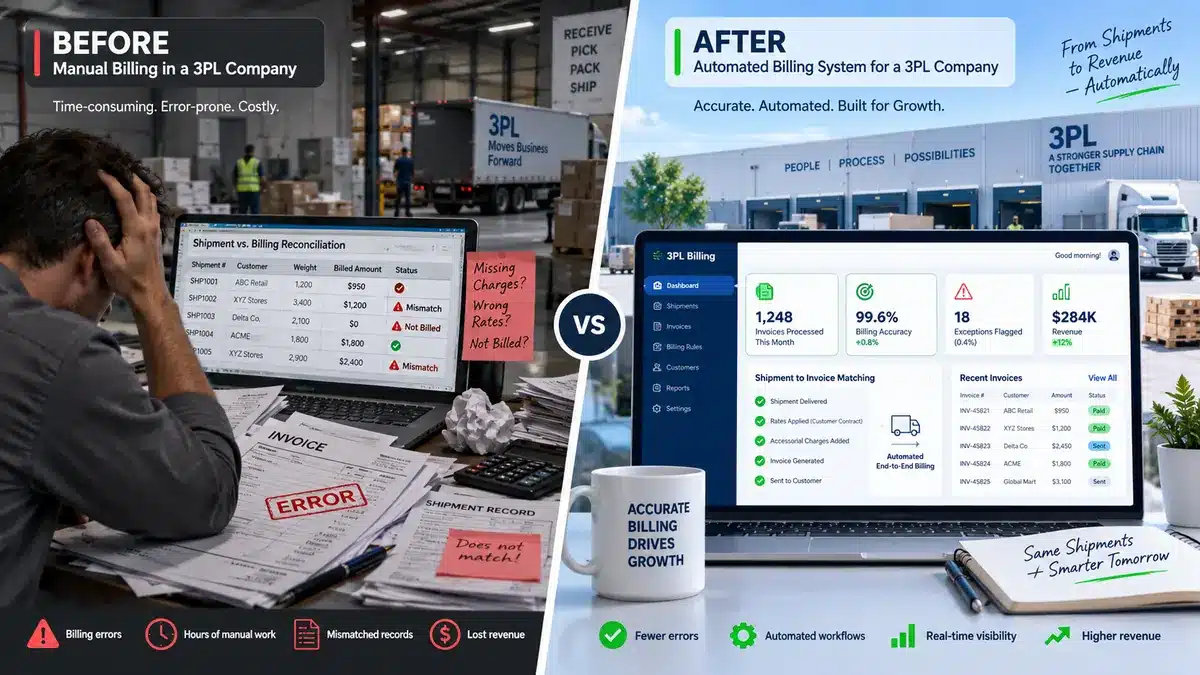
An automated billing system depends on the information captured before a 3PL ever creates the invoice.
An incorrect order entry, missing document, unrecorded delivery event or disconnected operational system can create problems much earlier. Finance often discovers them only when it is time to bill the customer.
A decades-old American logistics company faced this problem as its business grew. Its operations covered warehousing, long-haul transportation, local delivery and returns, but many processes still depended on manual work and disconnected systems.
Mechsoft worked with the company to build a custom 3PL platform that brought operational, documentation and financial processes together. The solution included automated invoice generation, contract-based customer billing, AR/AP management and carrier-billing integration as part of the broader 3PL system.
The published case study reports fewer redundant tasks and errors, more timely invoicing and better cash flow. However, it does not provide a separate percentage for billing-error reduction, so this article does not claim one.
Quick answer: What changed after implementing an automated billing system?
The company did not solve the problem by simply replacing an invoice screen.
The system reduced manual order entry and generated logistics documents such as BOLs and invoices. It also allowed customer billing to follow contract terms while bringing accounts receivable and payable processes into the same operational environment.
This gave the billing team more direct access to information already captured during logistics operations, reducing the need to re-enter data or work from disconnected records.
The changes affected more than finance. Mechsoft’s published case study reports a 200%+ increase in order-handling capacity and a 30% improvement in profit margins and cash flow, along with fewer errors and more timely invoicing.
Why the automated billing system had to address a larger 3PL billing problem
Before implementation, the logistics company relied on disjointed systems and substantial manual data entry. As volumes increased, those processes became harder to scale.
The case study also records limited visibility across finances, operations and order fulfilment, along with frequent document errors and shipment delays.
That distinction matters.
A 3PL can improve the invoice-generation step and still have billing problems if the information reaching finance is incomplete or inaccurate.
For example, a shipment may be physically complete even though some of the information needed for billing is still missing. A missing BOL, incorrect order entry or incomplete return or reconsignment details can leave finance without everything it needs to prepare the invoice correctly.
This is why effective billing automation has to consider the information feeding the billing process, not just the final invoice.
Why an automated billing system depends on accurate operational data
The development work began with the operation itself.
According to the case study, Mechsoft interviewed stakeholders, observed operations and mapped business processes before designing the system. This helped the team understand areas such as carrier selection, returns and reconsignments, and truck loading and scheduling.
That groundwork matters for billing because every charge has to come from an operational event or an agreed commercial rule.
The implemented platform connected several of these events:
|
Workflow area |
Existing problem |
What automation changed |
| Order processing | Heavy manual data entry | Manual order entry was reduced through process automation |
| Logistics documents | Frequent document errors | BOLs, invoices and carrier forms could be generated through the system |
| Customer billing | Fragmented financial processes | Customer billing could follow contract terms |
| AR/AP | Limited financial visibility | Receivables and payables were managed within the platform |
| Carrier billing | Separate external information | Carrier billing could use system integration |
| Operational identification | Manual handling risk | Barcode scanning supported data capture during logistics workflows |
Barcode-based data capture also matters here. GS1 standards explain how barcode or RFID identification can connect physical logistics activity with business systems. Transport and logistics operators use these methods to record the receipt, storage and movement of logistics units.
A barcode does not fix an invoice by itself. What it can do is capture information at the point where the activity happens, so teams have less data to reconstruct manually later.
For more background on how these operational stages connect, see Mechsoft’s guide to how 3PL logistics software works.
How the automated billing system fitted into the wider 3PL workflow
In this case, billing was part of a wider operational process rather than a standalone finance function:
Operational activity → Order and shipment data → Barcode/document capture → Customer or carrier billing rules → AR/AP → Invoice and financial visibility
The platform documented on Mechsoft’s product page supports customer billing according to contract terms, carrier billing through integration, and accounts receivable and payable management. The case-study implementation also included automated invoices and other logistics documents.
This is different from using logistics billing software only to create invoices.
Billing depends on what happened during the order, movement and delivery. When those activities and their records are connected, finance has better information to work with when preparing the invoice.
Why an automated billing system matters beyond the finance team
The 2026 3PL Study on Emerging Technologies in the Supply Chain found that 90% of shippers consider technology capabilities critical when selecting a 3PL. However, only 57% said they were satisfied with their providers’ technology capabilities. The study also notes that digital supply-chain technologies support the movement of goods, information and finances.
This is why billing is not only an accounting issue. A single billing problem can involve operations, documents, client agreements, carrier information and finance at the same time.
If those areas work in separate systems, staff may spend time checking which record is correct, locating missing information or re-entering details.
The American 3PL in this case had exactly that broader problem: fragmented systems were affecting scalability, operational visibility and financial processes.
What results accompanied the automated billing system in this 3PL case?
The results also need some context.
Mechsoft reports:
- a 200%+ increase in order-handling capacity without additional headcount;
- reduced redundant tasks and errors;
- improved cash flow and more timely invoicing;
- improved profit margins;
- better financial visibility; and
- stronger client retention linked to improved transparency.
The case-study header also reports a 30% improvement in profit margins and cash flow.
These results came from the broader 3PL automation program, not from billing automation alone. So it would be inaccurate to credit the full 200% capacity increase or 30% financial improvement solely to the automated billing system.
Billing was one part of a wider change that also covered orders, documents, tracking, delivery workflows, returns and financial processes.
That distinction is important when assessing ROI.
The 2026 State of Logistics Report also points to logistics companies accelerating automation and digital investment as they respond to productivity and labor pressures.
What this automated billing system case suggests for other 3PL companies
One clear lesson from the case is that 3PL billing needs to be mapped as part of the operation, not handled only as a finance task.
Before selecting or building a system, a 3PL should know:
- which activities create billable events;
- which customer-contract rules affect charges;
- where operational information is currently recorded;
- which details employees still enter manually;
- which documents finance needs before invoicing;
- how returns and reconsignments affect billing; and
- how customer and carrier billing information reaches AR/AP.
If those answers are unclear, automating invoice generation may simply speed up the last step of a process that still has problems earlier on.
Where iLogistech fits in this automated billing system case
The case ultimately led to the development of Mechsoft’s iLogistech 3PL logistics platform. It supports workflows described in the case, including order processing, barcode-supported operations, document management, customer billing according to contracts and carrier billing integration. It also supports AR/AP, tracking, returns and reconsignments.
This does not mean the same configuration or results will apply to every logistics company.
Business size, customer contracts, data quality, existing integrations, workflow maturity, implementation effort and user adoption all affect the outcome.
The case shows something practical: a 3PL billing problem may start much earlier in the workflow than the invoice itself.
Readers who want the complete implementation background can review Mechsoft’s American 3PL management software case study.
FAQs about an automated billing system for 3PLs
Q. What is an automated billing system in 3PL logistics?
A. An automated billing system uses operational and contractual information to reduce manual work in preparing customer or carrier billing. Depending on the system, this can include contract-based customer billing, invoice generation, AR/AP processes and integrations with external billing data.
Q. How can an automated billing system reduce manual billing errors?
A. It can reduce repeated manual entry and connect billing more closely with source operational information. However, automation still depends on accurate source data, correctly configured billing rules and appropriate review of exceptions.
Q. Can an automated billing system prevent every 3PL billing error?
A. No. Incorrect contracts, poor source data, missing events, integration problems or incorrect configuration can still create errors. Automation reduces specific manual risks; it does not remove the need for controls and review.
Q. Did the automated billing system reduce billing errors by a measured percentage?
A. No. Mechsoft’s public case study reports reduced redundant tasks and errors, automated invoice generation, improved financial visibility and timely invoicing, but it does not publish a standalone percentage reduction specifically for billing errors.
Conclusion
For this American 3PL, improving billing meant fixing more than invoice preparation.
The company was dealing with disconnected systems, manual data entry, document errors and limited financial visibility. By connecting operational information, logistics documents and financial processes, the new system gave billing a more reliable flow of data to work from.
That is the practical lesson from the case.
An automated billing system works best when the events that eventually become an invoice are captured properly throughout the operation.
For 3PLs dealing with recurring billing errors or delayed invoicing, the first question should not simply be, “Which billing tool should we buy?”
A better question is, “Where does the information needed for an accurate invoice come from, and where is it breaking today?”
If the problem extends across orders, documents, customer contracts, carrier information and AR/AP, a broader billing automation approach may be more appropriate than replacing the invoice screen alone.


