
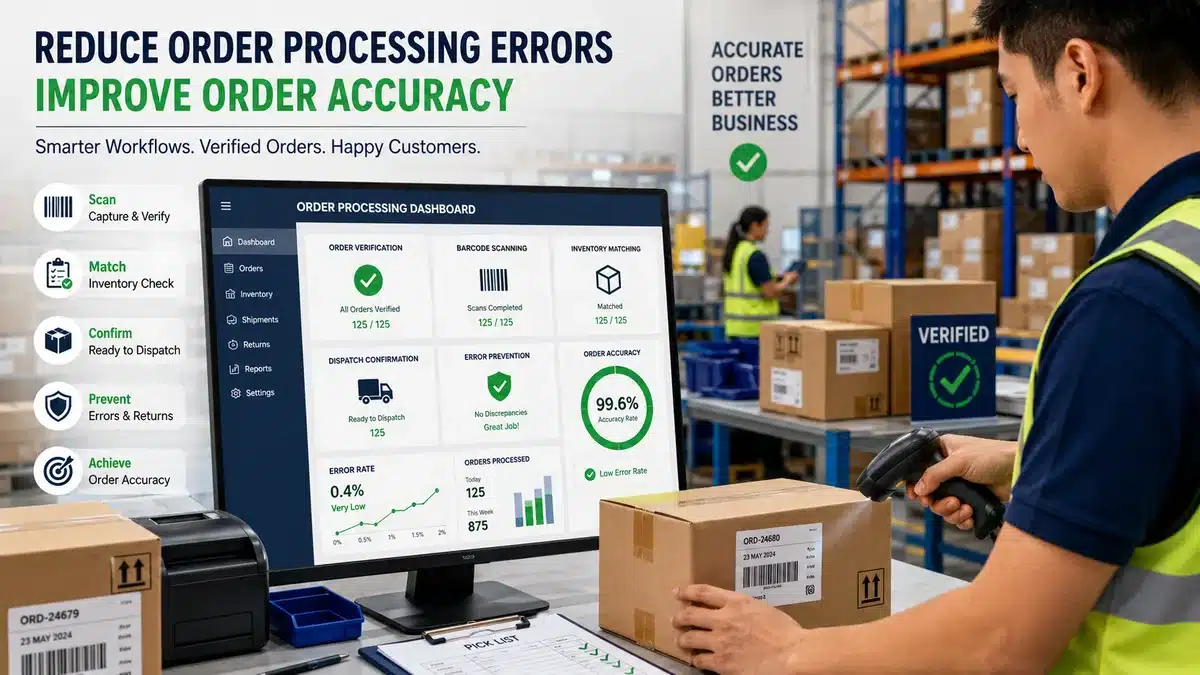
Every logistics company wants to improve order accuracy, but the challenge becomes harder as shipment volumes, customers, warehouses, and documentation grow. A single mistake made while entering an order can trigger picking errors, incorrect invoices, delayed deliveries, customer complaints, and additional operational costs. For many 3PL companies, these problems are not caused by one employee – they are usually the result of disconnected systems, manual data handling, and inconsistent workflows.
The good news is that most order processing mistakes are preventable. By improving data quality, standardizing processes, and introducing order processing automation where it makes business sense, logistics companies can reduce operational errors without disrupting their existing workflows.
Ways to Improve Order Accuracy
To improve order accuracy, logistics companies should focus on eliminating manual data entry wherever practical, validating order information before processing, standardizing operational workflows, using barcode verification, integrating business systems, and continuously monitoring recurring errors. Combining these practices with carefully implemented logistics process automation helps reduce costly mistakes while improving customer satisfaction.
Why It Matters to Improve Order Accuracy in Logistics
Order processing involves much more than creating an order in the system.
A typical logistics order moves through several operational steps:
- Customer order received
- Order verification
- Inventory allocation
- Warehouse picking
- Packing
- Documentation
- Shipment dispatch
- Delivery confirmation
- Billing
An error introduced during any one of these stages often carries forward into every subsequent process.
For example, a customer submits an order with an incorrect product quantity. If nobody verifies it, the warehouse picks the wrong quantity. The shipment then leaves according to the incorrect order, the customer receives the wrong items, and the invoice reflects the same incorrect information. Customer service must eventually resolve the issue.
The original mistake may have taken only a few seconds to make but can require hours to correct.
Common Problems That Make It Harder to Improve Order Accuracy
Many organizations initially assume that employee mistakes are the primary reason for inaccurate orders. In reality, operational issues are often built into the process itself.
Some of the most common causes include:
Manual Data Entry
Information copied from emails, spreadsheets, PDFs, or customer portals increases the likelihood of typing mistakes. For example, order numbers, quantities, SKU codes, addresses, and pricing can all be entered incorrectly. As order volumes increase, even experienced teams become more vulnerable to these mistakes.
Multiple Disconnected Systems
Many logistics companies use separate applications for:
- Orders
- Documentation
- Billing
- Customer communication
- Shipment tracking
Without proper integration, staff members repeatedly enter the same information across different systems.
Each manual transfer creates another opportunity for errors.
Lack of Standard Operating Procedures
Different team members often process similar orders differently.
For example:
One employee verifies customer addresses before releasing the order.
Another skips verification because the customer is familiar.
While both approaches may appear reasonable, inconsistent processes increase the risk of avoidable mistakes.
Incomplete Customer Information
Missing delivery instructions, incorrect addresses, outdated pricing agreements, or invalid product codes often cause downstream operational issues.
These problems usually become visible only after warehouse activities have already started.
Limited Validation Before Order Release
Some businesses release orders immediately after receiving them. Without validation rules, the system or operations team may fail to catch duplicate orders, incorrect quantities, pricing mismatches, or unavailable inventory before fulfillment begins.
Practical Ways to Improve Order Accuracy
Improving order accuracy does not always require replacing existing software.
Many organizations achieve meaningful improvements by strengthening operational discipline and introducing targeted automation where it delivers measurable value.
Standardize Order Entry to Improve Order Accuracy
The first step is ensuring every order follows the same verification process.
Before releasing an order, verify:
- Customer details
- Delivery address
- Product codes
- Quantities
- Pricing
- Required documents
A standardized checklist reduces dependence on individual experience and makes onboarding new employees easier.
Use Order Processing Automation to Reduce Repeated Data Entry
Repeatedly entering the same information increases both workload and error rates.
Where practical, integrate customer portals, ERP systems, order management software, and billing systems so information flows automatically instead of being retyped.
This approach supports order processing automation while allowing employees to focus on exception handling rather than routine data entry.
Validate Orders Before Warehouse Processing
Many avoidable problems can be detected before warehouse work begins.
Validation rules may include:
- Duplicate order detection
- Missing mandatory fields
- Invalid SKU numbers
- Incorrect pricing
- Customer account verification
- Inventory availability confirmation
Finding these issues before picking starts prevents larger operational disruptions later.
Use Barcode Verification During Fulfillment
Barcode scanning helps verify that warehouse staff are picking the correct products and quantities.
The following GS1 Logistics Label Guideline improves consistency in product identification while reducing picking mistakes across warehouse operations.
Barcode verification does not eliminate every error, but it significantly reduces mistakes caused by manual product identification.
A Simple Workflow to Improve Order Accuracy
Improving order accuracy is not about adding more approval steps. It is about placing the right validation checks at the right points in the workflow.
This approach helps prevent errors from moving downstream, where they become more expensive and time-consuming to fix.
How Logistics Process Automation Can Improve Order Accuracy
Automation is often associated with replacing manual work, but in logistics its primary value is consistency.
Instead of relying on employees to remember every validation step, automation performs routine checks every time an order is processed.
Examples include:
- Validating mandatory customer information before an order is accepted
- Automatically checking SKU codes against the product master
- Detecting duplicate customer orders
- Sending warehouse tasks only after order approval
- Generating shipping documents from verified order data
- Preventing billing until delivery confirmation is received
The objective is not to remove people from the process but to reduce repetitive activities where human error is most likely.
Organizations implementing logistics process automation often begin with high-volume repetitive tasks and expand automation gradually as operational processes mature.
Automation delivers better results when existing workflows are already standardized. Automating inconsistent or poorly documented processes usually transfers the same problems into software rather than solving them.
Preventing Invoice Errors Starts Earlier Than Billing
Many companies investigate invoice errors within the finance department.
However, billing mistakes often originate much earlier.
Consider this example:
- Incorrect quantity entered during order creation
- Warehouse picks exactly that quantity
- Shipment is dispatched
- Customer receives fewer products than expected
- Invoice reflects dispatched quantity
- Finance appears responsible for the error
The invoice is technically correct according to the operational data, but the original order contained incorrect information.
Reducing invoice errors therefore requires improving order quality throughout the operational workflow rather than focusing only on finance processes.
Cross-functional communication between operations, warehouse teams, customer service, and finance plays an important role in identifying where recurring issues begin.
Manual Processes vs Automated Validation
|
Process Area |
Mostly Manual Workflow |
Workflow with Validation & Automation |
| Order Entry | Repeated typing across systems | Data captured once and reused |
| Customer Verification | Depends on employee experience | Mandatory validation rules |
| Picking | Visual product matching | Barcode verification |
| Documentation | Prepared manually | Generated from verified order data |
| Billing | Errors discovered after invoicing | Data verified before invoice creation |
| Error Detection | Customer reports issue | System identifies many issues earlier |
Automation does not eliminate every mistake, but it reduces many of the repetitive activities where inaccuracies commonly occur.
Build a Process for Continuous Improvement
No logistics operation remains error-free indefinitely.
Customer requirements change, new products are introduced, warehouse layouts evolve, and new integrations are added.
That makes continuous monitoring just as important as initial process improvements.
Operations teams should regularly review:
• Most common order correction reasons
• Frequently rejected orders
• Repeated customer complaints
• Picking discrepancies
• Billing disputes
• Root causes of recurring invoice errors
Looking for patterns instead of isolated incidents helps organizations improve processes over time rather than reacting to individual problems.
As the CSCMP Supply Chain Resources highlight, continuous process improvement is a core principle of effective supply chain management.
Where Software Can Help
As order volumes increase, maintaining consistent processes through spreadsheets, emails, and disconnected applications becomes increasingly difficult.
Businesses often reach a point where they need better visibility across order management, operational workflows, documentation, customer communication, and billing.
For organizations evaluating long-term improvements, it helps to understand What Is 3PL Logistics Software and How It Works . It is also worth reviewing Signs Your 3PL Management Process Has Outgrown Excel Sheets.
Solutions such as iLogistech are designed to support order lifecycle visibility, document management, workflow management, and business-specific operational processes. However, results depend on implementation quality, workflow maturity, data accuracy, system integrations, and user adoption rather than software alone.
Frequently Asked Questions
Q. How can logistics companies improve order accuracy?
A. Companies can improve order accuracy by standardizing order entry, validating customer and product information, and reducing manual data entry. Barcode verification, appropriate system integrations, and regular reviews of recurring errors can further strengthen the process.
Q. What causes most order processing errors?
A. The most common causes include manual data entry, inconsistent operating procedures, disconnected business systems, incomplete customer information, insufficient order validation, and communication gaps between operational teams.
Q. How does order processing automation reduce errors?
A. Order processing automation performs routine validation checks consistently, reduces duplicate data entry, routes orders through predefined workflows, and identifies issues before warehouse processing or billing begins.
Q. Can automation eliminate invoice errors?
A. No. Automation reduces many avoidable mistakes, but invoice errors can still occur if source data is incorrect or business processes are inconsistent. Good data quality and standardized workflows remain essential.
Q. Is barcode scanning enough to improve order accuracy?
A. Barcode verification significantly reduces picking mistakes, but it should be combined with order validation, standardized processes, employee training, and regular operational reviews to achieve consistent improvements.
Conclusion
Every logistics operation experiences occasional order mistakes. The difference lies in how frequently they occur and how early they are detected.
Businesses that consistently improve order accuracy focus less on fixing errors after delivery and more on preventing them before warehouse work begins.
Standardized workflows, accurate master data, practical validation rules, barcode verification, and carefully implemented logistics process automation create a more reliable order management process while reducing customer complaints and costly invoice errors.
Rather than treating each issue as an isolated incident, reviewing operational patterns helps organizations build processes that remain reliable as order volumes grow. Over time, this approach supports better customer experiences, fewer manual corrections, and more predictable logistics operations.


