
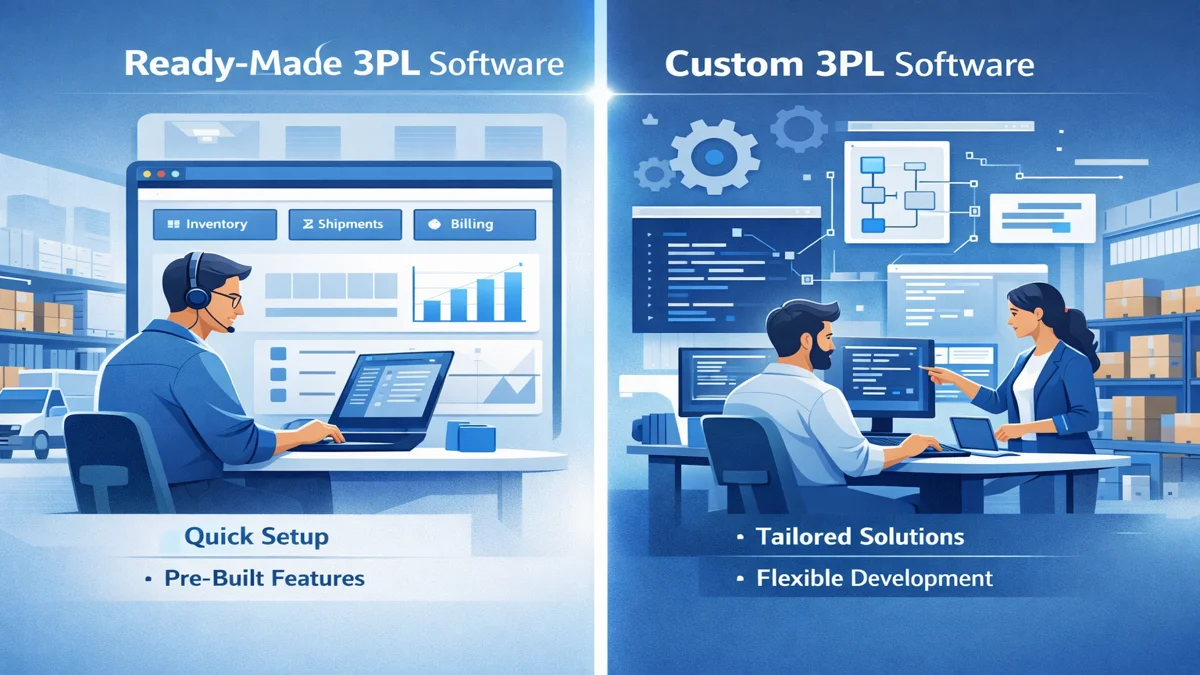
The choice of technology whether custom 3PL software solutions or readymade 3Pl is not a decision for the logistics company’s IT department anymore; it is a business decision that affects the company’s efficiency, scalability, and profitability.
With increased complexity in logistics operations, many logistics companies are being presented with a choice between:
- Ready-made 3PL software solutions
- Custom 3PL software solutions
Although ready-made software solutions may appear to be quicker to implement, the limitations of using such solutions for logistics operations become apparent as the complexity of the logistics business increases. In this blog, we will highlight the difference between the two solutions without beating around the bush.
What is Ready-Made 3PL Software?
Ready-made 3PL software solutions are designed to meet the needs of a variety of 3PL logistics companies.
The software solutions usually come with the following functionalities:
- Warehouse management software solutions
- Transportation management software solutions
- Inventory management software solutions
- Billing software solutions
The main benefit of using ready-made software solutions is that they can be implemented quickly.
When to Use Ready-Made 3PL Software Solutions
Ready-made software solutions may not be the most ideal solutions for all logistics companies; however, they can be used for certain situations.,
Ready-made software solutions can be considered for situations where:
- The logistics business is simple
- The number of clients is small
- The billing is simple
- Integration is minimal
The Real Problem with Ready-Made Software
The thing is, most blogs don’t tell you when things actually begin to fall apart. Ready-made systems are designed for average use cases, not for the way your business actually runs.
As your operations grow, so does the complexity:
- Multiple clients with different contracts
- Customized billing models
- Multi-location warehouse operations
- Client-specific reporting requirements
- Integration with ERP, eCommerce, and transport systems
This is the point where businesses start adjusting their processes just to fit the software. That’s your first real warning sign.
What is the real problem with ready-made software?
- Does “ready” mean plug-and-play? No. It is never truly plug-and-play. Ready products are developed based on possible use cases, integrations, and limited flexibility. In most cases, they require you to change your business processes to fit their predefined structures. If you are just starting out and do not yet have your own methods or unique value propositions, then you can consider going for them.
Yes, SaaS solutions are often considered plug-and-play, but SaaS essentially means “as-is” software. These systems will not adapt to your specific processes or integration requirements. You are typically left with two choices:
- Continue manual data movement where integrations are not available
- Modify your existing systems and processes to match the SaaS software
- Most SaaS products perform very well in areas where processes are standardized and clearly defined, such as accounting software, where workflows and compliance requirements are structured across industries and geographies.
But building everything from scratch is not always the right approach either. The key is to find a solution that best matches your requirements while still offering the ability to customize. It is important to look for companies like Mechsoft Digital Technologies that provide ready building blocks to accelerate development and have a proven track record in your domain or across multiple industries
What Are Custom 3PL Software Solutions?
Custom 3PL software solutions are built specifically around how your logistics operations work.
Instead of forcing your workflows to adapt to software limitations, the system is designed to support your workflows from the start.
This is made possible through custom logistics software development, where every component like billing, warehouse management, transportation, and reporting is tailored to your exact requirements.
Why Companies Move Toward Custom Logistics Software
There’s a clear pattern in the logistics industry. Most companies don’t begin with custom 3PL software solutions. They switch to them when ready-made systems can no longer keep up.
That shift usually happens as the business grows and operations become more complex. At that stage, the real benefits of logistics software become more visible, especially when combined with logistics automation software to streamline processes and cloud based 3pl software to maintain flexibility and accessibility.
Benefits of Custom Logistics Software (Backed by Research)
1. Perfect Fit for Your Operations
One of the biggest advantages of custom systems is that they are built around how you actually work.
Research on enterprise systems highlights that:-
In practical terms, this means your operations don’t have to change to fit the system. The system is designed to fit you.
2. Better Integration Across Systems
Logistics doesn’t run on a single tool, it runs on a connected ecosystem. With custom logistics software development, you can seamlessly integrate:
- ERP systems
- Warehouse tools
- Client platforms
- Accounting software
This reduces manual work, minimizes errors, and improves data flow.
3. Scalability Without Restrictions
As your business grows, your software should grow with it, not hold you back. Ready-made tools often struggle with increasing complexity, but custom systems are built to scale.
You can easily introduce:
- New clients
- New billing structures
- New workflows
- Advanced analytics
All this is without depending on vendor timelines or limitations.
4. Stronger Automation Capabilities
Today’s logistics operations rely heavily on logistics automation software to stay competitive. According to McKinsey, digital transformation in logistics significantly improves efficiency and reduces manual errors.
With custom systems, automation isn’t generic, it’s built specifically around your workflows, making it far more effective.
5. Long-Term Cost Efficiency
Ready-made software often looks more affordable at the beginning, but costs tend to increase over time.
Research shows that off-the-shelf tools may require additional configuration, integrations, and licensing as needs evolve.
Custom systems help eliminate many of these ongoing inefficiencies, making them more cost-effective in the long run.
Ready-Made vs Custom: A Practical Comparison
Let’s move beyond theory and look at how things actually play out.
Implementation Speed
Ready-made software is quicker to deploy. Custom logistics software development takes time but delivers a more tailored result.
Flexibility
Ready-made tools offer limited flexibility. Custom 3PL software solutions give you full control.
Integration
Ready-made systems rely on standard APIs. Custom platforms integrate directly into your existing ecosystem.
Cost Over Time
Ready-made software may seem cheaper upfront. Custom solutions typically provide better long-term ROI.
Operational Fit
Ready-made tools often force you to adjust your processes.
Custom systems are designed to match how you already operate.
When Should You Choose Ready-Made Software?
It comes down to where your business is right now.
Ready-made solutions make sense if:
- You’re just getting started
- Your operations are still simple
- Budget is tight
- Speed matters more than customization
When Custom 3PL Software Solutions Become Necessary
There’s a tipping point where ready-made tools stop working effectively.
You should consider custom 3PL software solutions when:
- You manage multiple clients with different billing models
- Manual workarounds are becoming common
- Your team spends time fixing system limitations
- Integration issues are slowing things down
- You want to offer differentiated services
At this stage, ready-made software often becomes a bottleneck rather than a solution.
The Future: Why Customization Is Becoming Critical
But here’s the key point, technology alone isn’t enough.
The real advantage comes from how well that technology aligns with your operations.
The Mechsoft Approach to Custom 3PL Software Development
While we have a solid logistics software foundation to start with, our approach is not software-centric; it is process-centric.
Our process starts with understanding our clients’ existing business processes, workflows, and system dependencies. We don’t ask our clients to change their business to accommodate our software structures; instead, we identify gaps between their current processes and areas where improvements can drive better efficiency, accuracy, and overall performance.
At every point where we see opportunities whether through logistics automation software, process optimization, or system integration, we always recommend improvements. These are never forced. They are discussed, validated, and implemented only when both sides are aligned.
We adapt our platform to fit the client’s workflows, not the other way around. This is what sets us apart from many large, rigid systems with predefined structures. Our approach is rooted in custom logistics software development, ensuring flexibility at every stage.
A key part of our implementation is continuity. Logistics businesses rely heavily on their existing or legacy systems, and their teams are already comfortable using them. We ensure smooth integration, so the transition feels natural, not disruptive.
We also make sure that historical data remains accessible and usable, allowing teams to continue operations without losing visibility or control.
Our role doesn’t end at deployment. We provide long-term support and stay involved during critical moments to ensure system reliability, business continuity, and ongoing improvements as operations evolve.
Final Thoughts:
While the advantages of custom 3PL software solutions are clear, their real value becomes evident during implementation. Platforms like iLogistech, built with flexible and scalable architecture, show how aligning technology with real-world workflows can deliver measurable results.
By bringing together order management, warehouse operations, transportation, tracking, and billing into a single system, such solutions have enabled logistics providers to achieve up to 200% growth in order processing capacity, a 66% reduction in operational costs, and nearly a 30% improvement in profit margins and cash flow.
These outcomes go beyond simple automation. They reflect the true benefits of logistics software when it is designed around business needs, combining the strengths of custom logistics software development, logistics automation software, and cloud based 3pl software to create systems that actually work the way businesses operate.


