
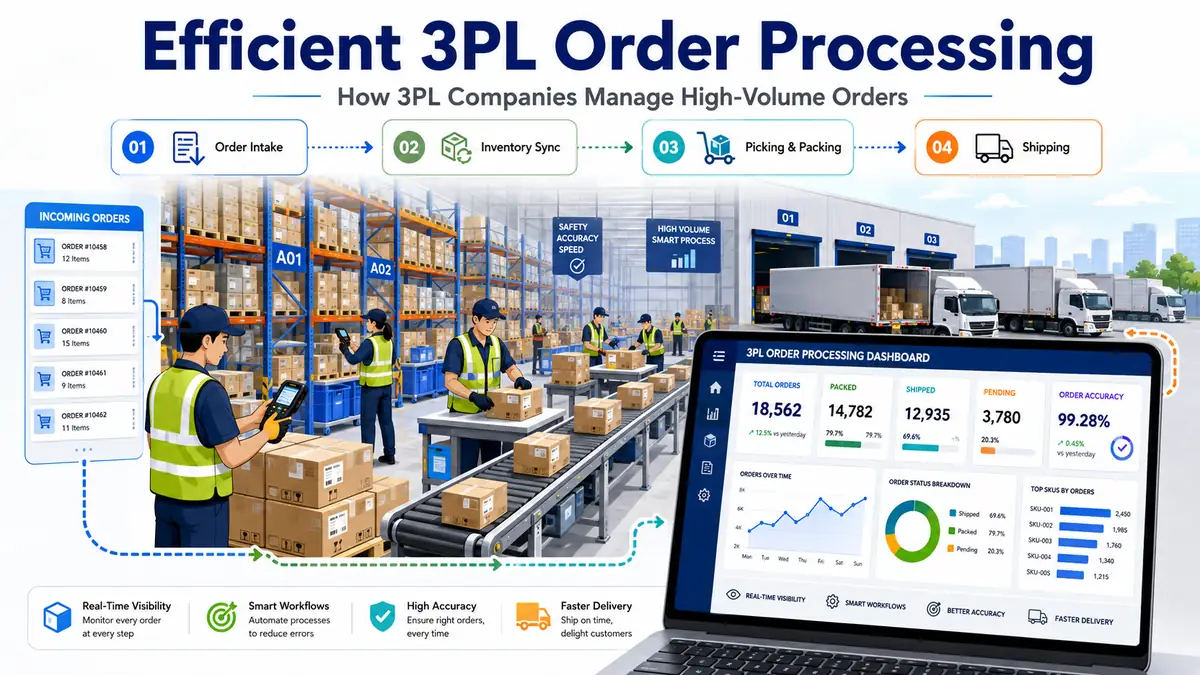
A 3PL may process a manageable number of orders during an ordinary week. Volumes can then rise sharply during promo tions, seasonal demand, new client onboarding, or marketplace campaigns. The difficult part is not simply receiving more orders. It is keeping thousands of individual order requirements organized while maintaining accuracy, shipment priorities, documentation, tracking, and client-specific rules. That is why effective 3PL order processing depends less on adding people every time volume rises and more on designing a workflow that can absorb higher demand without creating proportional manual work.
For growing logistics providers, efficient high-volume order fulfillment starts with controlling the flow of information before warehouse activity begins.
Quick Answer: How Do 3PL Companies Handle High-Volume Orders?
3PL companies manage large order volumes by centralizing order intake, validating incoming data, and separating orders according to client and service requirements. They then assign priorities, group compatible work, track orders through operational checkpoints, and manage exceptions separately.
A practical process generally looks like this:
Order intake → Validation → Client/SLA classification → Prioritization and segregation → Warehouse execution → QA and dispatch → Tracking → Exception or delivery completion
The exact warehouse execution method may differ. Some facilities use batch, wave, zone, or individual picking depending on their WMS, layout, products, workforce, and shipping commitments.
The important point is that more volume should not automatically create more administrative confusion.
Why High Order Volumes Expose Weaknesses in 3PL Order Processing
A workflow that works for 300 orders can fail badly at 3,000.
At lower volumes, employees can compensate for inefficient processes. Someone can correct an incomplete spreadsheet, call the warehouse about a priority order, manually combine files from different clients, or check an email to confirm a shipping instruction.
As volumes rise, those workarounds become bottlenecks.
Common problems include:
- Orders arriving through different files, systems, APIs, portals, or emails
- Duplicate or incomplete order information
- Different SLAs for different clients
- Priority shipments being buried among standard orders
- Manual order segregation
- Delayed warehouse instructions
- Status updates spread across different systems
- Errors in labels, manifests, or other shipment documents
- Teams spending too much time investigating routine order status
- Exceptions being discovered only after a shipment is already late
These are not unusual edge cases. Extensiv’s 2025 Third-Party Logistics Warehouse Benchmark Report found that just over 70% of surveyed 3PL warehouses reported order-volume growth. The report, based on responses from more than 200 3PL warehouses, also shows continued interest in automation and AI as operators look for ways to handle greater operational complexity.
Therefore, volume alone is not the problem. The real issue is volume moving through processes that were designed for a smaller operation.
1. Centralize Order Intake for Efficient 3PL Order Processing
The first requirement for scalable order processing in logistics is a reliable intake process.
A 3PL may receive orders from multiple clients, and each client may send them differently: API, EDI, CSV, ERP integration, e-commerce platform, portal, or another structured source.
When employees repeatedly download, reformat, copy, and upload this data manually, order volume creates administrative work before fulfillment even starts.
A better process brings incoming orders into a controlled system and checks whether required information is present.
Validation may include:
- Client identification
- Delivery address
- Order number
- SKU and quantity information
- Service level
- Required delivery date
- Special handling instructions
- Duplicate-order checks
The system should flag invalid orders instead of allowing them to enter the normal workflow.
This prevents warehouse teams from discovering basic data problems after picking or dispatch preparation has already begun.
For businesses still coordinating growing volumes through spreadsheets, the warning signs are discussed further in Signs Your 3PL Management Process Has Outgrown Spreadsheets.
2. Use Operational Rules to Improve 3PL Order Processing
After intake and validation, the next challenge in 3PL order processing is deciding what should happen to each order.
A 3PL serving several customers cannot treat every shipment identically.
Orders may need to be separated according to:
- Client
- Delivery ZIP code or region
- SLA
- Shipping priority
- Delivery date
- Order type
- Destination
- Special handling requirements
This classification becomes especially important during peak periods.
Consider a facility receiving several thousand orders before noon. Some must ship the same day, while others can leave tomorrow. A smaller group may require a different operational process. If staff review every order manually, the queue itself becomes a source of delay.
Rule-based segregation gives the operation a defined sequence instead.
Mechsoft discusses this issue specifically in its guide to order management challenges in high-volume 3PL operations, including the difficulty of separating multi-client orders according to shipping and service requirements.
3. Match Picking and Release Methods with Your 3PL Order Processing Workflow
Once orders are classified, warehouse execution needs to reflect the actual demand pattern.
There is no universally correct picking method for high-volume order fulfillment.
For example, batch picking can make sense when many orders contain the same or similar SKUs. Wave-based execution, meanwhile, can help a warehouse release groups of work around carrier cutoffs, staffing, or dispatch windows. Zone picking may be suitable when SKUs are distributed across clearly defined areas.
Other facilities may require a combination.
The mistake is choosing a method because it sounds efficient rather than because it fits the warehouse.
A 3PL should consider:
- SKU overlap between orders
- Lines per order
- Product size and handling requirements
- Warehouse layout
- Number of active clients
- Packing capacity
- Shipping cutoffs
- Labor availability
- Existing WMS or execution-system capabilities
Order-management software can prepare and prioritize work, but physical picking efficiency also depends on warehouse layout, equipment, labor processes, and the execution system being used.
4. Manage Exceptions Separately in 3PL Order Processing
One of the most important principles of scalable logistics order management is simple: employees should spend their attention on exceptions, not repeatedly manage orders that are moving normally.
An exception might include:
- Missing order information
- Failed validation
- Damaged goods
- Quantity mismatch
- Missed SLA risk
- Failed delivery
- Address issue
- Return request
- Reconsignment
- Integration failure
When normal and problematic orders sit in the same queue, operations teams waste time searching for what actually requires intervention.
A stronger process separates exceptions, assigns responsibility, records the reason, and tracks resolution.
This becomes more valuable as order volumes grow because the absolute number of unusual cases will usually increase even if the percentage of problematic orders stays low.
5. Keep Operational Status Visible Across the Order Lifecycle
High volume becomes difficult when nobody can answer a simple question quickly:
Where is this order right now?
A useful logistics order management process should provide clear status points rather than forcing staff to call another department for updates.
Depending on the operation, those points may include:
Received → Validated → Assigned → Processing → QA → Dispatched → In transit → Delivered
Returns and reconsignments should have their own statuses.
This visibility matters internally, but it also affects the clients that depend on the 3PL.
Why Efficient 3PL Order Processing Matters Beyond the Warehouse
Brands increasingly compete partly on delivery experience, which means logistics failures can affect far more than warehouse KPIs.
The DHL E-Commerce Trends Report 2025 surveyed 24,000 shoppers across 24 global markets and found that 81% said they would abandon a purchase if their preferred delivery option was unavailable.
That statistic does not mean the 3PL controls every part of the checkout experience. It does show how closely logistics capabilities are tied to the promises retailers make to customers.
For a 3PL, reliable order processing in logistics therefore supports more than throughput. It helps clients protect their delivery commitments and reduces avoidable status enquiries, disputes, and last-minute escalation.
When Should You Automate 3PL Order Processing?
Automation is useful when the underlying workflow is clear.
Automating a badly defined process simply allows bad decisions to happen faster.
Before introducing more automation, a 3PL should know:
- Which data is mandatory when an order enters the system
- Which client rules affect processing
- Which SLAs determine priority
- Which exceptions require manual approval
- Which system owns each status
- Which operational events should trigger documentation or billing activity
- How integration failures will be identified
The 2026 MHI Annual Industry Report found that 56% of surveyed organizations expected to increase supply-chain innovation spending. MHI and Deloitte also highlight a more disciplined approach in which businesses first identify the problem they need to solve and assess operations before scaling technology investment.
That distinction matters. Technology should remove specific bottlenecks, not become another system employees have to work around.
Where iLogistech Fits into 3PL Order Processing
For operations where the challenge involves multi-source order receipt, order synchronization, segregation, tracking, logistics documentation, billing workflows, returns, or reconsignment, iLogistech has documented capabilities that are directly relevant.
According to Mechsoft’s iLogistech 3PL logistics software page, the platform supports receiving orders in multiple formats, synchronizing orders, and segregating outbound orders using criteria such as ZIP code, priority, and SLA. It also supports order tracking, barcode-based checkpoints, logistics documents, receivables/payables processes, returns, and reconsignments.
That does not mean software alone fixes a high-volume operation. Results still depend on workflow design, master-data quality, integrations, implementation effort, warehouse processes, employee adoption, and the size and complexity of the operation.
For 3PLs evaluating technology, the useful question is not simply, “Can this system handle more orders?”
The better question is: Which manual decisions and handoffs are creating the bottleneck today, and can the system manage those specific workflows reliably at higher volume?
FAQs About 3PL Order Processing
Q. What Is 3PL Order Processing?
A. 3PL order processing is the workflow used by a third-party logistics provider to receive, validate, classify, prioritize, process, track, and complete orders for its clients. The process may also connect with warehouse execution, shipment documentation, delivery tracking, returns, and billing activities.
Q. How Can Better 3PL Order Processing Help Handle More Orders Without Adding Staff?
A. The main opportunity is reducing repetitive administrative work. Centralized order intake, validation rules, automatic classification, structured status tracking, integrations, and exception-based workflows can reduce the amount of manual handling required per order. Teams still need to assess physical warehouse capacity and labor requirements separately.
Q. What Causes Delays in 3PL Order Processing During High-Volume Fulfillment?
A. Common causes include incomplete order data, manual re-entry, unclear priorities, poor segregation, warehouse congestion, inventory or SKU issues, insufficient picking or packing capacity, integration failures, documentation problems, and exceptions that are identified too late.
Q. When Should a 3PL Automate Its Order Processing?
A. Automation becomes particularly valuable when growing volume creates repeated data entry, multiple spreadsheet versions, slow segregation, missed priorities, delayed status reporting, frequent manual follow-ups, or difficulty maintaining client-specific workflows. The process should first be clearly defined so the automation reflects actual operational requirements.
Conclusion
Managing more orders efficiently is not mainly about making employees work faster.
It requires controlling how orders enter the business, validating them early, applying client and SLA rules consistently, releasing work in a way the warehouse can actually execute, maintaining visible statuses, and sending unusual cases to the right people before they become larger problems.
That is the foundation of scalable 3PL order processing.
For 3PL companies dealing specifically with multi-source order intake, segregation, tracking, documentation, billing, returns, and related workflow complexity, reviewing iLogistech’s documented 3PL workflow capabilities can help determine whether the platform matches the operational bottlenecks that need to be addressed.


