
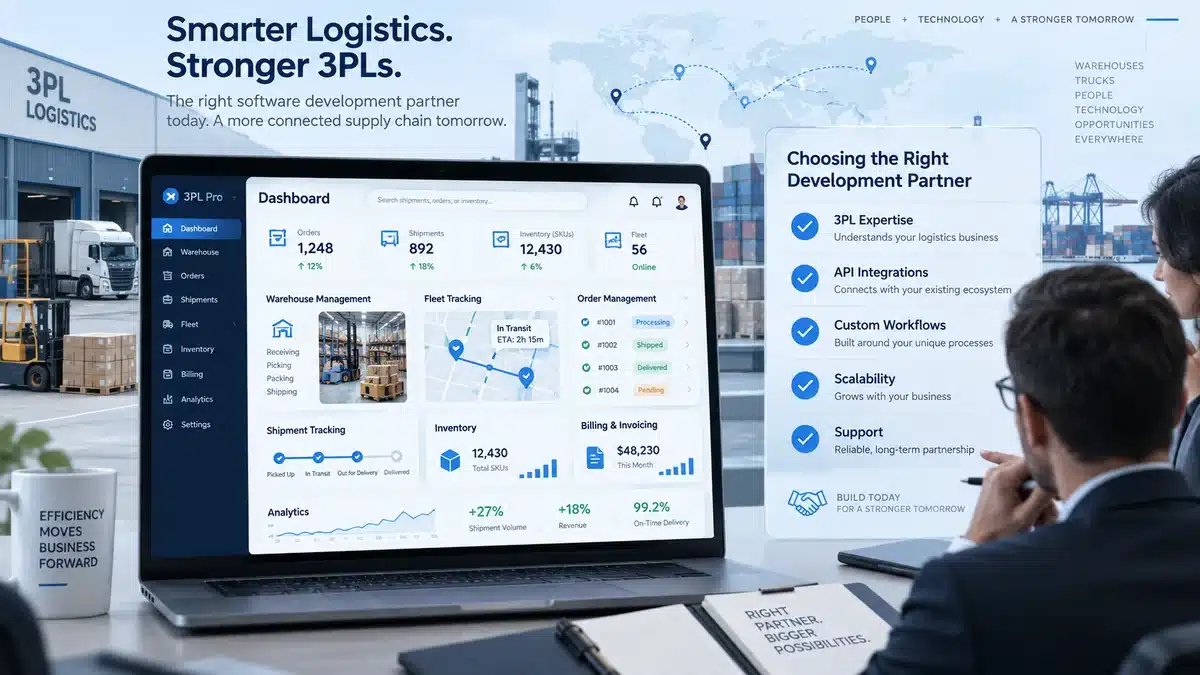
Choosing logistics software development services for a 3PL is not the same as hiring a general development team to build a dashboard or mobile app.
A 3PL system touches several parts of the daily operation. Orders come in from different clients, freight is received and checked, pallets may need to be reorganized, and documents have to stay with the right loads. Delivery updates, returns and other exceptions also matter because billing depends on what actually happened during the shipment.
The best providers are not necessarily the ones with the biggest team or the longest feature list. A better question is whether the company understands how your 3PL actually operates and can build around those workflows without adding another disconnected system.
Quick Answer: What Makes Good Logistics Software Development Services for 3PLs?
A strong logistics software company should understand 3PL workflows before discussing technology.
It should understand client-specific rules, operational exceptions, documents, integrations, billing dependencies, user roles, data ownership and rollout risks. And when a packaged solution can handle a standard process well, the company should say so instead of pushing custom development every time.
Why Domain Knowledge Matters in Logistics Software Development Services
A developer can learn a technology stack relatively quickly. Learning how a 3PL actually runs is harder.
The 2026 3PL Study: Emerging Technologies in the Supply Chain reports that 90% of shippers consider technology capabilities critical when selecting a 3PL. Yet only 57% are satisfied with their providers’ technology capabilities. It also identifies IT systems and technical expertise as an important differentiator.
So hearing “we build logistics software” is not enough. The development team should be able to explain how one operational event affects the next.
A delayed delivery update can affect client visibility. A missing BOL or manifest record can hold up billing. A return or reconsignment can change both the operational trail and the financial transaction.
Before discussing software development for logistics, make sure the vendor can explain your actual workflow back to you accurately. For additional context, see how 3PL logistics software works across operational stages.
What to Evaluate Before Choosing Logistics Software Development Services
Do not start with programming languages. Start with the operating risks the software must handle.
|
Area |
Weak signal |
Stronger signal |
| 3PL discovery | Asks for a feature list | Maps order flow, QA, handoffs, exceptions, documents, billing and users |
| Integrations | “We support APIs” | Identifies client, carrier, ERP, accounting and partner connections, including failure handling |
| Scalability | Says the system is “cloud-ready” | Discusses order volume, concurrent usage, client separation, locations and peak loads |
| Security | Uses vague “enterprise security” language | Defines testable security requirements and verification practices |
| Implementation | Proposes a big-bang launch | Plans migration, pilot, user testing, fallback and phased rollout |
| Ownership | Leaves support unclear | Defines code, data, documentation, hosting and post-launch responsibilities |
The 2025 MHI Annual Industry Report findings also point to the growing importance of connected digital systems, accurate real-time data and cybersecurity. The research found that 55% of surveyed supply-chain leaders had increased their technology and innovation budgets.
The lesson is not simply to spend more on technology. It is to avoid investing in another system that cannot exchange reliable data with the rest of the operation.
Before Choosing Logistics Software Development Services, Check Workflow Fit
Custom software is useful when your operating model contains rules that packaged products cannot support cleanly. It is not automatically the better option.
Suppose one client sends orders through an API, another sends files, and a third requires a specific document trail. One customer has one billing structure, another has accessorial rules, while another follows a different returns process. If employees keep moving data manually between systems to make those workflows work, a configurable platform, custom development or a hybrid approach may make sense.
But if your processes are common across the industry and a SaaS product already supports the required integrations and controls, custom development may not be necessary. Building everything from scratch can waste money and create unnecessary maintenance.
If most of your processes are standard, packaged software may be enough. If the workflows differ but can still be configured, an extensible platform may be a better fit. Custom or hybrid development starts to make more sense when those differences directly affect service, cost, client requirements or your competitive advantage.
For a deeper comparison, see custom 3PL software versus ready-made systems.
If spreadsheets and manual follow-ups are already creating operational friction, also review the signs that a 3PL management process has outgrown spreadsheets.
How Logistics Software Development Services Move from Discovery to Rollout
A credible logistics app development company or development partner should have a clear process for moving from understanding the operation to testing and rolling out the software.
Operational discovery → Process and exception mapping → Build/buy/hybrid decision → Data and integration design → Pilot → Phased rollout → Measure and improve
The important work happens before coding.
Before development starts, the team needs to know where the data comes from, who updates it and what happens next. It should also understand what happens when information is missing and which later processes depend on that data.
A technically correct application can still fail operationally. Employees may continue using side spreadsheets, integrations may break without alerts, or the new workflow may create more manual work than the system it replaced.
Security Requirements to Check in Logistics Software Development Services
3PL software can contain client records, shipment information, documents, billing data, user access and connections to third-party systems. Security needs measurable requirements.
For example, the OWASP Application Security Verification Standard (ASVS) 5.0.0 provides a basis for testing application-security controls. It can also help specify security-verification requirements during procurement.
Ask potential providers how they handle authentication, authorization, audit trails, API security, secrets, vulnerability testing, backups and incident response.
A vendor saying its platform is secure is not enough. Ask for security requirements and practices that can actually be checked.
How Mechsoft Approaches Logistics Software Development Services for 3PLs
Mechsoft is relevant when the requirement is specifically connected to 3PL logistics workflows rather than a generic warehouse or transportation software brief.
Its iLogistech 3PL logistics platform documents functionality covering multi-source order intake, inbound QA and barcode scanning, and outbound segregation and re-palletizing. It also covers tracking, local delivery-agent workflows, BOL and manifest documentation, accounts receivable/payable processes, returns and reconsignments. The platform also documents integrations with external systems through APIs.
That does not mean every logistics company should use the same configuration. Nor should buyers automatically treat iLogistech as a replacement for every WMS or TMS.
A better approach is to look at the 3PL functionality already available and compare it with the workflows your operation actually needs. From there, you can see what already fits and what still needs configuration or development.
The broader Mechsoft 3PL logistics software domain approach also focuses on the relationship between operational data, documents, partner handoffs and financial processes.
The software alone will not determine the result. Workflow maturity, data quality, implementation effort, integration reliability, team adoption and business scale all play a part, regardless of which development company you choose.
Common Mistakes When Selecting Logistics Software Development Services
Do not select a partner because the demo looks polished.
Be cautious if a vendor cannot explain how exceptions will be handled or leaves integrations until late in the project. A firm estimate before the workflow has even been understood is another warning sign. The same goes for vendors that claim every logistics function is already covered or start talking about AI before looking at the quality and structure of your operational data.
A good development partner should also tell you when custom development is unnecessary. Not every requirement needs to become a new module.
FAQ
Q. What should I look for in logistics software development services?
A. Look for 3PL domain understanding, workflow discovery, integration capability, measurable security practices, scalable architecture, phased implementation and clear ownership of code, data and support. Technical skill matters, but operational fit matters just as much.
Q. Is custom software development for logistics always better for a 3PL?
A. No. Established SaaS products often serve standard workflows better. Custom or hybrid software becomes more useful when client-specific rules, billing logic, documentation, integrations or exception processes create meaningful operational differences.
Q. How Are Logistics Software Development Services Different from General App Development?
A. A logistics app development company should understand operational states, scanning, documents, partner handoffs, user roles, field-use conditions, integrations and exception handling. A general developer may have the technical ability to build the application but still require substantial guidance on logistics operations.
Q. How Do I Compare Logistics Software Development Services Providers?
A. Give shortlisted vendors the same real operational workflow. Ask each team to explain the process, exceptions, integrations, risks, rollout strategy and ownership model.
Compare how well they understand the problem before comparing programming languages or proposed technology stacks.
Conclusion
Do not choose a 3PL software development company simply because it promises more features. Look for a team that can first work out whether the real issue is the software, the process or the way different systems are connected.
Choose logistics software development services that understand how your operation moves from order intake through operational handoffs, delivery, documentation and billing.
If your workflows are standard, buying may make more sense than building. However, when your competitive advantage depends on specific operating rules, client requirements or integrations, a configurable, custom or hybrid approach deserves a closer look.
For a 3PL considering its options, start by mapping the workflow as it actually runs today. Then compare those requirements with the functionality available in Mechsoft’s iLogistech platform to see what already fits and what may need configuration, extension or new development.


