
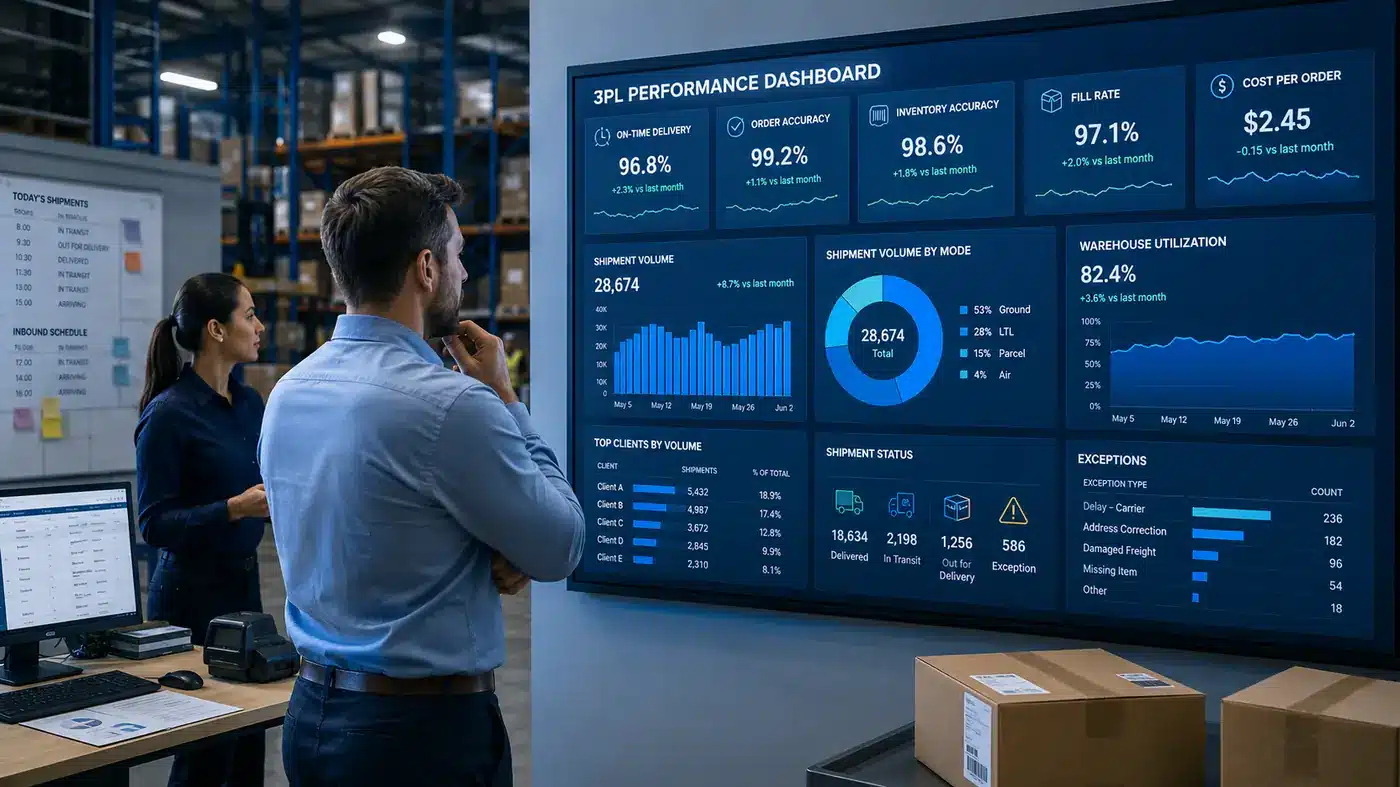
3PL performance metrics help 3PL companies understand whether inventory is received correctly, orders are picked accurately, shipments are dispatched on time, invoices are raised without leakage, and client-specific SLAs are met consistently. A dashboard that only shows shipped volume or monthly revenue is incomplete. It confirms activity, but it does not show whether the business is profitable, scalable, or safe for client commitments.
This matters most for operations leaders, founders, warehouse heads, fulfillment teams, and commercial leaders inside growing 3PL businesses. A multi-client 3PL does not manage one standard workflow. Instead, it handles different SLAs, reporting rules, billing logic, carrier relationships, and order profiles across customers. As a result, many teams move beyond spreadsheet-based reporting toward centralized operational systems, as discussed in what 3PL logistics software is and how it works.
Start with these 3PL performance metrics
The most important 3pl performance metrics for most 3PL companies include service, warehouse, transportation, and billing measures: OTIF, perfect order rate, order accuracy, inventory accuracy, order cycle time, dock-to-stock time, on-time dispatch, transportation exception rate, billing accuracy, and margin by customer or service line. If you are only tracking shipped orders and revenue, your reporting is too shallow to manage real operational risk.
A practical KPI setup should measure reliability, speed, cost, quality, and cash-flow impact together. This helps turn scattered logistics kpis, warehouse kpis, supply chain kpis, and transportation kpis into useful management reporting instead of a dashboard that only looks good.
What makes a useful KPI framework for a 3PL company
A good 3PL KPI model is balanced. The SCOR Digital Standard is useful here because it gives companies a common language for supply chain processes and performance, linking processes, metrics, best practices, and technology into one structure. This matters in 3PL because warehouse, fulfillment, transport, and billing depend on each other. A delay or error in one area usually shows up as a client-facing problem later.
Recent work of APQC order management KPIs highlights the need to track OTIF, perfect order performance, response time, and cost-related measures together rather than chasing one isolated metric. The same approach works for 3PL leaders because service, cost, and execution quality are connected.
Many 3PL dashboards fail because teams define the same event in different ways. Warehouse says an order is complete when it is packed. Transport says it is complete when the truck leaves. Finance says it is complete when billing is posted. If event timing is not clearly defined, the KPI report cannot be trusted.
Which 3PL performance metrics matter most?
For a growing 3PL business, the scorecard below is a useful starting point. It combines service quality, warehouse flow, transport execution, and revenue protection. It also reflects the operational realities behind order management challenges in high-volume 3PL operations, where segregation complexity and fulfillment flow can quickly distort service levels If teams do not measure them well.
Core 3PL performance metrics scorecard for service, warehouse, transport, and revenue control
| KPI | What It Shows | Why It Matters |
| Order accuracy | Correct orders shipped | Reduces rework and complaints |
| Perfect order rate | Error-free fulfillment | Shows total service quality |
| On-time delivery | Shipments delivered on time | Protects SLA and client trust |
| Inventory accuracy | System stock vs physical stock | Prevents stock mismatch |
| Warehouse utilization | Space usage | Controls storage cost and flow |
| Order cycle time | Time from order to dispatch/delivery | Finds process delays |
| Picking accuracy | Correct items picked | Reduces fulfillment errors |
| Transport cost per shipment | Average delivery cost | Supports pricing and cost control |
| Damage/claims rate | Shipment quality issues | Finds handling or carrier gaps |
| Billing accuracy | Correct invoice generation | Reduces disputes and revenue leakage |
These are the 3pl kpis most teams should track first. The exact formula can vary by contract, client promise, region, and service mix, so do not compare unlike-for-unlike accounts. A cold-chain account, a B2C parcel account, and a bulky B2B distribution account should not be judged by the same service tolerance.
Another useful way to review supply chain kpis is to separate leading indicators from lagging indicators:
| Metric type | Examples | What it helps you do |
| Leading indicators | Inventory accuracy, dock-to-stock time, pick accuracy, unbilled orders, dispatch adherence | Identify issues before they affect the client |
| Lagging indicators | OTIF, perfect order rate, claims, credit notes, margin erosion, client escalations | Show where service, cost, or margin has already been affected |
If your OTIF is poor, the root cause is often upstream. Bad slotting, poor receiving discipline, weak order cut-off control, or delayed client data usually show up before the late truck does.
Why inventory accuracy deserves executive attention in 3PL performance metrics
Many leaders treat inventory accuracy as a warehouse-only metric. That is a mistake. APQC research on inventory accuracy links better inventory accuracy with better fill rates, fewer expedited orders, and lower inventory carrying cost. When stock records are wrong, the problem goes beyond counting. It can lead to service failures, avoidable expedited shipments, rework, and margin pressure.
For 3PLs, inventory accuracy matters even more because the issue is commercial as well as operational. If stock data is wrong, picking, fulfillment status, client reporting, and billing can all become unreliable. That chain reaction is exactly why centralized reporting and real-time visibility matter more than manually stitched reports from multiple spreadsheets, emails, and warehouse tools.
How should a 3PL review logistics KPIs?
A serious KPI program uses different review layers. One monthly dashboard for every team is usually too broad to support useful decisions.
| Review cadence | Who should review it | Best metrics to include |
| Daily operations review | Warehouse, transport, fulfillment supervisors | Backlog, pick accuracy, dock-to-stock, late dispatches, open exceptions |
| Weekly management review | Operations heads, account managers, finance ops | OTIF, perfect order, order cycle time, inventory variance, billing errors, customer escalations |
| Monthly executive review | Leadership team | Margin by customer, revenue leakage, SLA breach trends, claims cost, system/process bottlenecks |
This is also the right place to answer the question many shippers ask: what are the real kpis to track with 3pl provider relationships? At minimum, they should ask for OTIF, perfect order rate, inventory accuracy, exception rate, claims, and billing accuracy. These should be reported by account or lane. Anything less leaves too much room for selective or incomplete reporting.
What mistakes usually ruin 3PL performance metrics reporting?
Most KPI reporting problems come from avoidable process issues.
| Common mistake | Better practice |
| Reporting one blended OTIF across all customers | Break metrics down by client, lane, service type, and SLA promise |
| Measuring only output volume | Pair volume with quality, cost, and billing control |
| Reviewing KPIs too late | Use daily and weekly operational reviews for leading indicators |
| Building reports in spreadsheets from multiple systems | Pull event data from operational systems directly |
| Ignoring invoice quality | Track billing accuracy and credit-note drivers |
| Using one benchmark for every account | Set thresholds by contract, handling type, and region |
The spreadsheet issue needs to be addressed directly. If your team is still combining files manually, your reporting is already behind your operation. This is not just a reporting preference. It affects operational control.
Another common mistake is treating finance metrics as separate from operations. A 3PL can look operationally busy and still lose money because billing control is weak. That is why metrics such as billing accuracy, unbilled services, credit-note rate, and gross margin by customer deserve a permanent place beside your service metrics. The same issue is explained in why 3PL companies lose revenue due to manual billing.
When do warehouse KPIs and transportation KPIs become a system problem?
If your team has clear KPI definitions but still receives late, inconsistent, or impossible-to-reconcile numbers, The issue is probably not the dashboard itself. It is more likely a system or workflow problem.
This usually appears in four areas:
- warehouse events are not connected to order status,
- transport milestones are updated manually,
- billing depends on rechecking operational data,
- client reporting takes days instead of minutes.
At that stage, the question is no longer “Which warehouse kpis or transportation kpis should we track?” The better question is “What operational structure will let us trust them?”
A structured 3PL system can centralize order status, documentation, billing workflows, and reporting data. That structure helps teams move from late reporting to more reliable operational control.
FAQ
Q. What are the most important 3PL KPIs?
A. For most 3PLs, start with OTIF, perfect order rate, inventory accuracy, order cycle time, billing accuracy, transportation exception rate, and margin by customer. That mix covers service, execution quality, speed, risk, and profitability.
Q. How often should a 3PL company review KPIs?
A. Daily for operational exceptions, weekly for management trends, and monthly for executive decisions. One monthly review is not enough if the goal is to prevent issues rather than record them after they happen.
Q. What is the difference between OTIF and perfect order rate?
A. OTIF measures whether the order arrived on time and in full. Perfect order rate is stricter. It also considers damage-free delivery and accurate documentation or invoicing, so it gives a fuller picture of execution quality.
Q. Which warehouse kpis matter most for a multi-client 3PL?
A. Inventory accuracy, dock-to-stock time, pick accuracy, order cycle time, and backlog visibility usually matter most. In a multi-client environment, these metrics should also be segmented by account, SLA, and handling profile.
Q. Which kpis to track with 3pl provider matter most for shippers?
A. Ask for OTIF, perfect order rate, inventory accuracy, claims rate, transport exception rate, and billing accuracy. If a provider cannot define or report these clearly, You are relying on performance claims that are difficult to verify.
Conclusion
The right 3pl performance metrics do not just help a 3PL prove performance. They help it protect margin, identify process failures earlier, and make software, staffing, and customer-service decisions based on reality. The core point is simple: do not track only the numbers that are easy to collect. Track the metrics that explain service reliability, operational flow, and revenue quality.
If your current dashboards are fragmented, delayed, or too shallow to support decisions, that is a sign the operating model behind the metrics needs work, not just the dashboard layout. For teams evaluating a better foundation for reporting, billing control, and account-level visibility, review your operational requirements, integrations, and billing model before choosing any software option.
If you are evaluating your current reporting stack, start with one practical exercise: list your top client promises, then map each promise to the KPI that proves it, the system that captures it, and the team that owns it. If the team cannot do that clearly, the KPI setup still needs work.


