
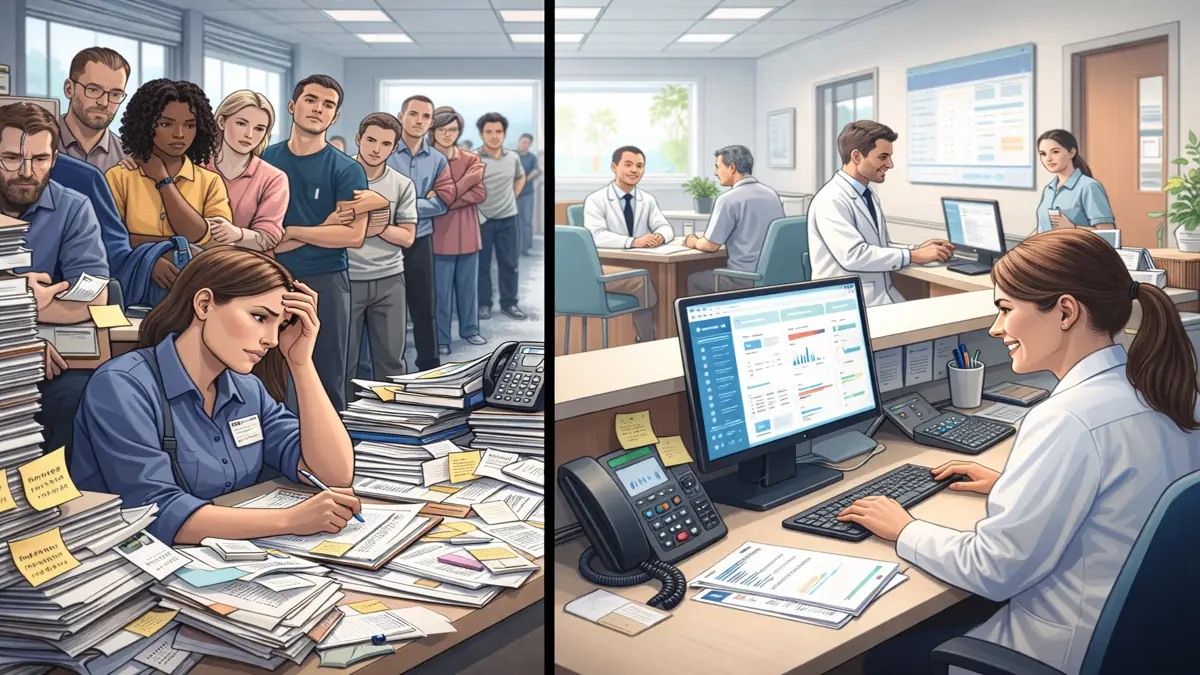
Operating a clinic without dedicated software might appear to be quite doable at the smaller scale but it can be a reason for some major clinic problems if you are planning for expansion. It only results in hidden inefficiencies that are made worse as time goes on. Medical record errors, billing discrepancies, and appointment mix-ups are just some of the signs of a problematic clinic that goes beyond operations and affects patient care, the clinic’s income and its development over time. At a time when data precision and patient experience are very important in healthcare, depending on manual systems is not only outdated but can also cause clinic problems. Various studies on healthcare reveal that a major chunk of loss of revenue in clinics is due to administrative inefficiencies and errors in documentation. Lack of clinic management systems results in disconnected workflows, higher human errors and dissatisfaction among patients.
According to an article by NetSuite on healthcare industry challenges, disconnected systems, manual processes, and absence of real-time data visibility still affect the operational efficiency, increase the administrative workload, and cause financial inefficiencies in healthcare organizations.
Let’s break down the real problems clinics face without software and why ignoring them is costing more than most realize.
1. Medical Record Errors: The Most Dangerous Gap
When clinics rely on old-fashioned manually handled record-keeping, mistakes slip in all the time. The handwriting can be impossible to read, details from a patient’s past get left out, folders go missing, and the way things are recorded jumps all over the place.
These aren’t just minor paperwork issues they create real dangers. The Journal of Patient Safety points out that errors in medical records play a huge role in preventable harm to patients.
Why does this matter so much? If a patient’s file is missing information or filled with mistakes, doctors are left to guess or work with a half-told story. That means inconsistent treatments, plans that don’t add up, and disrupted follow-ups. It’s not just inefficient it can put patients at risk.
The research is clear about what needs to happen: Stop treating error as just a hazard of the job. Look closely at what causes mistakes and use that knowledge to redesign care. The goal is straightforward fewer errors, and when they happen, less harm.
Reality Check
If a doctor cannot instantly access:
- Previous prescriptions
- Allergy history
- Test reports
…then the clinic is operating blindly.
Modern systems eliminate this by offering structured, retrievable, and standardized patient records, this is something manual processes simply cannot match.
2. Inefficient Patient Flow and Long Waiting Times
When clinics don’t use software to organize patient flow, everything feels chaotic. You end up with overbooked schedules one day, and empty slots the next. Staff members are left trying to guess where they’re needed, and nobody has a clear picture of how many patients are actually waiting. Tracking appointments manually turns into a nightmare. The end result? Patients sit around getting frustrated, staff feel swamped, and doctors waste precious time that could have been spent seeing someone else. Studies show that bad scheduling doesn’t just annoy people it actually increases clinic problems and makes clinics less productive. In today’s crowded healthcare market, patient experience isn’t just nice to have. It’s the thing that sets you apart.
3. Billing Errors and Revenue Leakages
Relying on manual billing is pretty much asking for trouble. It’s way too easy to make mistakes maybe someone enters the wrong amount, forgets to charge for a service, or messes up calculations. With no clear system to track payments, money just slips through the cracks. These errors aren’t just occasional, they add up fast and eat into your earnings. Financial reports make it clear: if your clinic isn’t using automated billing, you’re losing money. The tough part is you probably don’t even know how much you’ve lost.
4. Poor Data Management and Zero Insights
Every clinic generates piles of data every day, but without software, that information might as well not exist. Manually, you can’t spot patterns in patient visits, you can’t track how treatments are working, and you sure can’t measure how well the clinic itself is running. Without these insights, you stay stuck you can’t fix what’s broken, spot wasted time or grow your practice. These days, making decisions based on real data isn’t just something to aspire to. It’s absolutely essential.
5. Lack of Standardized Clinic Management
One of the most overlooked clinic problems is the absence of standardized processes.
In manual environments:
- Every staff member follows a different workflow
- Documentation styles vary
- Case handling depends on individual habits
This leads to:
- Inconsistency in patient care
- Operational confusion
- Increased dependency on specific individuals
The Result
Your clinic becomes:
- Hard to scale
- Difficult to manage
- Vulnerable to staff turnover
6. Difficulty in Managing Follow-Ups and Continuity of Care
Follow-ups are critical in healthcare—but without software, they are often missed or poorly managed.
Common issues:
- No reminder system
- Lost patient history
- No tracking of ongoing treatments
Clinical Impact
Missed follow-ups lead to:
- Poor treatment outcomes
- Reduced patient trust
- Loss of repeat visits
Digital systems solve this with automated reminders, structured follow-ups, and complete patient history tracking.
7. Communication Gaps with Patients
Clinics without software rely heavily on manual communication:
- Phone calls
- Physical reminders
- In-person coordination
This creates:
- Missed appointments
- Poor engagement
- Low patient retention
What Research Shows
Studies on patient engagement highlight that automated communication (SMS, WhatsApp, email reminders) significantly improves appointment adherence and patient satisfaction.
8. Administrative Overload on Staff
Let’s be honest: running a clinic manually eats up staff time.
Staff spends time on:
- Registering patients manually
- Searching files
- Coordinating appointments
- Managing billing records
The Problem
This leads to:
- Burnout
- Errors
- Reduced efficiency
Instead of focusing on patient care, staff gets stuck in repetitive tasks.
9. Compliance and Legal Risks
Healthcare industry is heavily regulated and follow strict rules. Miss a detail or lose a record, and you’ve got trouble as compliance issues arises.
Without software:
- Records are incomplete
- Data is not secure
- Audit trails are missing
The Risk
Clinics may face:
- Legal complications
- Penalties
- Loss of credibility
But when you switch to digital tools, you lock down your documents and create a clean, traceable history. That’s how you keep your clinic safe.
10. No Scalability for Growth
A clinic still running on manual systems can’t scale up.
You cannot:
- Handle increased patient volume
- Expand services efficiently
- Maintain quality at scale
The Reality
If your systems can’t handle growth, your clinic can’t grow either. Simple as that.
Where Clinic Management Software Changes the Game
This is exactly where structured clinic management systems come in.
A well-designed system solves these problems by:
- Centralizing patient records
- Automating appointments and billing
- Standardizing workflows
- Providing actionable insights
Take Mechsoft’s FlexiClinic, for example. It’s built to fix all these gaps with flexible patient records, smart outpatient department management, and automated billing. The result? Your clinic runs cleaner, faster, and with less chance for errors. Your team finally gets to do what they do best: focus on patient care.
Staff spends time on:
- Registering patients manually
- Searching files
- Coordinating appointments
- Managing billing records
The Problem
This leads to:
- Burnout
- Errors
- Reduced efficiency
Instead of focusing on patient care, staff gets stuck in repetitive tasks.
Key Features That Directly Solve Clinic Problems
Instead of talking in theory, let’s connect problems to solutions:
| Clinic Problem | Software Solution |
|---|---|
| Medical record errors | Structured digital patient records |
| Appointment chaos | Online scheduling & queue management |
| Billing mistakes | Automated billing systems |
| Poor follow-ups | Reminders & CRM integration |
| No insights | Analytics & reporting |
| Admin overload | Workflow automation |
The Bigger Picture: Patient Experience
Every operational inefficiency eventually impacts the patient.
Without software:
- Patients wait longer
- Records are inconsistent
- Communication is poor
With software:
- Consultations are smoother
- Records are accurate
- Experience is seamless
And in healthcare, experience builds trust and trust builds long-term success.
Conclusion
Here’s the truth: managing a clinic without digital tools isn’t merely slow – it can’t last.
Errors in patient files, disorganized scheduling – these aren’t just small hiccups. Behind each lies a deeper flaw baked into how clinics operate. A misplaced form can delay treatment. Staff confusion often stems from unclear protocols. When systems lack consistency, mistakes grow more likely. Weak oversight allows gaps to widen unnoticed. Poor communication feeds delays. What seems like an isolated slip may reflect routine breakdowns. Fixing symptoms won’t help if the foundation stays shaky.
- Reduce quality of care
- Increase operational costs
- Limit growth
Faster changes hit health care every day, clinics slow to shift lose ground fast. A lag now means getting left out later.
This shift doesn’t revolve around using new tools just because they exist – instead, it centers on purpose. What matters comes down to fit, not trends. Driven by need, choices take shape slowly. Real change follows function, never fashion. The goal stays rooted in what actually works.
- Improving accuracy
- Enhancing efficiency
- Delivering better patient care
Should your clinic be stuck with paper-based tasks? Thinking about software becomes less of a choice.
Book a demo and to check how FlexiClinic and can help you deal with all the clinic problems that you are facing currently.
FAQs
Q.1. What are the most common clinic problems without software?
Ans. The most common issues include medical record errors, inefficient appointment management, billing mistakes, poor patient communication, and lack of data insights.
Q.2. How do medical record errors affect clinics?
Ans. They lead to incorrect diagnoses, inconsistent treatments, and increased clinical risk due to incomplete or inaccurate patient information.
Q.3. Why is clinic management software important?
Ans. It helps streamline operations, reduce errors, improve patient experience, and enable data-driven decision-making.
Q.4. Can small clinics benefit from software?
Ans. Yes. Even small clinics face operational inefficiencies that software can solve, especially in patient records, billing, and scheduling.
Q.5. How does software improve patient experience?
Ans. By reducing waiting times, ensuring accurate records, enabling easy appointments, and improving communication through automated reminders.

