
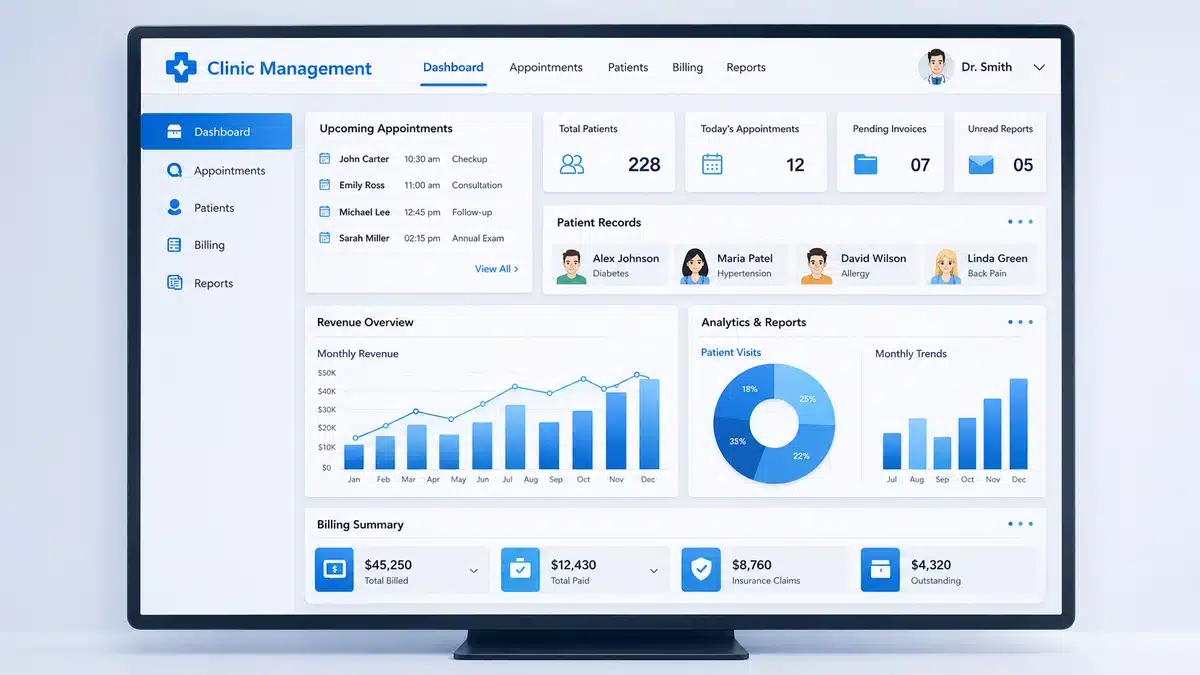
The lack of doctors is not a reason of struggle for healthcare; it is the flawed and broken systems.
Most problems in clinics like missed appointments, billing errors in healthcare, are operational, not clinical. If the workflow in your clinic is inefficient, no medical skill can make up for that.
The modern clinic management software is no longer a luxury item; it is a must have.
Do you miss managing and protecting clinical patient data regularly? Well, we all know how hectic it can get and how things can get misplaced. Now, we all want to keep our patient data safe and organized and Patient Management Systems came into existence just for that. Let’s delve deeper into what a patient management system is. In simpler terms, a patient management system is computer software that offers physicians a way to manage client data. It does this while improving the flow of information and its availability. With the help of this technology, healthcare systems now find it easier to utilize patient data, which leads to improved patient care outcomes.
Functionalities of a Clinic Management Software
Direct the patient requests with management software. Notify clients through automated appointment reminders. Closure should include notifications at the appointment locations. Monitor the quality of care through surveys. Prepare for treatment with mobile a home treatment instruction.
Why Clinics Fail When They Don’t Have A System
Most clinics fail not due to patient care but due to.
- Patient records are a mess.
- Incorrect or late generation of bills.
- Improper management of appointments.
- Lack of visibility across departments.
Reality backed by research:
According to the Office of the National Coordinator for Health IT, the lack of structured and accessible patient data can negatively impact care coordination, while effective digital systems improve patient outcomes and safety.
1. Smart Patient Registration & Centralized Records
Why this matters:
Electronic Health Records (EHRs) are no longer optional.
Research insight:
Modern EHR systems improve clinical decision-making and enable data-driven care delivery.
What you need:
- Digital patient registration
- Unified records
- Instant access to history
Without this, clinics waste time, repeat tests, and risk errors.
2. Intelligent Appointment Scheduling
The hard fact:
Missed appointments are not a minor issue—they’re a systemic problem.
Data-backed insight:
- Patient no-shows represent a significant operational burden in healthcare, with rates ranging from 23% to 27% across specialties and contributing to an estimated $150 billion annual loss in the U.S. healthcare system. The adoption of digital scheduling systems has emerged as a key solution, helping clinics reduce missed appointments while improving patient flow and operational efficiency.
- Digital scheduling systems significantly reduce no-shows and improve clinic efficiency.
What modern systems do:
- Real-time booking
- Automated reminders
- Rescheduling workflows
Impact:
Clinics adopting digital scheduling report:
- Reduced waiting time
- Better patient flow
- Higher satisfaction
3. Smooth due payments and accurate billing.
Billing mistakes in healthcare kill margins, let’s be honest.
Both operational inefficiencies and missed charges generate revenue leakage.
What a system must perform.
- Billing automation
- Pricing by service.
- Reduction of Errors
Humans can’t catch every charge, but automation can.
4. Integrated Systems for Pharmacy and Inventory
Poor inventory management equals silent loss.
All that you need.
- Stock tracking in real time.
- Expiry Notifications
- Integration of Suppliers
5. Improving Medical Staff Workflow
Doctors should avoid wasting time to navigate systems.
Importance of this. All systems available digital.
- Quicker appointments.
- Improved Diagnosis
- Lessened the load of administration
Reality.
Inefficient clinical operations negatively affect patient care and increase fatigue.
6. Analytics and reporting that motivate decisions.
When it comes to performance, guesswork is never a good idea.
What modern systems allow.
- Insights on revenue.
- Patterns in Appointments
- Operational gaps
Evidence-based knowledge.
Operational efficiency and patient management decisions getting much better because of predictive systems.
7. Role-Based Access & Data Security
Healthcare data is sensitive. One breach = massive trust loss.
Must-have:
- Controlled access
- Audit trails
- Secure systems
8. Cloud-Based Access
Outdated clinics rely on desktops. Modern clinics operate anywhere.
Why it matters:
- Remote monitoring
- Real-time updates
- Business continuity
9. Patient Engagement & Communication
Here’s something most clinics ignore:
Patients don’t return because of experience, not treatment.
Research proves:
- Patient portals and digital engagement tools significantly reduce no-shows
- In one large-scale study, digital portals contributed to 21 million fewer missed appointments annually
Features required:
- Reminders
- Follow-ups
- Feedback systems
10. Scalability for Growth
Most clinic management software fails here.
Why?
They’re built for small operations—not growing clinics.
What you need:
- Multi-location support
- High patient volume handling
- Flexible workflows
The Bigger Shift: From Software to Operational Backbone
Healthcare is moving toward integrated, data-driven systems.
Emerging trend:
AI-powered scheduling and analytics are helping clinics:
- Match demand with staffing
- Reduce burnout
- Improve efficiency
Where Mechsoft’s FlexiClinic fits in.
Many tools claim to do everything just make things more complicated.
What current clinics really do need is.
- Simplicity.
- Incorporation.
- Practical application.
FlexiClinic is an efficient and reliable clinic management software as it is based on actual clinic activities, not theoretical features. This doesn’t add complexity; rather, it simplifies every day tasks such as managing patient records, scheduling appointments, generating bills, and reporting within the system. Due to its compatibility with existing clinic workflows, which decreases administrative workload, mitigates billing mistakes in healthcare and enhances overall efficiency without steep learning curve, it is a good fit for modern-day clinics. For scalable business solutions to execute core operations of a clinic, FlexiClinic offers the best mix of usability, functionality and scalability.
Conclusion by
If your clinic continues to deal with.
- Hand-written notes.
- Misunderstanding of bills.
- Appointment disorder.
- Low visibility.
It’s not your staff that’s causing the problem; it’s your broken system.
It is essential to implement clinic management software. The basis for a scalable health care operation.
Frequently Asked Questions (FAQ):
Q.1. What should you look for in a clinic management software?
Ans. When choosing clinic management software, you should look for:
- Easy patient record management
- Automated billing and reduced billing errors in healthcare
- Smart appointment scheduling
- Real-time reporting and analytics
- Cloud-based accessibility
Modern solutions like FlexiClinic are designed to combine these features into a single platform, helping clinics streamline operations without adding complexity to their existing workflow.
Q.2. How can clinic management software solve common clinic problems?
Ans. Clinic management software helps address common clinic problems such as disorganized records, inefficient clinic workflow, and billing inaccuracies.
For example, platforms like FlexiClinic integrate patient data, billing, and scheduling into one system, allowing clinics to reduce manual work, improve coordination, and gain better operational visibility.
Q.3. How does clinic management software improve billing accuracy?
Ans. Billing errors in healthcare often occur due to manual data entry and disconnected systems.
A well-designed clinic management software automates billing by linking services, pricing, and patient records. Solutions like FlexiClinic help minimize errors by ensuring all billable services are captured accurately, improving revenue tracking and reducing financial discrepancies.
Q.4. Can clinic management software adapt to different clinic workflows?
Ans. Yes. One of the biggest challenges with traditional systems is that they force clinics to change their workflow.
Modern platforms like FlexiClinic are built to adapt to real-world clinic workflows, allowing customization based on clinic size, specialty, and operational needs—making adoption smoother and more practical.
Q.5. How does clinic management software support clinic growth?
Ans. As clinics grow, managing multiple patients, services, and locations becomes complex.
Scalable solutions like FlexiClinic support growth by offering:
- Centralized data management
- Multi-user access
- Real-time reporting
- Flexible system expansion
This allows clinics to scale operations without switching systems later.

