

Introduction
Even when a 3PL company has solid operational capabilities, such as well-run facilities, timely shipments, and meeting customer expectations, it can still experience inconsistency in profitability. The cause of this inconsistency often sits in an overlooked area: the 3PL billing process.
The 3PL billing process involves more than generating invoices. It includes tracking warehouse activities, applying client-specific rates, calculating transportation charges, and ensuring every billable service appears on the correct invoice.
However, manual billing can become a significant source of revenue leakage when charges are missed, incorrect rates are applied, or invoices are delayed.
What Is the 3PL Billing Process?
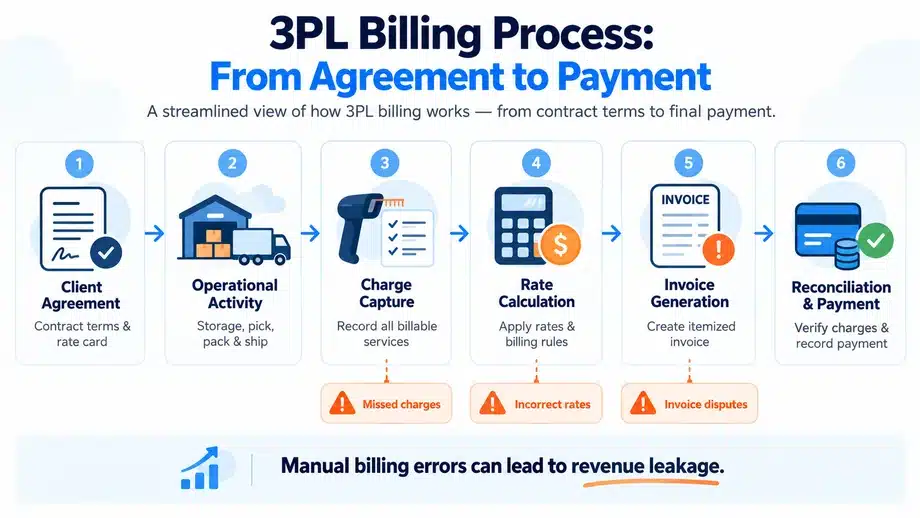
The 3PL billing process is the method third-party logistics providers use to calculate, invoice, and collect payments for services such as warehousing, storage, order fulfillment, transportation, and value-added activities.
A typical 3PL billing process follows this sequence:
Client agreement → Operational activity → Charge capture → Rate calculation → Invoice generation → Reconciliation/payment
For example, a 3PL provider may charge one client based on pallet storage and another based on orders processed. The billing team must record the activities, apply the agreed rates, and generate accurate invoices.
Why 3PL Billing Is More Complex Than Normal Invoicing
Unlike standard invoicing, where a customer may pay a fixed amount for a product or service, 3PL billing involves multiple activities, pricing structures, and billing cycles.
A standard 3PL operation should be able to handle:
- Different billing structures for multiple clients
- Rate cards based on contracts
- Storage slabs and variable warehouse charges
- Value-added services like labelling, kitting, and repacking
- Operations of warehouses in multiple locations
- Transportation and carrier integrations
- Fuel surcharges and additional accessorial charges
- Recurring storage or service charges
- Order-related picking, packing, and handling charges
- Returns processing and billing adjustments
- Weekly, monthly, or event-based billing cycles
An analysis by AFS Logistics of nearly 250,000 LTL freight invoices found 11,881 billing errors, approximately 4.5% of the invoices audited. Of these errors, 42.8% involved incorrect accessorial charges, while 14.4% were related to fuel surcharges. These findings show how easily billing discrepancies can occur when multiple charges and pricing rules are involved.
Managing these billing rules manually becomes difficult as operations expand.
Where Revenue Is Lost in a Manual 3PL Billing Process
Revenue leakage in a 3PL company is not always caused by fraud or poor operational performance. Often, it occurs because the billing process fails to capture or calculate charges correctly.
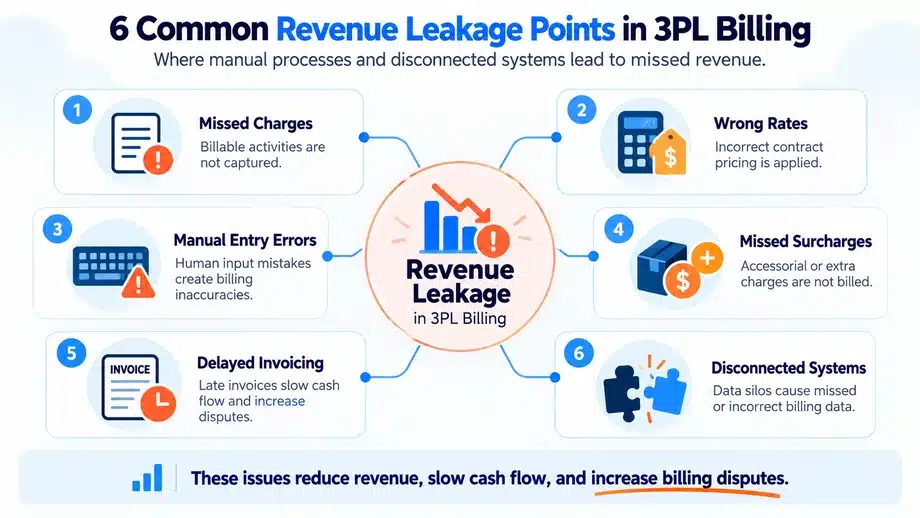
1. Missed Billable Events and Accessorial Charges
Additional services such as detention, repacking, labelling, quality checks, special handling, longer storage, returns, and additional picking activities may go unbilled if they are not recorded.
If the 3PL billing process is manual, these services may be provided without the corresponding charges appearing on the invoice.
For example, if a warehouse performs additional repacking for a client but the activity is not recorded in the billing sheet, the service may never be billed.
2. Incorrect Rate-Card Calculations
Clients may have slab-based storage, per-pallet, per-SKU, or hybrid pricing agreements.
When calculations are performed manually, employees must check contract references, select the correct rates, calculate charges, and identify duplicate entries.
A simple mistake, such as applying an outdated storage rate or selecting the wrong pricing slab, can result in an incorrect invoice.
3. Manual Data-Entry Errors
Billing teams often collect data from spreadsheets, warehouse reports, emails, and transport records. Each time information is entered or transferred manually, there is a possibility of missing, duplicating, or incorrectly recording a transaction.
For example, if 210 pallets are handled but only 180 are entered into the billing sheet, the company may undercharge for 30 pallets.
4. Delayed Invoicing and Cash Flow Pressure
In many 3PL operations, finance teams collect month-end data from multiple sources, delaying invoices and affecting cash flow while operational expenses continue.
A 3PL company that dispatches efficiently but bills slowly is financing its clients unintentionally.
Delayed invoicing also creates additional reconciliation work when billing teams need to verify activities from several weeks earlier.
5. Disputes and Audit Challenges
Clients expect clear breakdowns of storage, handling, and transportation charges. Without structured audit trails, 3PL companies face invoice disputes, payment delays, credit note adjustments, and loss of client trust.
A 2024 study published in the International Journal of Current Science Research and Review examined revenue leakage in the revenue-recognition process at Gajah Logistics. Using the Six Sigma DMAIC approach, the researchers identified process inefficiencies and evaluated improvements to reduce revenue loss.
6. Disconnected Operational and Billing Systems
When warehouse and billing systems are disconnected, finance teams must manually collect activity records, increasing the risk of missed charges and delayed invoices.
Underbilling vs Overbilling in 3PL Billing
Manual billing errors can result in either underbilling or overbilling. Both create financial problems, although their effects are different.
|
Underbilling |
Overbilling |
| The client is charged less than the agreed amount. | The client is charged more than the agreed amount. |
| Causes direct revenue loss. | May result in invoice disputes and refunds. |
| Example: A repacking charge is missed. | Example: A client is charged for 120 pallets instead of 100. |
| Reduces recoverable revenue. | Can delay payment and damage client trust. |
Underbilling can go unnoticed because the client has little reason to question a lower invoice. Overbilling, however, is more likely to result in complaints, credit notes, or payment disputes.
How Manual Billing Errors Affect 3PL Profitability
Manual billing error → Incorrect invoice → Dispute or missed revenue → Delayed payment → Reduced margin → Poor client experience
When a company underbills, it may lose revenue for services already delivered. When it overbills, employees may spend additional time investigating disputes, correcting invoices, and processing adjustments.
The Financial Reality for a 3PL Company
For example, a 3PL company generating $10 million annually could lose $300,000 if 3% of its revenue goes unbilled. This is a hypothetical example, but it shows how billing errors can affect profitability.
How Client-Specific Rate Cards Create Billing Complexity
Each customer has different commercial terms.
Consider a 3PL company serving three clients with different pricing agreements:
|
Client |
Billing structure |
Example |
| Client A | Storage-based billing | $12 per pallet per month |
| Client B | Order-handling billing | $2 per order plus handling charges |
| Client C | Special contract terms | Fixed monthly fee plus return-processing charges |
These rates are illustrative examples only.
If Client A receives a discount, Client B increases order volume, or Client C adds repacking services, billing rules must be updated accordingly. Outdated Excel formulas or missed contract changes can lead to incorrect invoices across multiple billing cycles.
Why Manual 3PL Billing Becomes Worse as the Business Grows
Manual billing may work with fewer clients and consistent volumes, but growing 3PL operations involve more transactions, complex contracts, and changing storage requirements.
As the business grows, billing complexity increases because:
- The number of clients and contracts increases.
- Order volumes create more billable activities.
- Warehouse activity becomes more difficult to track manually.
- Rate cards include additional pricing rules and exceptions.
- More employees become involved in recording and approving charges.
- Multiple software systems create additional data handoffs.
3PL Billing Process vs Automated Billing Process
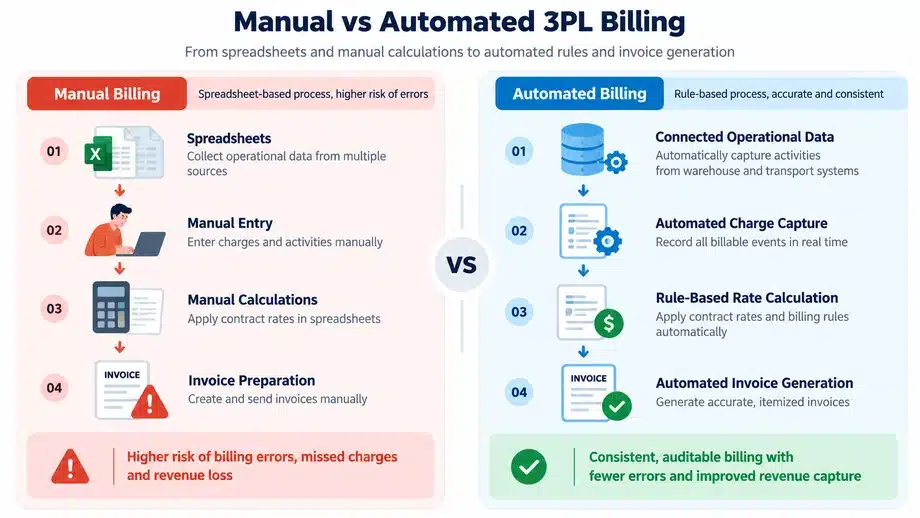
The main difference between manual and automated billing is how operational activities are captured, calculated, and converted into invoices.
|
Billing activity |
Manual billing process |
Automated billing process |
| Charge capture | Employees record activities manually. | Configured systems capture billable activities from operational records. |
| Rate calculation | Rates are selected and calculated using spreadsheets. | Client-specific rate rules are applied automatically. |
| Invoice preparation | Information is collected from multiple sources. | Invoices can be generated from available billing records. |
| Approval | Invoices are reviewed through emails or spreadsheets. | Approval workflows and exception checks can be configured. |
| Reconciliation | Finance manually matches invoices with records. | System-assisted matching helps identify discrepancies. |
| Reporting | Reports are prepared manually. | Billing and revenue information can be viewed centrally. |
Automation can reduce repetitive work and improve consistency, but it does not eliminate the need for accurate data, updated rate cards, and invoice reviews.
Why 3PL Billing Should Connect With Operational and Accounting Systems
When warehouse operations and finance systems are disconnected, billable activities may be missed or invoiced late.
A reliable billing process should connect information from:
- Warehouse management systems: Storage, receiving, picking, handling, and inventory activities.
- Order management systems: Order processing, fulfillment, and related charges.
- Dispatch and transportation systems: Shipment movements, carrier charges, and accessorial services.
- Accounting systems: Approved invoices, payments, receivables, and reconciliation records.
Connecting these systems can reduce manual entries, improve reconciliation, speed up invoice generation, and provide better visibility into revenue and outstanding payments.
Best Practices to Improve the 3PL Billing Process
- Define client-wise billing rules clearly: Document rates, contract terms, discounts, and special charges.
- Capture every billable activity: Record additional services when they occur rather than reconstructing them at month-end.
- Review rate cards regularly: Verify contract updates and ensure outdated rates are not used.
- Connect billing with operations: Make warehouse, order, dispatch, and transportation data available to the billing team.
- Automate recurring charges where possible: Reduce repeated manual calculations for fixed storage and service fees.
- Reconcile invoices before sending: Compare invoiced quantities and charges with operational records.
- Maintain audit trails: Keep records of billing adjustments, approvals, and client disputes.
Final Perspective: Improving the 3PL Billing Process Protects Revenue
The logistics industry is on the rise, but that doesn’t mean companies are automatically making money.
A lot of 3PLs don’t lose revenue because they’re performing poorly or missing deliveries. The problem may occur during billing, when the process fails to keep up with daily operations.
If you’re still juggling spreadsheets, firing off emails, and trying to piece together data from all over the place, billable activities can easily be overlooked.
Even teams that do everything right can end up with financial losses that nobody notices at first.
As business picks up and transactions pile up, it gets even harder to keep billing in sync with the work you’re doing.
This is why connecting warehouse operations, transportation records, client-specific rate cards, and billing information becomes increasingly important.
Take Mechsoft’s iLogistech – 3PL logistics software, for example.
It supports connected logistics workflows, customer billing based on contract terms, and accounts receivable and payable management. Such capabilities can help 3PL businesses reduce the manual coordination involved in operational billing.
Ultimately, improving the 3PL billing process is not just about generating invoices faster. It is about ensuring that the company accurately bills for the services it provides, reduces avoidable disputes, and protects its profitability.
Frequently Asked Questions About the 3PL Billing Process
Q. 1. What is the 3PL billing process?
A. The 3PL billing process involves recording logistics activities, applying client-specific rates, generating invoices, and reconciling payments. It covers services such as warehousing, storage, transportation, order fulfillment, and additional handling.
Q. 2. Why is 3PL billing more complex than normal invoicing?
A. 3PL billing involves multiple pricing structures, client-specific contracts, storage charges, transportation fees, recurring services, and different billing cycles. Each activity must be charged according to the relevant agreement.
Q. 3. Where do 3PL companies lose revenue in manual billing?
A. Common revenue leakage points include missed billable activities, incorrect rate calculations, manual data-entry errors, unrecorded accessorial charges, and delayed invoicing.
Q. 4. What is the difference between underbilling and overbilling?
A. Underbilling happens when a company charges less than the agreed amount, resulting in revenue loss. Overbilling happens when it charges more than agreed, which can cause invoice disputes, payment delays, and client dissatisfaction.
Q. 5. How can automation improve the 3PL billing process?
A. Automation can capture operational charges, apply configured client rates, generate invoices, and improve billing visibility. It also reduces repeated manual entries and helps finance teams identify discrepancies.
Q. 6. Why should 3PL billing connect with accounting systems?
A. Connecting billing with accounting systems helps reduce duplicate data entry, improve reconciliation, track receivables, and provide more consistent financial records. It also supports faster invoice processing and better payment visibility.


