Introduction: –
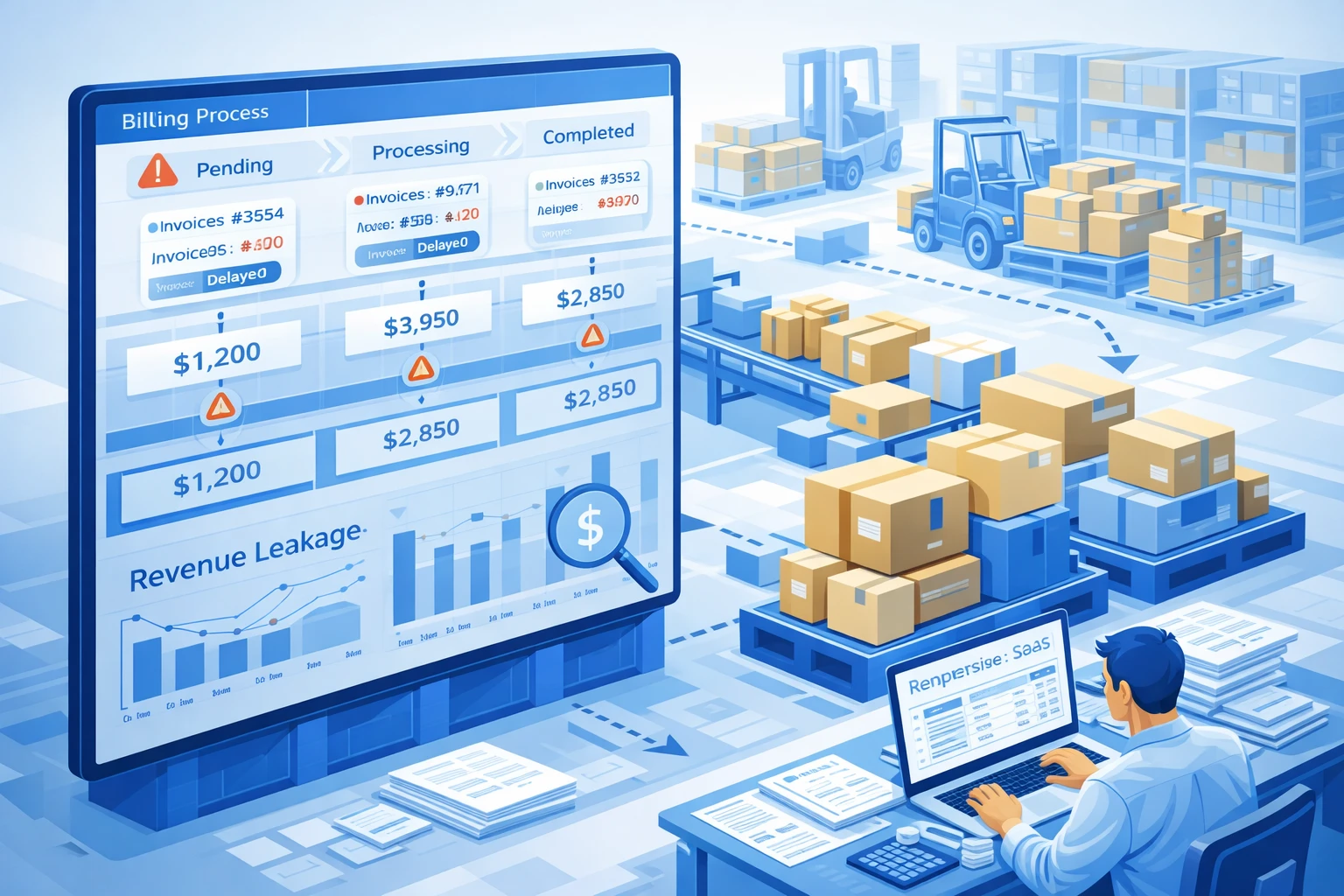
Even when a 3PL company has solid operational capabilities, such as having well-run facilities, timely ability to ship products and meeting customer expectations, it can still experience inconsistency with profitability. The cause of this inconsistency often sits in an overlooked area: the 3PL billing process. Billing or invoicing isn’t typically viewed as a very risky process; it’s generally perceived as a fairly manageable process. However, the process can be the single largest source of revenue leakage today within the 3PL industry. Let’s examine this more closely by reviewing factual information, instead of assumptions.
The scale of the 3PL Industry and the risk
As the volumes increase, the complexity of billing increases exponentially. A standard 3PL operations should be able to handle:
- Different billing structures for multiple clients
- Rate cards based on contracts
- Storage slabs and variable warehouse charges
- Value-added services like labelling, kitting, and repacking
- Operations of warehouses in multiple locations
- Transportation and carrier integrations
Now think of this simple question: Is it feasible for an expanding 3PL company to handle this magnitude of billing intricacy with spreadsheets and manual computations? With each shipment, storage event, and value-added service, the number of chargeable occurrences increases. The greater the volume of transactions, the faster one will approach full capacity for undercharging, misapplying rates, and invoicing errors.
Industry research confirms this concern. An analysis by AFS Logistics that looked at nearly 250,000 LTL freight invoices found many with discrepancies in billing, such as wrong accessorial charges, fuel surcharge errors, and freight classification mistakes. These findings show how complicated environments for freight billing can easily lead to financial inaccuracies if the processes are not adequately automated or monitored.
Where does revenue actually leak in a 3PL Company?
Revenue leakage in the 3PL company is not due to any fraudulent activities. The revenue leakage is due to the lack of process.
1. Missed Accessorial Charges
- Detention charges
- Repacking
- Labelling
- Quality checks
- Special handling
- Late dispatch
- Longer storage
If the 3pl billing process is manual, these services will be provided, and the customers will not be billed. For a mid-sized 3PL company, the percentage is not negligible; it is the margin.
2. Rate Card Calculations
Each customer has different commercial terms.
- Slab-based storage
- Per-pallet pricing
- Per-SKU handling
- Hybrid pricing
If the calculation is manual, there is a high chance that the calculation is incorrect.
- Slab rates
- Contract references
- Calculate
- Duplicate entries
The manual calculation is not only time-consuming; it is statistically incorrect.
3. Delayed Invoicing and Cash Flow Pressure
In many 3PL operations, billing is compiled at month-end. Data is collected from warehouse systems, emails, and operational logs.
The result?
Invoices are delayed.
Cash flow timing matters deeply in logistics, where operational expenses are constant. A delayed invoice cycle directly affects working capital stability.
A 3PL company that dispatches efficiently but bills slowly is financing its clients unintentionally.
4. Disputes and Audit Challenges
Clients today expect transparency. They want detailed breakdowns of storage duration, handling frequency, and transportation charges.
Manual 3PL operations struggle to provide structured audit trails.
This leads to:
- Invoice disputes
- Payment delays
- Credit notes adjustments
- Relationship strain
Disputes are not just accounting issues. There are trust issues.
A study published in the International Journal of Current Science Research and Review reveals the impact of inefficiencies in revenue recognition processes, which might directly translate into financial losses for logistics companies. The study clearly indicates that revenue loss might occur because of poorly structured billing and revenue workflow processes, which are mostly based on manual operations. By implementing Six Sigma methodologies, organizations might be able to identify the root causes of errors in billing processes, thus streamlining the financial workflow process to reduce revenue loss.
Why Manual Billing Fails as a 3PL Company Scales
Let’s get straight to it.
Manual billing is effective when:
- You have 5-10 clients
- Volumes are consistent
- Services are similar
But 3PL is not a simple business. Warehousing has thousands of transactions daily.
Clients need unique reporting solutions. Contracts are complex. Storage periods are dynamic. As volumes grow, the chances of error grow too. Not because of human error, but because of system design.
Human-based systems fail with high data density.
The Operational-Billing Disconnect
One of the largest structural flaws in the 3PL industry is the disconnect between the operations side and the billing side. Warehouse operations deliver the service.
Finance operations bills the customer later. However, if the billing function is not directly connected to the operations function, the ability to manage revenue is not real-time. Everyone in the industry understands the shift from a linear to a nonlinear approach to billing and revenue management. However, the question is who will begin to shift.
The Role of 3PL Automation in Revenue Protection
This is where 3PL automation changes the conversation about the importance of 3PL billing and revenue management.
3PL automation is not simply about reducing workload; it is about protecting revenue.
A formal approach to 3PL billing and revenue management through automation means:
- Automatic capture of value-added services
- Automatic application of the rate card
- Automatic real-time storage calculations
- Automatic activity-based billing triggers
- Automatic generation of invoices
This is not about replacing people; it is about eliminating errors.
The Competitive Risk of Staying Manual 3PL Operations
Let’s look at the situation from the strategic point of view. There are two 3PL companies competing in the same industry. They have the same level of infrastructure.
They have the same level of clients. One company has manual billing processes. The other company has a structured 3PL automation platform.
The company with the automation platform will have:
- Higher billing accuracy
- Faster collections
- Higher visibility into revenue
- Improved forecasting
- Lower dispute rates
These advantages will add up over time. Profit margin differences in the logistics industry can be operationally invisible but financially critical.
Subtle but Critical: Technology as Margin Insurance
3PL companies that think ahead aren’t investing in automation because it’s shiny and new. They’re doing it because manual processes create invisible financial risk.
3PL automation platforms that link warehouse operations with billing logic help eliminate reliance on memory, emails, and spreadsheets.
The Financial Reality
Imagine a 3PL company pulling in $10 million a year. If just 3% slips through the cracks because of manual mistakes, that’s $300,000 gone. Not because the market’s bad. Not because clients walked away. Just lost to broken processes. Now, think about what happens as these companies grow. This isn’t some tiny efficiency tweak. It’s about getting serious with your finances.
Final Perspective
The logistics industry is on the rise, but that doesn’t mean companies are automatically making money. A lot of 3PLs don’t lose revenue because they’re slacking off or missing deliveries. The real problem sneaks in during billing when the process can’t keep up with what’s actually happening day to day. If you’re still juggling spreadsheets, firing off emails, and trying to piece together data from all over the place, you’re probably missing out on money you’ve earned. Even teams that do everything right can end up with financial losses that nobody notices at first. As business picks up and transactions pile up, it gets even harder to keep billing in sync with the work you’re doing. That’s why more of the top logistics firms are switching to automation platforms. These platforms align everything together including warehouse operations, transportation details, and billing under one roof.
Take Mechsoft’s iLogistech– 3PL logistics software, for example. It’s built to keep things in line. By linking your operations straight to billing triggers, it makes sure everything right from storage fees to contract pricing reflects automatically on invoices.
You don’t have to slog through manual calculations or double-check every line item. The result? Billing gets faster and more accurate; you can actually see where your revenue stands, and you get a better handle on cash flow.