
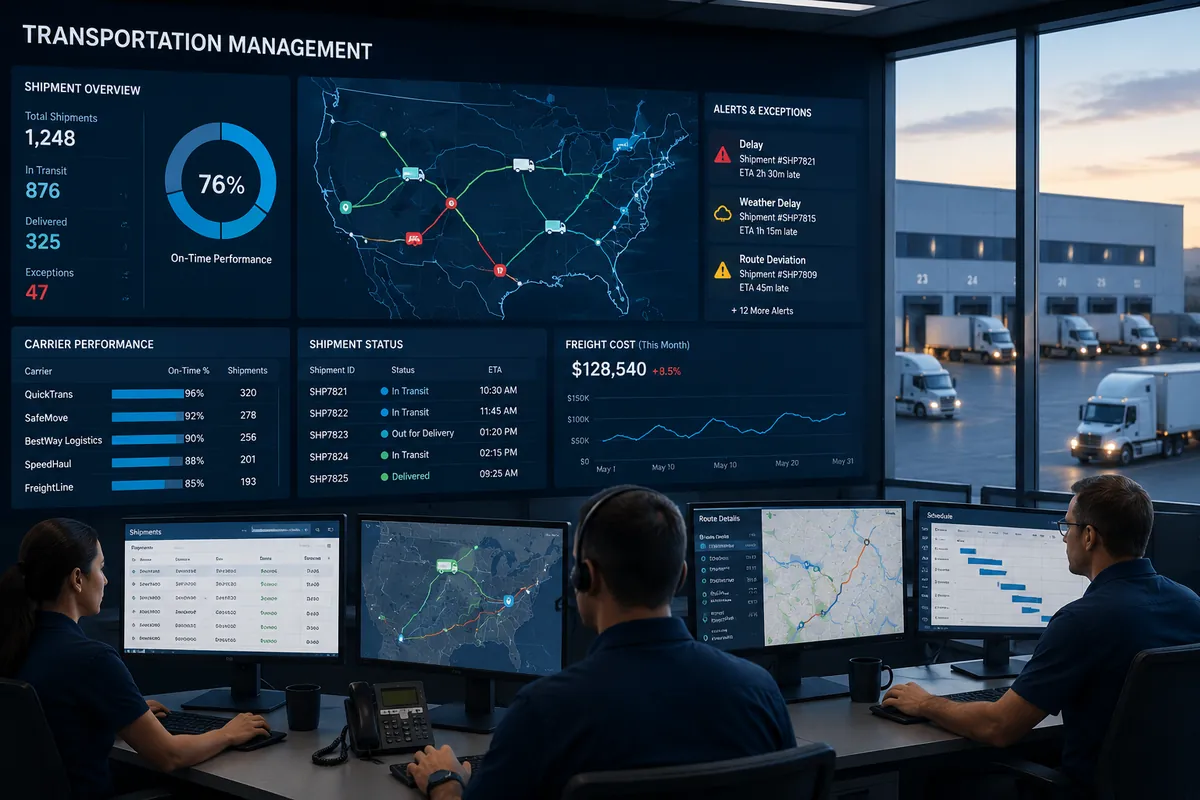
Transportation management software has become an essential tool for controlling one of the most difficult parts of logistics. Freight costs fluctuate, customers expect faster deliveries, carrier capacity changes constantly, and logistics teams are under pressure to provide real-time visibility from pickup to final delivery.
For 3PL providers, warehouses, distributors, manufacturers, retailers, and eCommerce companies, managing transportation through spreadsheets, phone calls, emails, and disconnected systems is inefficient. It creates delays, billing errors, poor carrier visibility, and unnecessary transportation costs.
That is where transportation management software starts to make a difference.
A Transportation Management System, commonly called TMS software, is a logistics platform used to plan, execute, track, and optimize the movement of goods. Oracle defines a TMS as a platform that helps businesses plan, execute, and optimize the physical movement of goods, both inbound and outbound. IBM also describes a TMS as a real-time logistics tool for managing inbound and outbound shipping.
In day-to-day operations, transportation management software helps logistics teams answer five key questions:
- How should this shipment move?
- Which carrier or mode should be used?
- What should the shipment cost?
- Is the shipment moving on time?
- Was the freight invoice accurate?
For growing logistics companies, especially 3PLs, TMS has moved beyond being optional and is increasingly used as a core logistics system.
What Is Transportation Management Software (TMS )?
TMS software is a system that manages the transportation side of logistics. It helps businesses plan shipments, select carriers, optimize routes, track freight, manage exceptions, and support freight audit and payment.
SAP describes a transportation management system as software that helps companies manage the logistics of moving physical goods by land, air, sea, or a combination of transportation modes.
A simple definition is this:
Transportation management software helps businesses move goods between locations more efficiently while maintaining cost control and shipment visibility.
It does not replace warehouse operations, inventory management, or order processing. Instead, it connects with those systems to manage what happens after goods are ready to move.
For example, a warehouse may pick and pack an order using a warehouse system. Then the TMS determines the best carrier, route, delivery schedule, transportation cost, and tracking process.
This is why TMS in logistics is especially important for businesses that manage:
- Multiple carriers
- High shipment volumes
- Multi-location distribution
- Inbound and outbound freight
- Customer delivery commitments
- Freight billing and reconciliation
- 3PL transportation workflows
Why Logistics Teams Use Transportation Management Software
Transportation influences more than deliveries alone. It directly affects customer satisfaction, delivery performance, operating costs, carrier relationships, and cash flow. The growth of the TMS market reflects increasing demand for transportation visibility, automation, and freight cost control.
Without transport management software, logistics teams often face the same recurring problems:
- Manual shipment planning
- Poor carrier rate comparison
- Limited shipment visibility
- Delayed delivery updates
- High freight costs
- Duplicate data entry
- Freight invoice errors
- Weak reporting
- Slow customer communication
As a result, a TMS reduces manual effort by automating transportation tasks and providing clearer visibility into shipment activity.
In addition, for 3PL companies, this matters even more. A 3PL is not only managing its own operations; it is also managing customer expectations. If shipment updates are late, carrier performance is unclear, or billing is inaccurate; the 3PL’s reputation suffers.
That is why logistics teams need better coordination between transportation updates, tracking, customer communication, and reporting.
How Transportation Management Software Works
A TMS usually supports the full transportation lifecycle: planning, execution, visibility, and settlement.
A typical transportation workflow follows these steps.
1. Shipment Data Enters the TMS
The process begins when order or shipment data enters the system. This data may come from an ERP, WMS, order management system, customer portal, or manual upload.
The TMS receives details such as:
- Origin and destination
- Shipment weight and dimensions
- Delivery date
- Service level
- Product type
- Carrier requirements
- Customer instructions
Therefore, accurate shipment data is important because planning decisions depend on it.
2. The TMS Plans the Shipment
The system evaluates shipment requirements and recommends how the freight should move.
This may include:
- Mode selection
- Carrier selection
- Route planning
- Load consolidation
- Delivery scheduling
- Cost comparison
For example, if multiple shipments are going to nearby locations, the TMS may recommend consolidation to reduce transportation costs.
3. Carrier Selection and Tendering
The TMS compares available carriers based on rates, transit times, service levels, historical performance, and capacity. Once the best option is selected, the system can tender the load to the carrier. If the carrier rejects it, the TMS can move to the next carrier in the routing guide. Consequently, this can reduce the amount of manual coordination required with carriers.
4. Shipment Execution
After a carrier accepts the shipment, the TMS manages execution details such as:
- Pickup scheduling
- Dispatch instructions
- Bills of lading
- Shipment documentation
- Carrier communication
- Delivery milestones
This stage covers the actual execution of the shipment.
5. Real-Time Shipment Tracking
Modern transportation management software provides shipment visibility while freight is in transit.
Teams can track:
- Pickup status
- Current shipment location
- Estimated arrival time
- Delays
- Exceptions
- Delivery confirmation
With better visibility, teams can identify and address issues earlier in the shipment process.
6. Freight Audit and Payment
After delivery, the TMS can compare carrier invoices against agreed rates, accessorial charges, contracts, and shipment details.
This helps identify:
- Overcharges
- Duplicate charges
- Incorrect accessorial fees
- Contract mismatches
- Billing disputes
However, freight audit is often overlooked, and recurring invoice errors can add up quickly across large shipment volumes.
Key Features of Transportation Management Software
TMS capabilities vary, but most platforms include the following features.
Carrier Management
A TMS helps maintain carrier profiles, contracts, rates, service areas, performance history, and communication records. As a result, teams gain a structured way to evaluate carrier options.
Rate Management
Rate management allows logistics teams to store and compare contract rates, spot rates, fuel charges, and accessorial fees. As a result, this helps control freight spend and improves quote accuracy.
Route Optimization
Route optimization helps determine the most efficient route based on delivery windows, distance, cost, capacity, traffic, and service requirements. Businesses handling multi-stop deliveries or regional distribution often rely on this capability.
Load Planning
Load planning helps maximize trailer, truck, or container utilization. Better load planning can reduce wasted space, improve shipment consolidation, and lower transportation cost per order.
Shipment Tracking
Shipment tracking gives teams visibility into freight movement from pickup to delivery. It provides better visibility for both internal teams and customers.
Exception Management
A good TMS should surface operational issues, not just report shipment status. Exception alerts help teams respond to delays, missed pickups, route changes, carrier issues, and delivery failures.
Freight Audit and Settlement
Freight audit tools compare actual invoices with contracted rates and shipment details. Therefore, this helps reduce billing leakage and improves financial control.
Reporting and Analytics
Transportation analytics help measure:
- Freight cost
- Cost per shipment
- On-time delivery
- Carrier performance
- Tender acceptance
- Shipment delays
- Invoice discrepancies
- Customer service levels
Analytics help transportation teams identify trends, measure performance, and make informed decisions.
Integrations
TMS software becomes far more valuable when it integrates with other systems, including:
- WMS
- ERP
- Accounting software
- Customer portals
- Carrier APIs
- EDI systems
- Parcel platforms
- Visibility tools
Oracle notes that a TMS can be part of a broader supply chain management system and supports transportation operations across inbound and outbound movement.
For 3PLs, integration is often necessary because disconnected systems increase manual effort.
Benefits of Transportation Management Software
1. Lower Transportation Costs
Cost control is one of the primary reasons companies invest in transportation management software.
A TMS helps reduce freight costs through:
- Better carrier selection
- Route optimization
- Load consolidation
- Rate comparison
- Reduced manual errors
- Freight invoice validation
Oracle notes that a transportation management system can help run operations more efficiently, reduce freight costs, and optimize service levels.
2. Better Shipment Visibility
Shipment visibility allows teams to know where freight is, whether it is on schedule, and what action is needed.
As a result, this reduces blind spots and improves customer communication.
3. Faster Decision-Making
Instead of checking emails, calling carriers, and manually updating spreadsheets, logistics teams can make decisions from one system.
Consequently, this speeds up dispatching, exception handling, and customer response.
4. Improved Customer Service
Customers expect accurate delivery updates. A TMS helps provide better ETAs, proactive delay notifications, and more reliable delivery information.
For 3PLs, this can become a competitive advantage.
5. Reduced Manual Work
A TMS automates repetitive tasks such as rate comparison, carrier tendering, document generation, tracking updates, and freight audit.
This frees operations teams to focus on exceptions and improvement instead of basic admin work.
6. Stronger Carrier Performance Management
With TMS analytics, businesses can measure which carriers perform well and which ones create problems.
This helps improve carrier negotiations, routing guide decisions, and service quality.
7. Better Scalability
Manual transportation processes may work at low volume. They break when order volume grows.
TMS software helps logistics businesses scale without adding unnecessary headcount.
Transformation Management Software in Logistics: Who Uses It?
Transportation management software is used by any business that regularly moves goods and needs better control over cost, visibility, and execution.
3PL Providers
3PL providers use TMS software to manage shipments for multiple customers, coordinate carriers, track deliveries, handle documentation, and improve customer visibility.
For 3PLs, transportation management is often part of a broader operational system that includes warehousing, order processing, billing, tracking, and customer communication.
Warehouses and Distribution Centers
Warehouses use TMS to coordinate outbound shipments after orders are picked and packed.
A warehouse may use WMS for inventory and fulfillment, then TMS for carrier selection, dispatch, route planning, and shipment tracking.
Manufacturers
Manufacturers use transportation management software to manage inbound raw materials and outbound finished goods.
This is how manufacturers can reduce production delays and improve delivery reliability.
Retailers and eCommerce Companies
Retailers and eCommerce companies use TMS to manage high-volume parcel, LTL, and last-mile transportation.
The focus is on improving delivery performance, controlling transportation costs, and keeping customers informed.
Distributors and Wholesalers
Distributors use TMS software to manage multi-stop deliveries, route planning, carrier coordination, and delivery performance.
WMS vs TMS: What Is the Difference?
The WMS vs TMS question comes up often because both systems are part of logistics operations. But they solve different problems.
The WMS vs TMS difference is simple: In general, WMS manages warehouse activity, while TMS manages transportation once goods are ready for shipment.
A Warehouse Management System (WMS) manages what happens inside the warehouse.
A Transportation Management System (TMS) manages what happens when goods move between locations.
| Area | WMS | TMS |
| Main purpose | Manage warehouse operations | Manage transportation operations |
| Core focus | Inventory, receiving, putaway, picking, packing | Shipment planning, carrier selection, routing, tracking |
| Main users | Warehouse managers, inventory teams, fulfillment teams | Transportation managers, dispatchers, logistics planners |
| Key benefit | Better inventory accuracy and warehouse productivity | Lower freight cost and better shipment visibility |
| Main problem solved | “We cannot control inventory and fulfillment properly.” | “We cannot control freight cost, carriers, and delivery visibility.” |
A WMS helps answer:
- What inventory do we have?
- Where is it stored?
- What needs to be picked?
- Has the order been packed?
- Is the warehouse workflow efficient?
A TMS helps answer:
- Which carrier should move this shipment?
- What route should be used?
- What will it cost?
- Where is the shipment now?
- Was the freight invoice correct?
Many companies try to use one system for both functions, which can create operational gaps. If your main issue is warehouse accuracy, you need WMS capabilities. If your main issue is transportation cost and visibility, you need TMS capabilities. If you manage both warehouse and transportation workflows, you likely need both systems connected.
How Transportation Management Software (TMS) and Wearhouse Management Software (WMS)Work Together
Many high-performing logistics operations integrate WMS and TMS rather than managing them separately.
A typical workflow looks like this:
- Customer order enters the system.
- Warehouse receives the fulfillment task.
- WMS manages picking, packing, and inventory updates.
- Shipment details move to the TMS.
- TMS selects the carrier and route.
- Carrier picks up the shipment.
- TMS tracks the shipment in transit.
- Delivery confirmation and billing data are recorded.
This connected workflow gives logistics teams end-to-end visibility from warehouse activity to final delivery. For 3PL businesses, this is especially important because clients want transparency. Clients are generally focused on receiving accurate status updates and reliable service, regardless of where a delay occurs.
As a result, many businesses are moving toward integrated logistics platforms rather than separate point solutions.
How to Choose the Right Transportation Management Software?
When evaluating transport management software, it is often more useful to begin with operational requirements than feature lists.
Before evaluating vendors, ask these questions.
What transportation problems are we trying to solve?
Define the requirements clearly. Do you need to reduce freight cost? Improve shipment visibility? Automate carrier tendering? Manage
customer-specific 3PL workflows? Reduce invoice errors?
Software selection tends to be more effective when objectives are clearly defined.
Does the TMS integrate with your existing systems?
Your TMS should connect with your WMS, ERP, accounting system, carrier network, and customer systems. If it does not integrate, your team will keep re-entering data manually.
Can it support your transportation modes?
Some businesses need parcel. Others need LTL, FTL, ocean, air, rail, or multi-modal transportation. Consider future transportation requirements rather than focusing only on current needs.
Does it support customer-specific workflows?
For 3PLs, this is particularly critical. Different clients may have different billing rules, delivery SLAs, documentation requirements, carrier preferences, and reporting needs. A highly inflexible system can become difficult to manage as requirements change.
Does it provide useful analytics?
A good TMS should help you measure cost, service, carrier performance, exceptions, and profitability. Dashboards are most valuable when the underlying data supports decision-making.
Can it scale?
Your TMS should support higher shipment volumes, more locations, more users, more carriers, and more complex workflows over time.
Transportation Management Software Implementation Checklist
A TMS implementation can fail if the business underestimates data quality, carrier onboarding, integrations, or process design.
Use this checklist before implementation.
| Checklist Item | What to Confirm |
| Business scope | Which modes, regions, customers, and workflows will be included? |
| Shipment data | Are order, location, weight, dimension, and service-level details accurate? |
| Carrier data | Are carrier contracts, rates, lanes, and accessorial rules updated? |
| Integration needs | Which systems must connect to the TMS? |
| Carrier onboarding | Which carriers need API, EDI, portal, or manual access? |
| Workflow design | Who handles tendering, exceptions, tracking, billing, and disputes? |
| KPI baseline | What are current freight costs, delivery rates, and invoice error rates? |
| Pilot plan | Which customer, lane, or location should be tested first? |
| User training | Do dispatch, warehouse, finance, and customer service teams know their roles? |
Buying TMS software alone will not resolve underlying transportation process issues. It often makes existing process weaknesses more visible. If your carrier data, shipment data, billing rules, and workflows are messy, the software will make that mess visible.
This highlights the importance of proper preparation before implementation.
Final Thoughts
Transportation management software helps businesses plan, execute, track, and optimize freight movement. It gives logistics teams better control over carrier selection, route planning, shipment visibility, freight costs, and billing accuracy.
Companies with simple shipping requirements may be able to rely on basic tools, while organizations managing more complex transportation operations often benefit from TMS software.
The key is understanding the role TMS plays within the broader logistics environment.
A WMS manages warehouse operations. A TMS manages transportation operations. ERP manages broader business processes. Many logistics organizations integrate these systems rather than relying on a single platform to perform every function.
For 3PLs and logistics businesses, transportation management software is often most effective when it operates as part of a connected logistics ecosystem that supports visibility, operational efficiency, customer service, and growth.


