
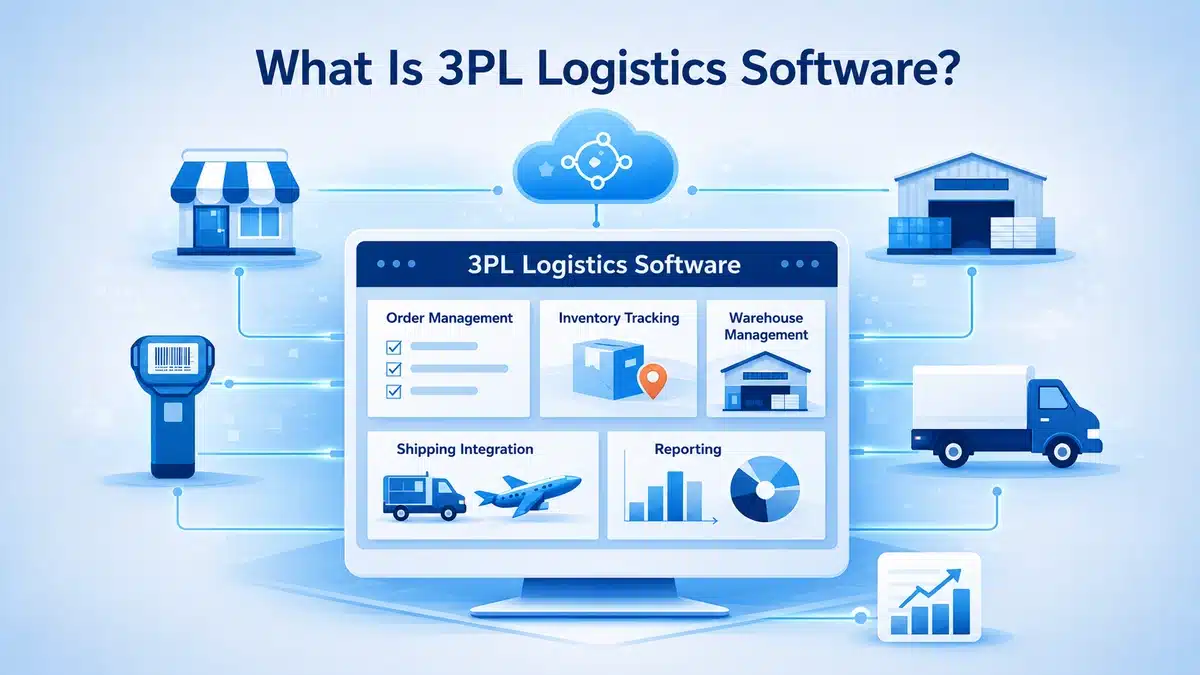
The worldwide supply chain is accelerating at an unprecedented pace. Consumers now demand same-day shipping, real-time tracking, precise documentation, and no delays. For third-party logistics providers, handling this increasing complexity manually is no longer sustainable, which is why many businesses are turning to 3PL Logistics Software to manage operations more efficiently.
The worldwide logistics sector was assessed at $9.6 trillion in 2023 and is anticipated to attain $14.3 trillion by 2030, exhibiting a compound annual growth rate (CAGR) of approximately 5.6%. This expansion is fuelled by the rise of e-commerce, the intricacies of global supply chains, and the demands for just-in-time delivery.
This is where 3PL logistics software plays a crucial role.
Rather than managing spreadsheets, disparate warehouse tools, emails, and accounting systems, 3PL providers utilize centralized 3PL software systems to oversee warehousing, order fulfilment, transportation, billing, and returns all from one platform.
As operations scale, complexity multiplies. The only way to maintain control, accuracy, and profitability is through structured automation.
So, let’s understand what 3PL software mean.
What is 3PL Software?
3PL software, which stands for third-party logistics software, is a tech platform that helps logistics service providers oversee their clients’ supply chain operations from start to finish.
If you’re wondering, “What is 3PL software?” here’s the simplest explanation:-
It serves as the operational backbone that enables a 3PL provider to efficiently and profitably manage logistics workflows for multiple clients.
Typically, modern 3PL logistics software features:
- Order processing and synchronization
- Warehouse and inventory management
- Transportation and trucking coordination
- Real-time tracking
- Billing and accounting automation
- Returns management
- Documentation and compliance control
In practical terms, it acts as the digital control tower for a 3PL operation. This growth isn’t just a theory; it shows a real shift towards automation and visibility.
Manual systems just can’t keep pace with today’s logistics demands.
Why 3PL Providers Need Specialized 3PL Software Systems
Not all warehouse or logistics platforms are built for third-party operations.
A 3PL provider does not manage just one supply chain. It manages multiple clients, each with:
- Different SLAs
- Unique billing structures
- Custom reporting requirements
- Separate compliance standards
Generic warehouse tools or systems struggle with this level of multi-client complexity.
Dedicated 3PL software systems are designed specifically to manage the following operations.
- Separate and secure client accounts
- Manage contract-based billing models
- Integrate multiple carriers
- Provide real-time dashboards to clients
- Automate receivables and payables
Without specialized 3PL logistics software, operational errors increase, billing disputes grow, and margins shrink.
And in logistics, thin margins leave little room for inefficiency.
Businesses that utilize 3PL software are seeing logistics costs drop by as much as 15% and operational efficiency rise by 20%. The worldwide market for 3PL software is expected to expand at a compound annual growth rate (CAGR) of 9% between 2022 and 2030. This highlights its significance.
How 3PL Logistics Software Works
It becomes clear why 3PL software systems are so effective when one understands how they operate.
1. Processing of Orders
Orders come in via client portals, EDI integrations, CSV files, and APIs. They are automatically synchronized into a central dashboard by the system.
Data entry is not done manually.
Order data is verified by the software, which then routes it for warehouse execution after assigning priority based on SLA. This minimizes human error and gets rid of duplication.
2. Operations of Warehouse Inbound
When merchandise is delivered to the warehouse:
Palletizing is documented.
- SKUs are verified by barcode scanning.
- Checks for quality assurance are recorded.
- Trucking information is recorded
The 3PL logistics software allows for real-time inventory updates. This entails precise stock visibility across customers and sites.
Manual reconciliation is no longer required.
3. Warehouse Outbound Operations
Outbound workflows are automated based on predefined logic:
- Delivery ZIP codes
- Client priority rules
- Service-level agreements
- Carrier availability
Re-palletizing is tracked. Documentation such as Bill of Lading (BOL) and manifests are generated automatically through the system.
This speeds up dispatch while ensuring audit readiness.
4. Tracking and Delivery Visibility
Real-time tracking is no longer optional. It is expected.
Modern 3PL software systems provide:
- Tracking numbers at every stage
- Agent and customer portals
- Delivery confirmations
- Barcode verification at final handover
5. Documentation and Compliance
Each shipment generates multiple documents:
- Truck manifest
- Order BOL
- Pallet documentation
- Delivery confirmation records
When managed manually, documentation errors increase compliance risks. Automated documentation within 3PL logistics software reduces disputes and strengthens regulatory control.
6. Automation of Accounts and Billing
One of the main operational problems for 3PL providers is billing complexity.
Sturdy 3PL software programs oversee:
- Receivables from customers
- Payables
- Contract-based client billing
- Integrations for carrier billing
Automated billing cycles reduce revenue leakage and enhance cash flow.
7. Reverse logistics and returns
Returns are frequently handled poorly and are costly to operate.
Software tracks for 3PL logistics:
- Procedures for reconsignment
- Approvals for returns
- Documentation for reverse shipping
- Workflows for close-out
Reverse logistics rapidly reduces profit margins in the absence of automation.
Key 3PL Trends Driving Software Adoption
Knowledge of current 3PL trends helps to explain the rapid adoption of 3PL logistics software.
E-commerce Growth
Increased order volumes mean increased complexity. Simultaneous fulfillment means centralized management.
Real-Time Requirements
Customers demand real-time views and immediate updates.
Margin Management
Inefficiency affects profitability directly.
Automation & AI
Predictive routing, barcode automation, and analytics integration are no longer niceties but necessities.
Multi-Client Scalability
3PL companies must be able to scale their operations without scaling their staff. If your 3PL software solutions lack scalability, your business lacks scalability.
How 3PL Logistics Software adds value to the business
The value is clear when implemented properly. Companies utilizing advanced 3PL software solutions report these benefits:
- Increased order processing
- Decreased manual processing
- Shorter billing cycles
- Improved cash flow
- Increased accuracy
- Enhanced profit margins
The difference between treading water and swimming forward often is the power of the system. In an environment where competition is increasing and customer demands are escalating, efficiency is a differentiator.
This is where iLogistech fits in: –
If you are evaluating a 3PL logistics software solution, flexibility and scalability matter.
iLogistech is designed specifically for third-party logistics providers who require customizable and scalable 3PL software systems to manage their operations end-to-end.
It supports:
- Order synchronization across formats
- Inbound and outbound warehouse management
- Trucking and delivery tracking
- Documentation automation
- Account receivables and payables
- Returns and reconsignment processes
The measurable outcomes include:
- 200% increase in order processing capacity
- 66% reduction in operational budget
- 30% improvement in profit margins and cash flow
Unlike rigid legacy systems, Mechsoft’s 3PL software system adapts to operational workflows rather than forcing disruptive changes.
Explore our iLogistech 3PL Logistics Software here. For 3PL providers looking to modernize operations and handle multi-client complexity efficiently, structured 3PL logistics software becomes the foundation of growth.
Conclusion
3PL logistics software has become essential rather than optional. It serves as a fundamental infrastructure.
As supply chains become increasingly intricate and 3PL trends focus on automation, visibility, and scalability, reliance on manual processes introduces operational risks and diminishes profits.
The appropriate 3PL software systems offer:
- Automation
- Visibility
- Compliance control
- Financial transparency
- Multi-client scalability
Organizations that adopt digital solutions early on achieve operational advantages. In contrast, those that postpone this transition encounter growing inefficiencies and heightened competitive pressures.
For 3PL providers pursuing sustainable growth, investing in specialized 3PL logistics software like iLogistech transcends a mere technological enhancement. It represents a strategic choice that significantly influences capacity, profitability, and client satisfaction.


